BusMA: A Bus Communication Substrate for Multi-Agent Systems
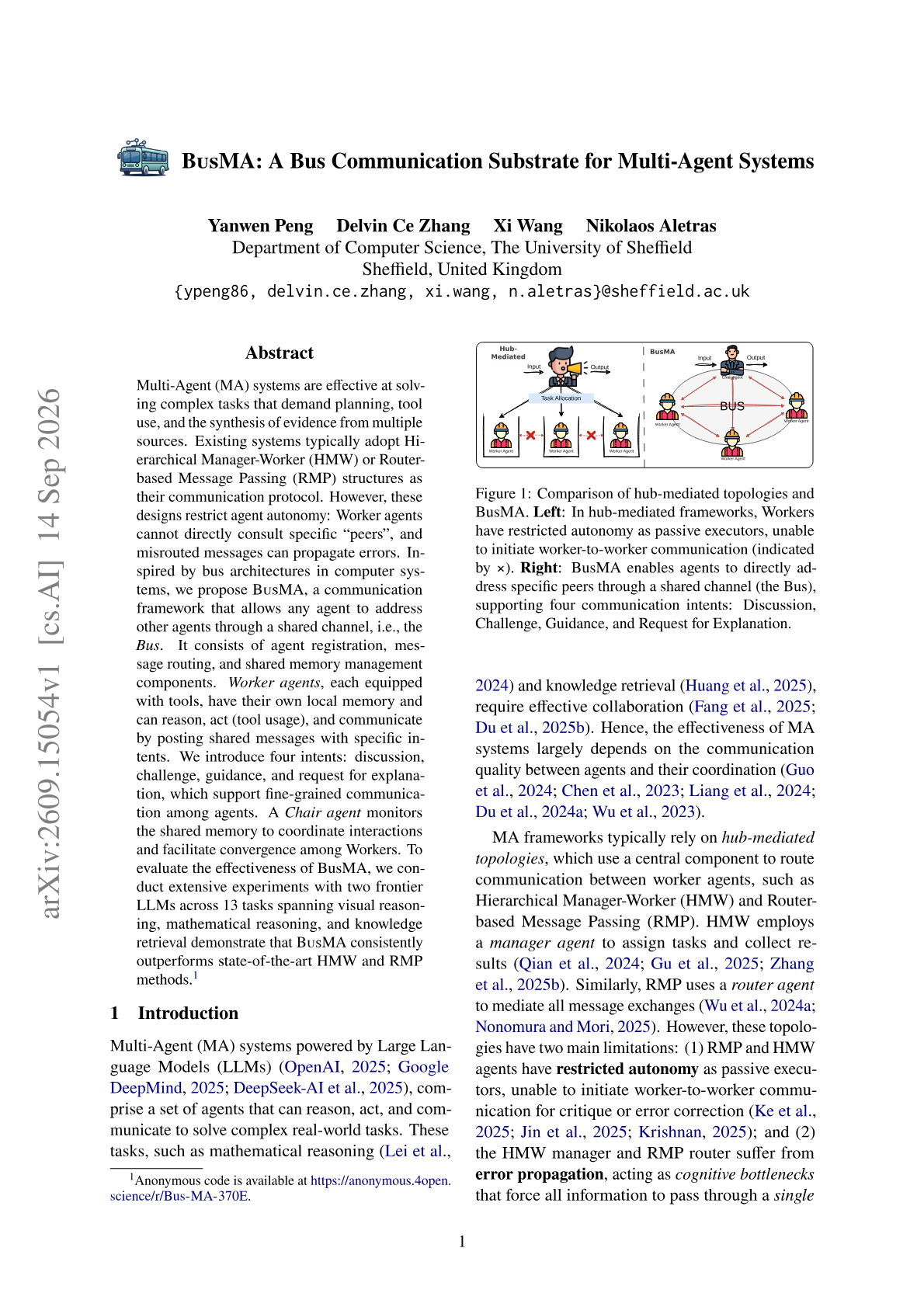
Peng, Zhang, Wang and Aletras replace the manager-worker and router topologies used in most multi-agent systems with a shared bus, so any agent can address any peer directly instead of routing through a coordinator.
Ask this paper
Hierarchy and routing both constrain autonomy. Under manager-worker or router-based message passing, a worker cannot consult a specific peer directly, and a misrouted message propagates its error onward.
A bus, borrowed from computer architecture. BusMA gives every agent a shared channel, with components for agent registration, message routing and shared memory management.
Workers are self-contained. Each worker has its own tools and local memory and can reason, act and communicate by posting messages to the shared channel.
Four explicit intents. Messages are tagged as discussion, challenge, guidance or request for explanation, which makes the communication fine-grained enough to analyze rather than a single undifferentiated channel.
A Chair agent handles convergence. It monitors shared memory to coordinate interactions and drive the workers toward agreement, which is the role the manager played without also owning routing.
Abstract
Multi-Agent (MA) systems are effective at solving complex tasks that demand planning, tool use, and the synthesis of evidence from multiple sources. Existing systems typically adopt Hierarchical Manager-Worker (HMW) or Router-based Message Passing (RMP) structures as their communication protocol. However, these designs restrict agent autonomy: Worker agents cannot directly consult specific "peers", and misrouted messages can propagate errors. Inspired by bus architectures in computer systems, we propose BusMA, a communication framework that allows any agent to address other agents through a shared channel, i.e., the Bus. It consists of agent registration, message routing, and shared memory management components. Worker agents, each equipped with tools, have their own local memory and can reason, act (tool usage), and communicate by posting shared messages with specific intents. We introduce four intents: discussion, challenge, guidance, and request for explanation, which support fine-grained communication among agents. A Chair agent monitors the shared memory to coordinate interactions and facilitate convergence among Workers. To evaluate the effectiveness of BusMA, we conduct extensive experiments with two frontier LLMs across 13 tasks spanning visual reasoning, mathematical reasoning, and knowledge retrieval demonstrate that BusMA consistently outperforms state-of-the-art HMW and RMP methods.