Can LLMs Unlock Novel Scientific Research Ideas
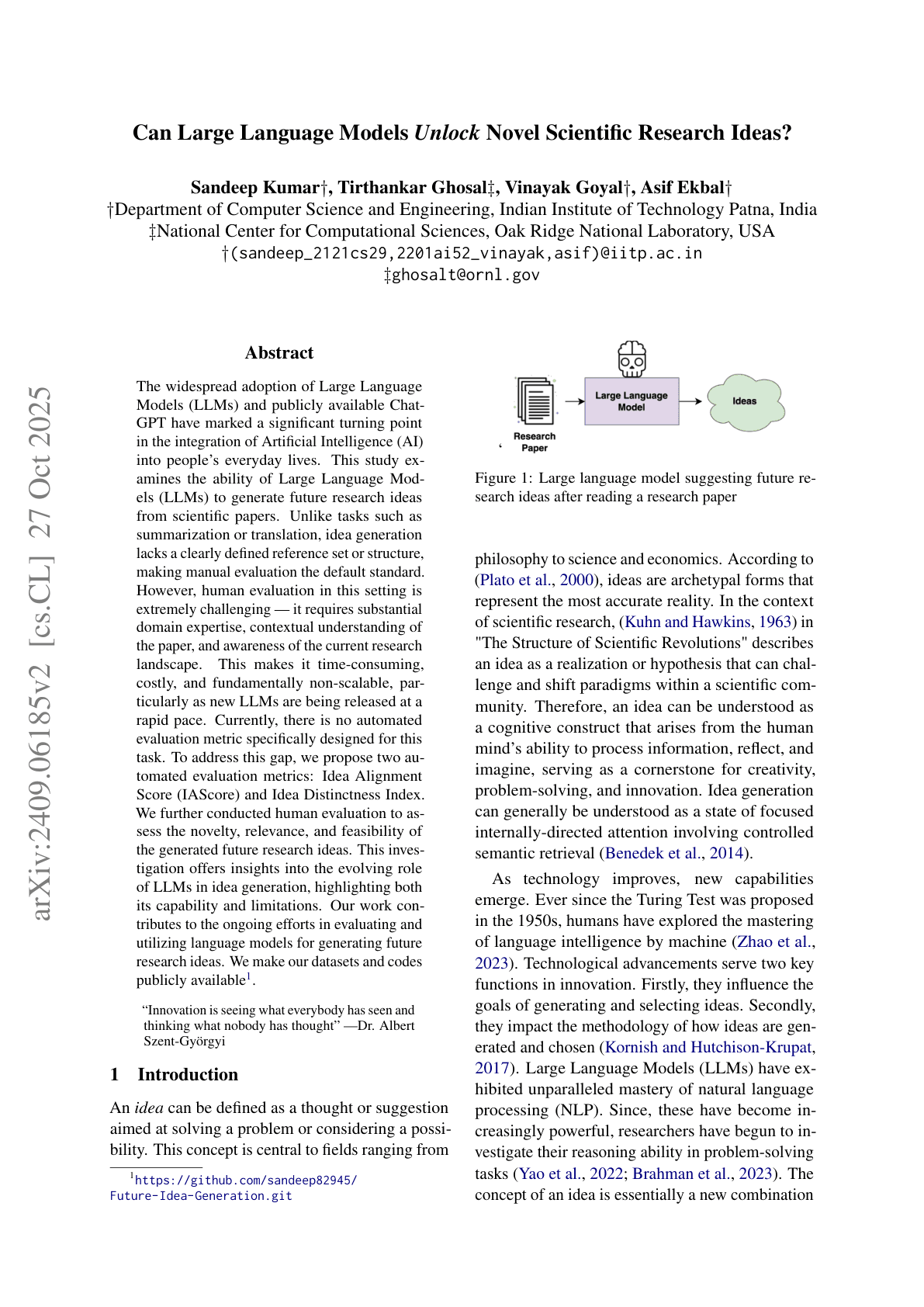
investigates whether LLM can generate novel scientific research ideas; reports that Claude and GPT models tend to align more with the author's perspectives on future research ideas; this is measured across different domains like science, economics, and medicine.
Ask this paper
Abstract
The widespread adoption of Large Language Models (LLMs) and publicly available ChatGPT have marked a significant turning point in the integration of Artificial Intelligence (AI) into people's everyday lives. This study examines the ability of Large Language Models (LLMs) to generate future research ideas from scientific papers. Unlike tasks such as summarization or translation, idea generation lacks a clearly defined reference set or structure, making manual evaluation the default standard. However, human evaluation in this setting is extremely challenging ie: it requires substantial domain expertise, contextual understanding of the paper, and awareness of the current research landscape. This makes it time-consuming, costly, and fundamentally non-scalable, particularly as new LLMs are being released at a rapid pace. Currently, there is no automated evaluation metric specifically designed for this task. To address this gap, we propose two automated evaluation metrics: Idea Alignment Score (IAScore) and Idea Distinctness Index. We further conducted human evaluation to assess the novelty, relevance, and feasibility of the generated future research ideas. This investigation offers insights into the evolving role of LLMs in idea generation, highlighting both its capability and limitations. Our work contributes to the ongoing efforts in evaluating and utilizing language models for generating future research ideas. We make our datasets and codes publicly available