Learning to Reason with LLMs
a new family of LLMs trained with reinforcement learning to reason before it responds to complex tasks; it produces a long internal chain of thought and exceeds in science, code, and math-related tasks; ranked in the 49th percentile in the 2024 International Olympiad in Informatics and exceeds human PhD-level accuracy on science-related benchmarks. -
Chai-1
a new multi-modal foundation model for molecular structure prediction that can predict proteins, small molecules, DNA, RNA, and more; it achieves state-of-the-art results on a variety of tasks in drug discovery; achieves a 77% success rate on the PoseBusters benchmark (vs. 76% by AlphaFold 3), as well as an Cα LDDT of 0.849 on the CASP15 protein monomer structure prediction set (vs. 0.801 by ESM3-98B).
Can LLMs Generation Novel Research Ideas
finds that LLM-generated research ideas are judged as more novel (p <0.05) than human expert ideas; however, they were rated slightly weaker in terms of flexibility; they also report that LLM agents lack diversity in the idea generation process and are not reliable evaluators.
DataGemma
includes a series of fine-tuned Gemma 2 models to help LLMs access and incorporate numerical and statistical data; proposes a new approach called Retrieval Interleaved Generation (RIG) which can reliably incorporate public statistical data from Data Commons into LLM responses; RIG is a tool-inspired approach, can interleave statistical tokens with natural language questions suitable for retrieval from Data Commons; to attain such capability, they fine-tune the LLM on an instruction-response dataset generated with the help of Gemini 1.5; the RIG approach improves factuality from 5-7% to about 58%.
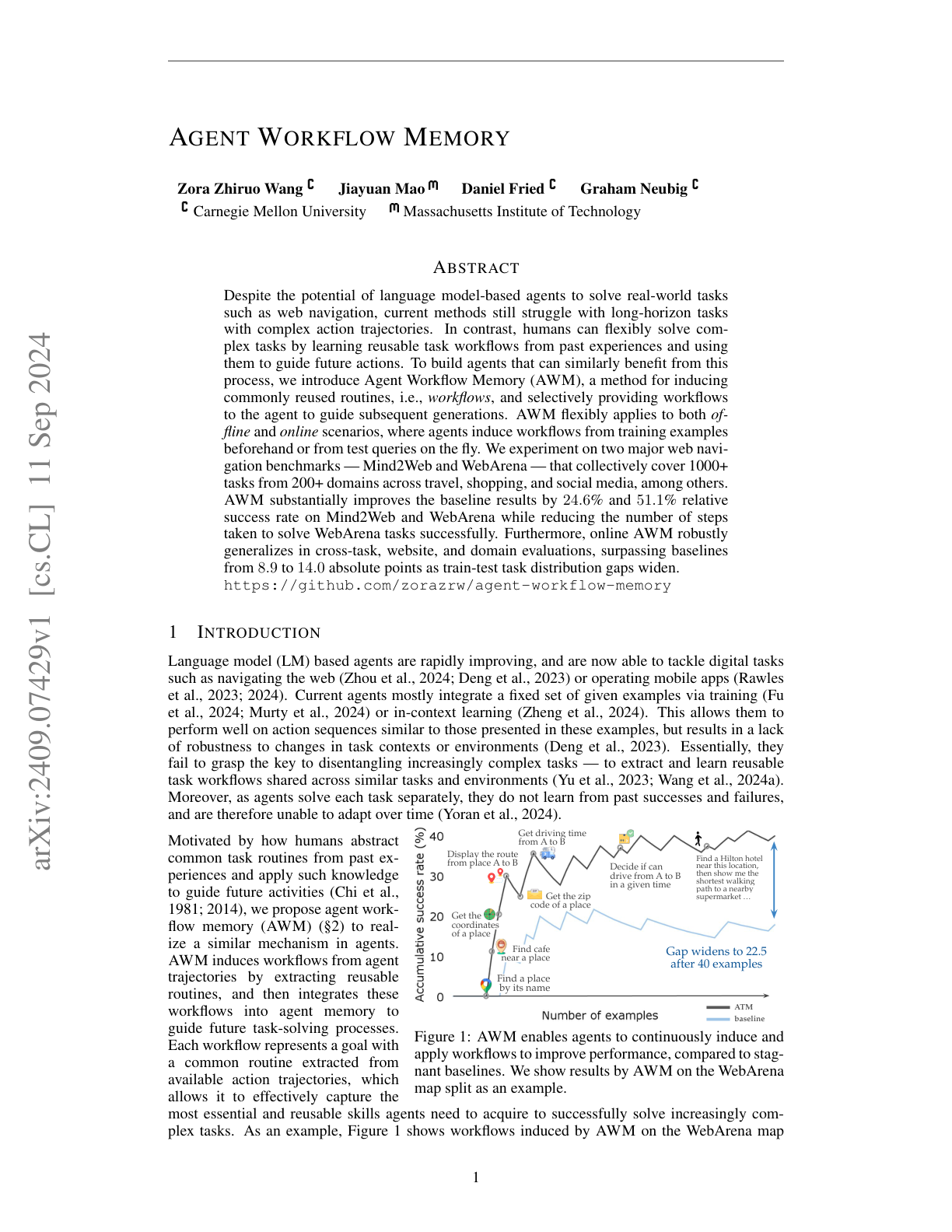
Agent Workflow Memory
introduces Agent Workflow Memory to induce commonly reused workflows and provide these to the agent on demand; works offline and online and is meant to guide the agent's subsequent generations; it’s inspired by how humans learn reusable workflows from past experiences and use them to guide future actions; claims to substantially improve the baseline results by 24.6% and 51.1% relative success rate on Mind2Web and WebArena while doing it in a more efficient way.
The Role of Small Language Models in the LLM Era
closely examines the relationship between LLMs and SLMs; common applications of SLMs include data curation, training stronger models, efficient inference, evaluators, retrievers, and much more; includes insights for practitioners to better understand the value of these SLMs.
LLaMa-Omni
a model architecture for low-latency speech interaction with LLMs; it is based on Llama-3.1-8B-Instruct and can simultaneously generate both text and speech responses given speech instructions; responses can be generated with a response latency as low as 226ms; architecture-wise, it involves a speech encoder (Whispter-large-v3), a speech adaptor, an LLM, and a speech decoder; they also created a dataset of 200K speech interactions and responses.
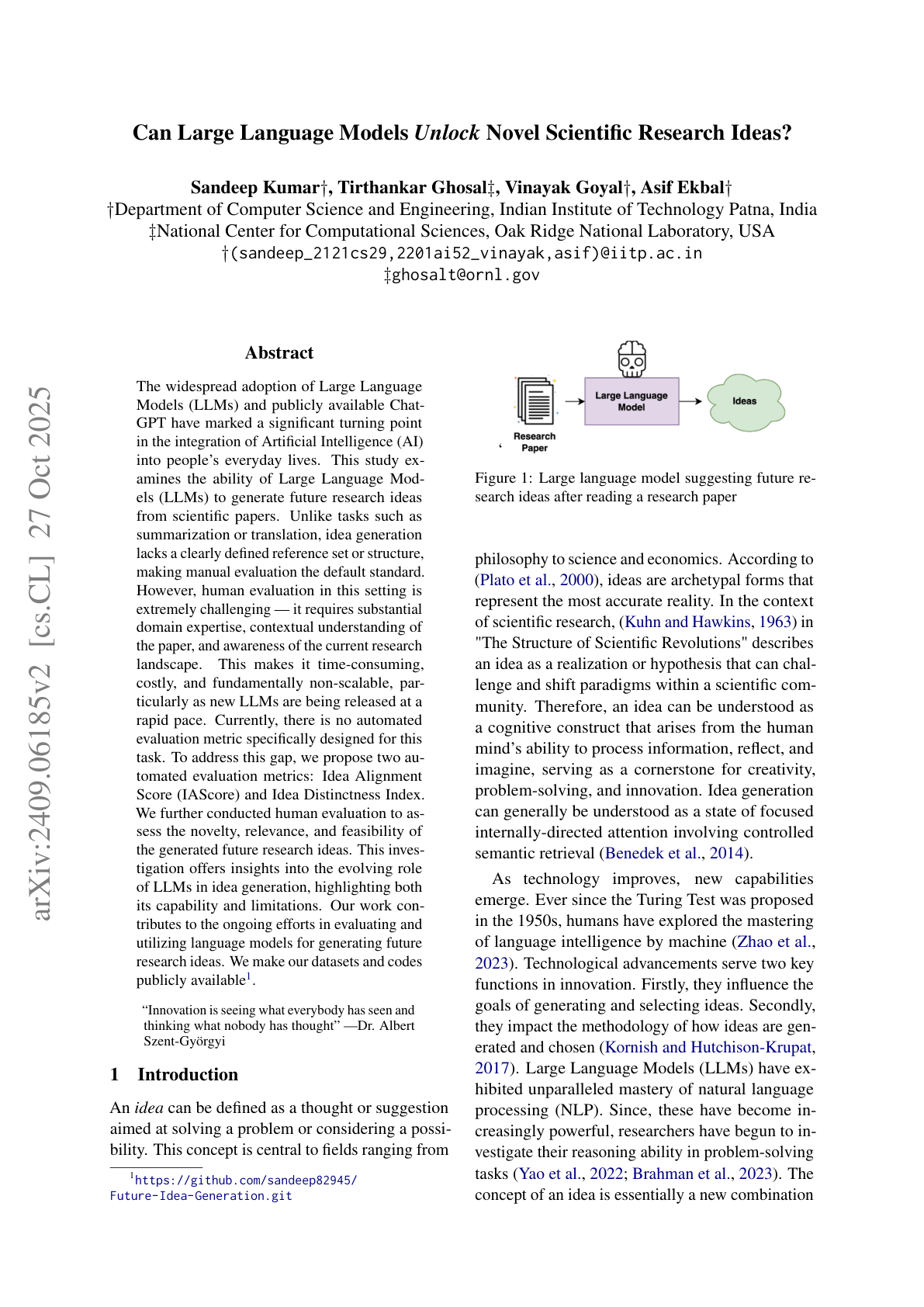
Can LLMs Unlock Novel Scientific Research Ideas
investigates whether LLM can generate novel scientific research ideas; reports that Claude and GPT models tend to align more with the author's perspectives on future research ideas; this is measured across different domains like science, economics, and medicine.
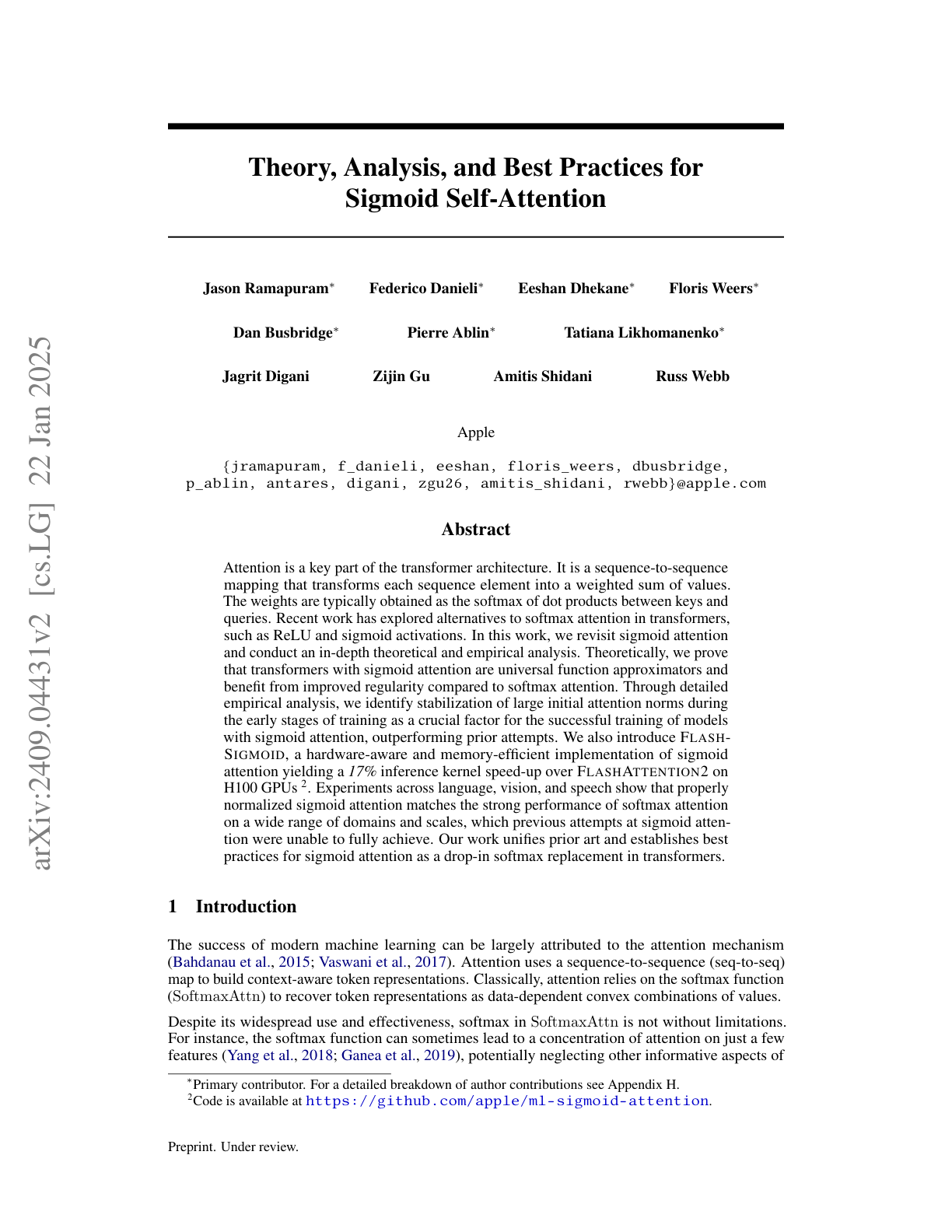
Theory, Analysis, and Best Practices for Sigmoid Self-Attention
proposes Flash-Sigmoid, a hardware-aware and memory-efficient implementation of sigmoid attention; it yields up to a 17% inference kernel speed-up over FlashAttention-2 on H100 GPUs; show that SigmoidAttn matches SoftwaxAttn in various tasks and domains.
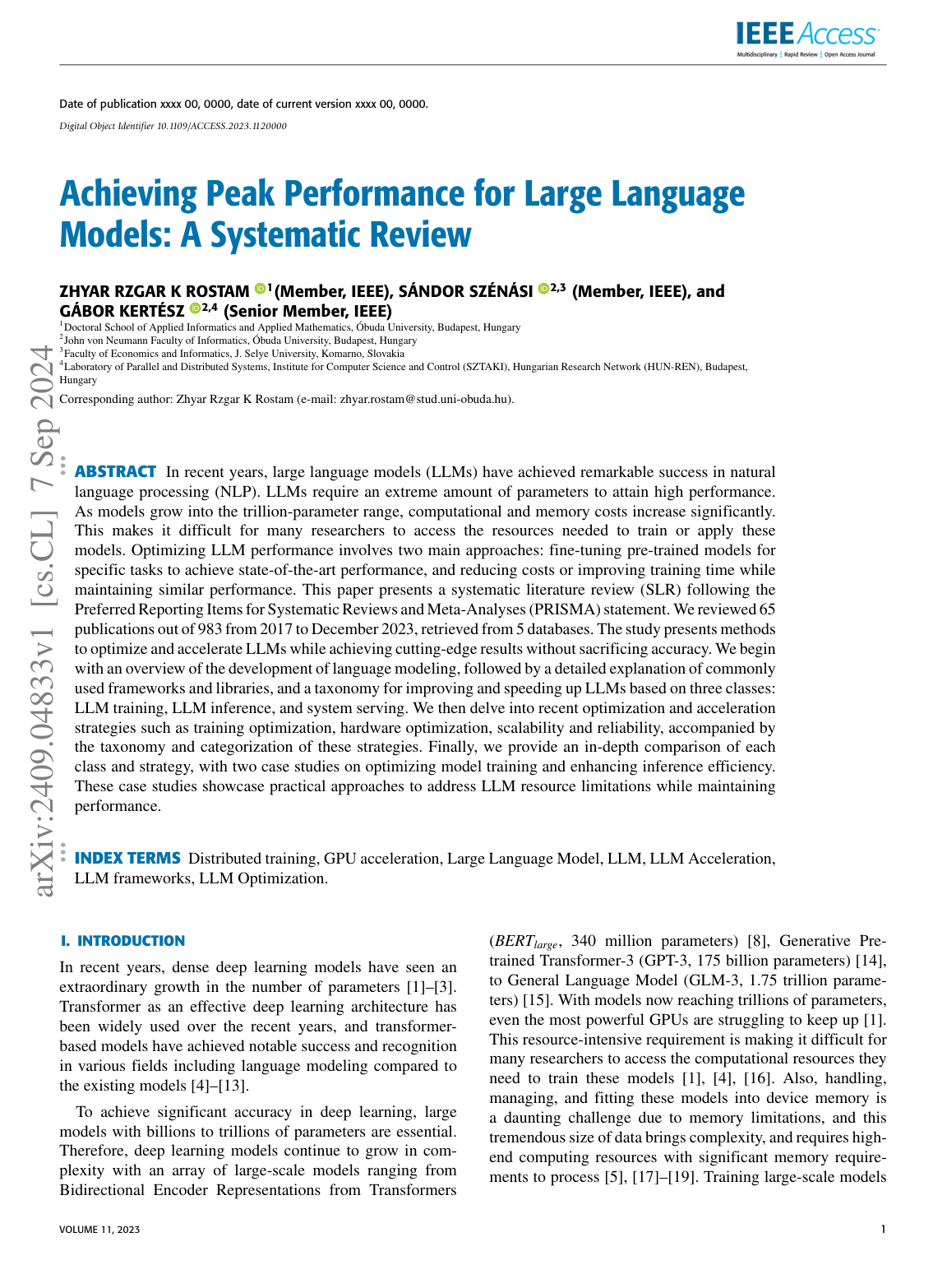
Achieving Peak Performance for LLMs
a systematic review of methods for improving and speeding up LLMs from three points of view: training, inference, and system serving; summarizes the latest optimization and acceleration strategies around training, hardware, scalability, and reliability.