Chain of Code
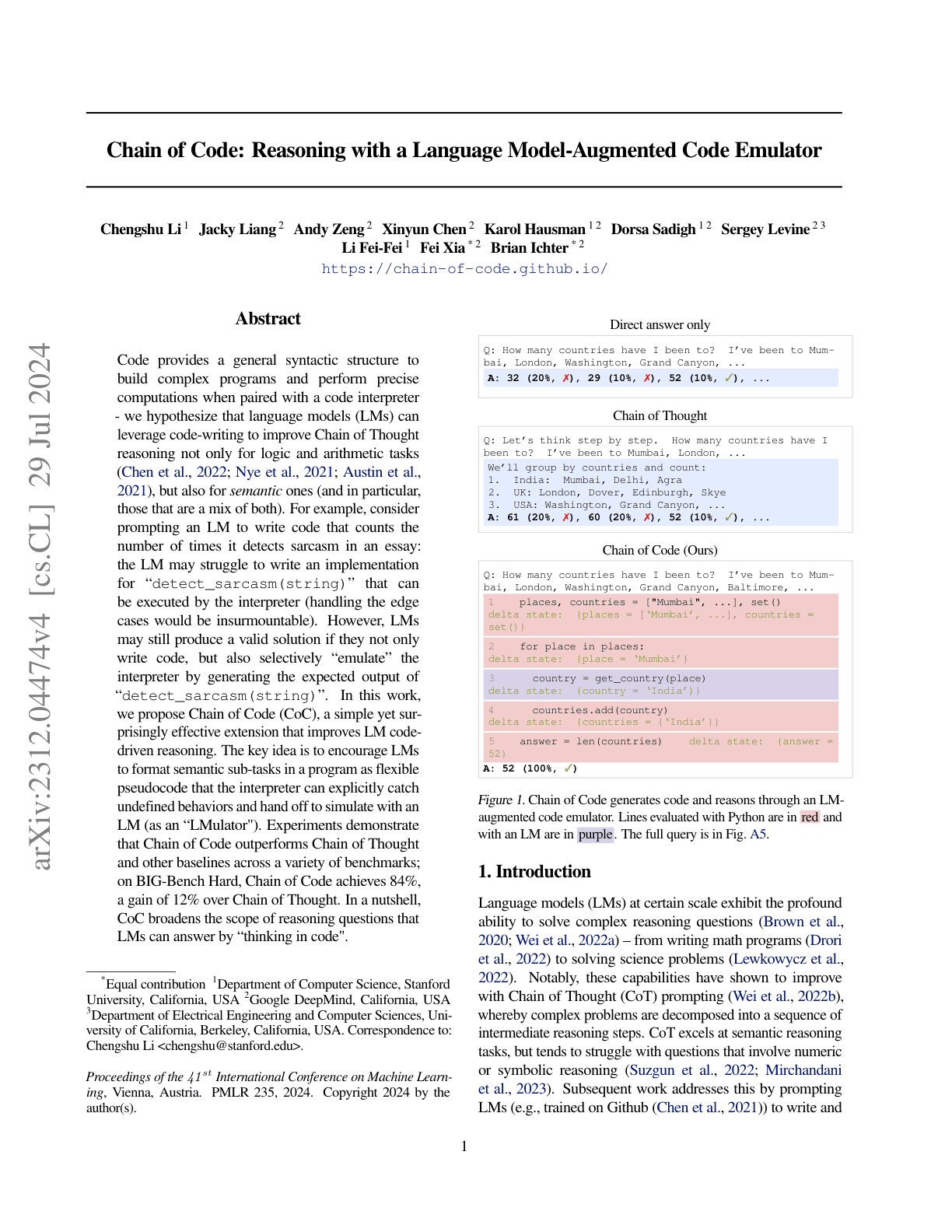
DeepMind's Chain of Code extends CoT by encouraging LMs to write pseudocode that mixes real code with LM-simulated sub-routines.
Ask this paper
LMulator: The LM generates pseudocode programs and explicitly annotates sub-tasks that can't be executed; a "LMulator" simulates those sub-tasks with the LM while the interpreter handles the rest.
Undefined-behavior handling: The interpreter catches undefined behavior and cleanly hands off to the LM, sidestepping the brittleness of code-first approaches that fail silently on hard ops.
84% on BIG-Bench Hard: Achieves 84% on BIG-Bench Hard - a 12-point gain over Chain of Thought and a clean demonstration that mixing exact execution with LM simulation beats either alone.
Broad applicability: Works across math, logic, and commonsense reasoning, positioning Chain of Code as a general-purpose CoT upgrade.
Abstract
Code provides a general syntactic structure to build complex programs and perform precise computations when paired with a code interpreter - we hypothesize that language models (LMs) can leverage code-writing to improve Chain of Thought reasoning not only for logic and arithmetic tasks, but also for semantic ones (and in particular, those that are a mix of both). For example, consider prompting an LM to write code that counts the number of times it detects sarcasm in an essay: the LM may struggle to write an implementation for "detect_sarcasm(string)" that can be executed by the interpreter (handling the edge cases would be insurmountable). However, LMs may still produce a valid solution if they not only write code, but also selectively "emulate" the interpreter by generating the expected output of "detect_sarcasm(string)". In this work, we propose Chain of Code (CoC), a simple yet surprisingly effective extension that improves LM code-driven reasoning. The key idea is to encourage LMs to format semantic sub-tasks in a program as flexible pseudocode that the interpreter can explicitly catch undefined behaviors and hand off to simulate with an LM (as an "LMulator"). Experiments demonstrate that Chain of Code outperforms Chain of Thought and other baselines across a variety of benchmarks; on BIG-Bench Hard, Chain of Code achieves 84%, a gain of 12% over Chain of Thought. In a nutshell, CoC broadens the scope of reasoning questions that LMs can answer by "thinking in code".