Challenges in Human-Agent Communication
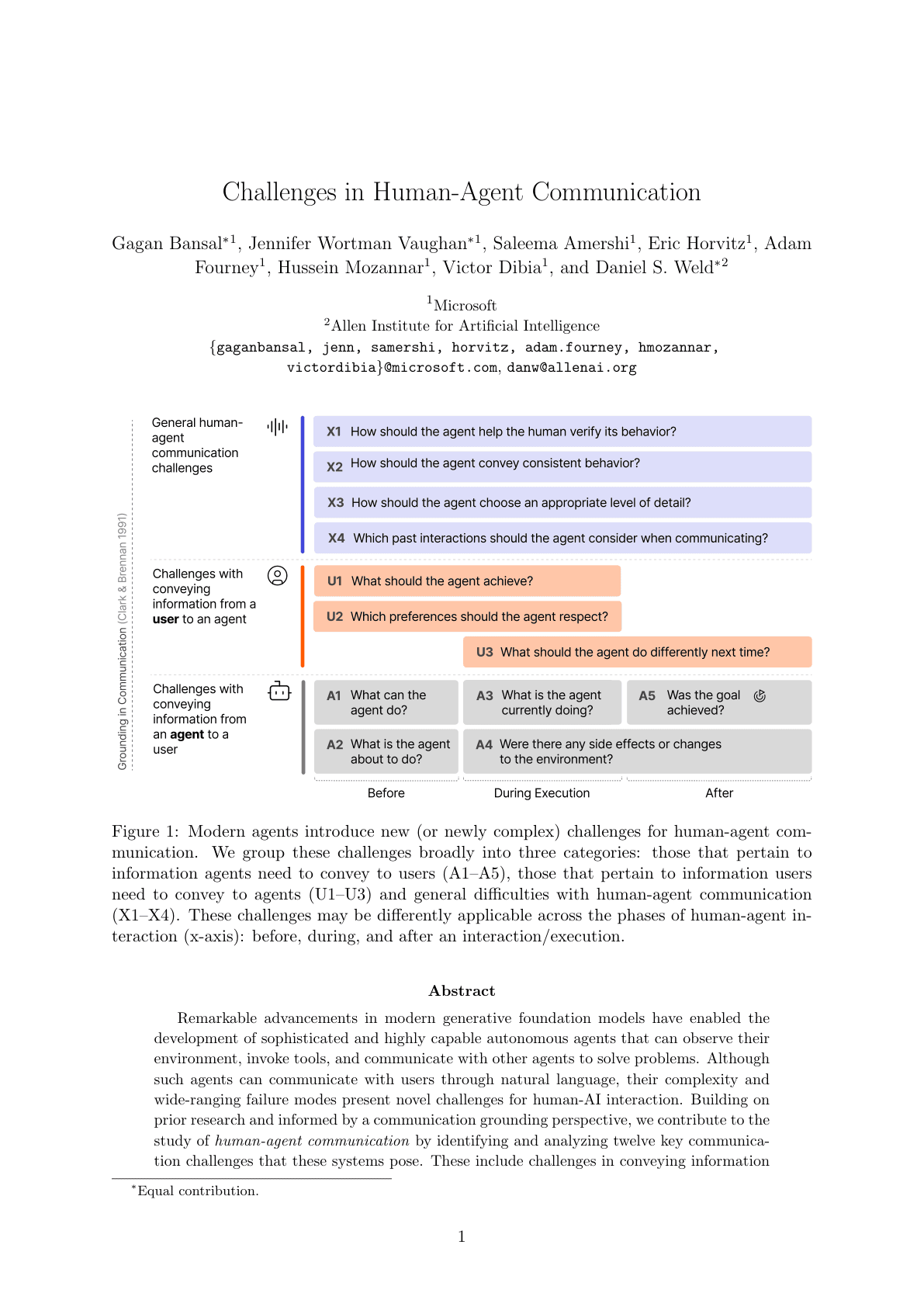
present a comprehensive analysis of key challenges in human-agent communication, focusing on how humans and AI agents can effectively establish common ground and mutual understanding; identifies 12 core challenges across three categories: conveying information from agents to users, enabling users to communicate information to agents, and general communication challenges that affect all interactions.
Ask this paper
Abstract
Remarkable advancements in modern generative foundation models have enabled the development of sophisticated and highly capable autonomous agents that can observe their environment, invoke tools, and communicate with other agents to solve problems. Although such agents can communicate with users through natural language, their complexity and wide-ranging failure modes present novel challenges for human-AI interaction. Building on prior research and informed by a communication grounding perspective, we contribute to the study of human-agent communication by identifying and analyzing twelve key communica- tion challenges that these systems pose. These include challenges in conveying information ∗Equal contribution. 1 from the agent to the user, challenges in enabling the user to convey information to the agent, and overarching challenges that need to be considered across all human-agent communica- tion. We illustrate each challenge through concrete examples and identify open directions of research. Our findings provide insights into critical gaps in human-agent communication research and serve as an urgent call for new design patterns, principles, and guidelines to support transparency and control in these systems.