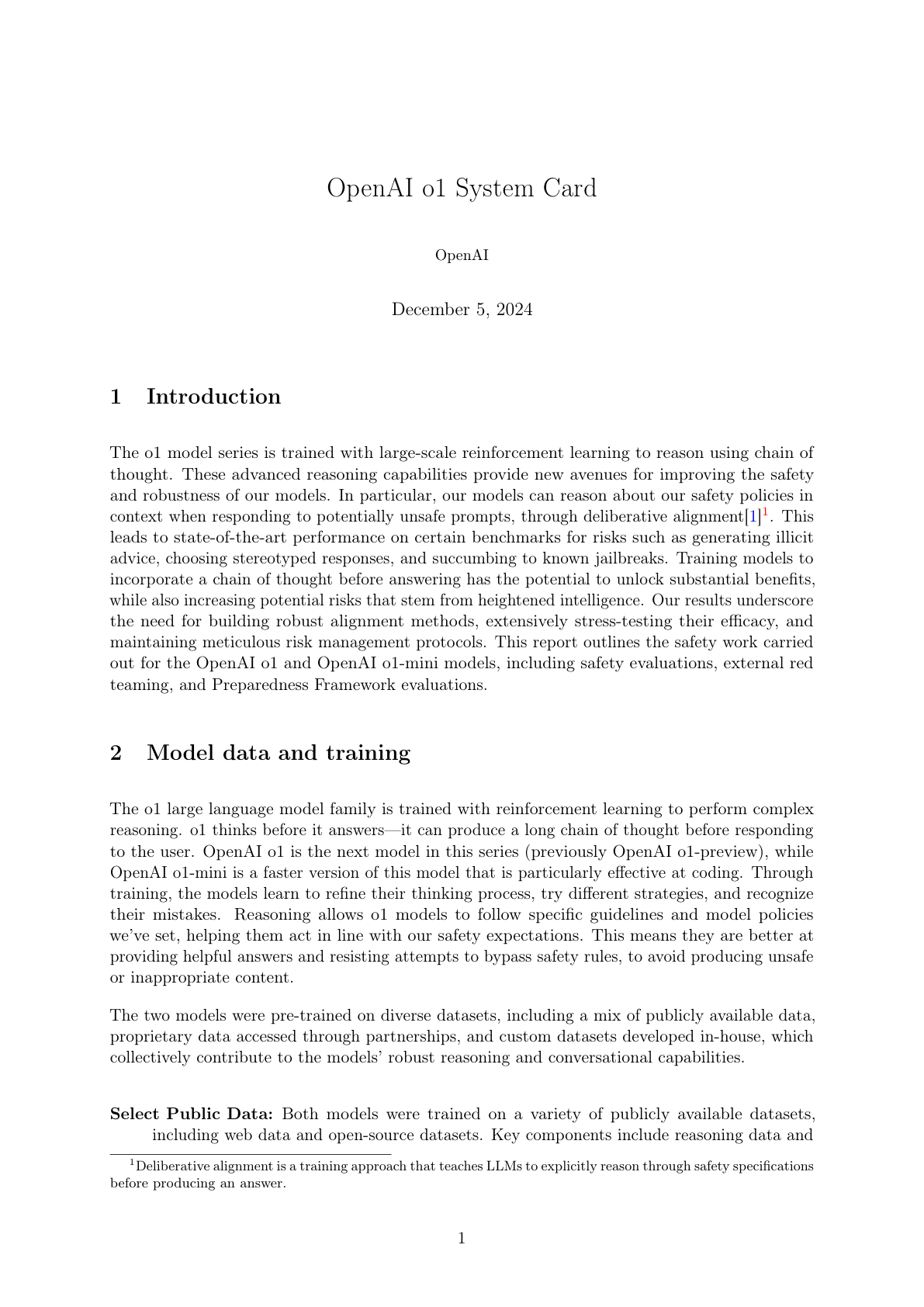
OpenAI o1
a model series trained with large-scale reinforcement learning to reason using chain of thought; o1 shows significant improvements across benchmarks related to math, code, and science; o1 is claimed to be 50% faster in generating thinking steps than o1-preview; results demonstrate that o1 is significantly better at reasoning tasks and produces more comprehensive and reliable responses.

Genie 2
a foundation world model that generates playable 3D environments from single prompt images, enabling endless training scenarios for AI agents with features like physics simulation, character animation, and object interactions; Genie 2 is trained on video data using a combination of autoencoder and transformer for generating virtual worlds; the model can create real-time interactive environments, with a faster but lower-quality version available for immediate play.
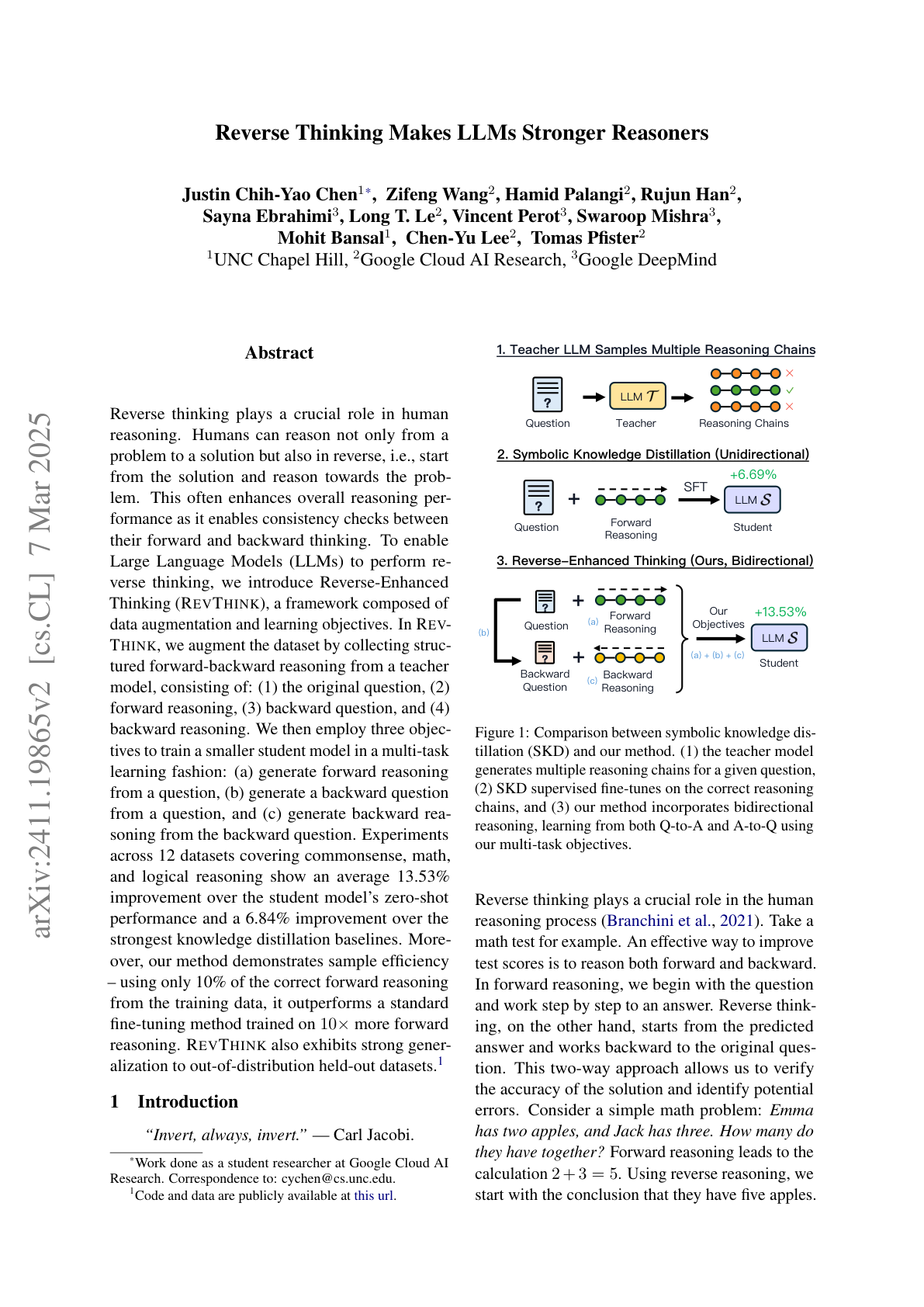
Reverse Thinking
shows that training LLMs to learn "reverse thinking" helps to improve performance in commonsense, math, and logical reasoning tasks. It claims to outperform a standard fine-tuning method trained on 10x more forward reasoning.
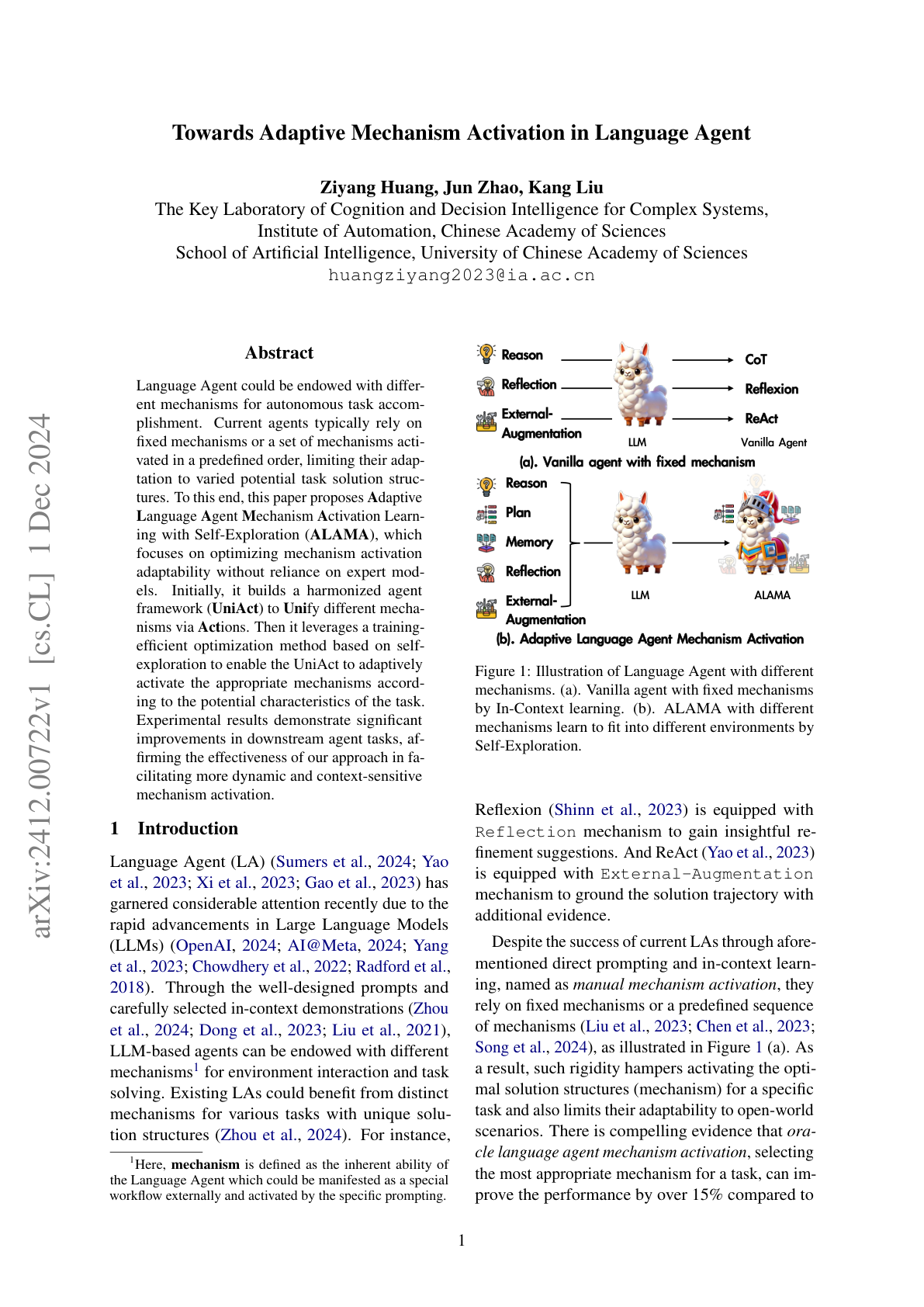
ALAMA
a new framework that helps language agents automatically learn when to use different mechanisms (ReAct, CoT, Reflection, etc.) for automatically completing tasks, improving on current approaches that use fixed or predefined mechanisms; the framework adaptively activates the appropriate mechanisms according to the potential characteristics of the task; experimental results demonstrate significant improvements in downstream agent tasks, including mathematical reasoning and knowledge-intensive reasoning.
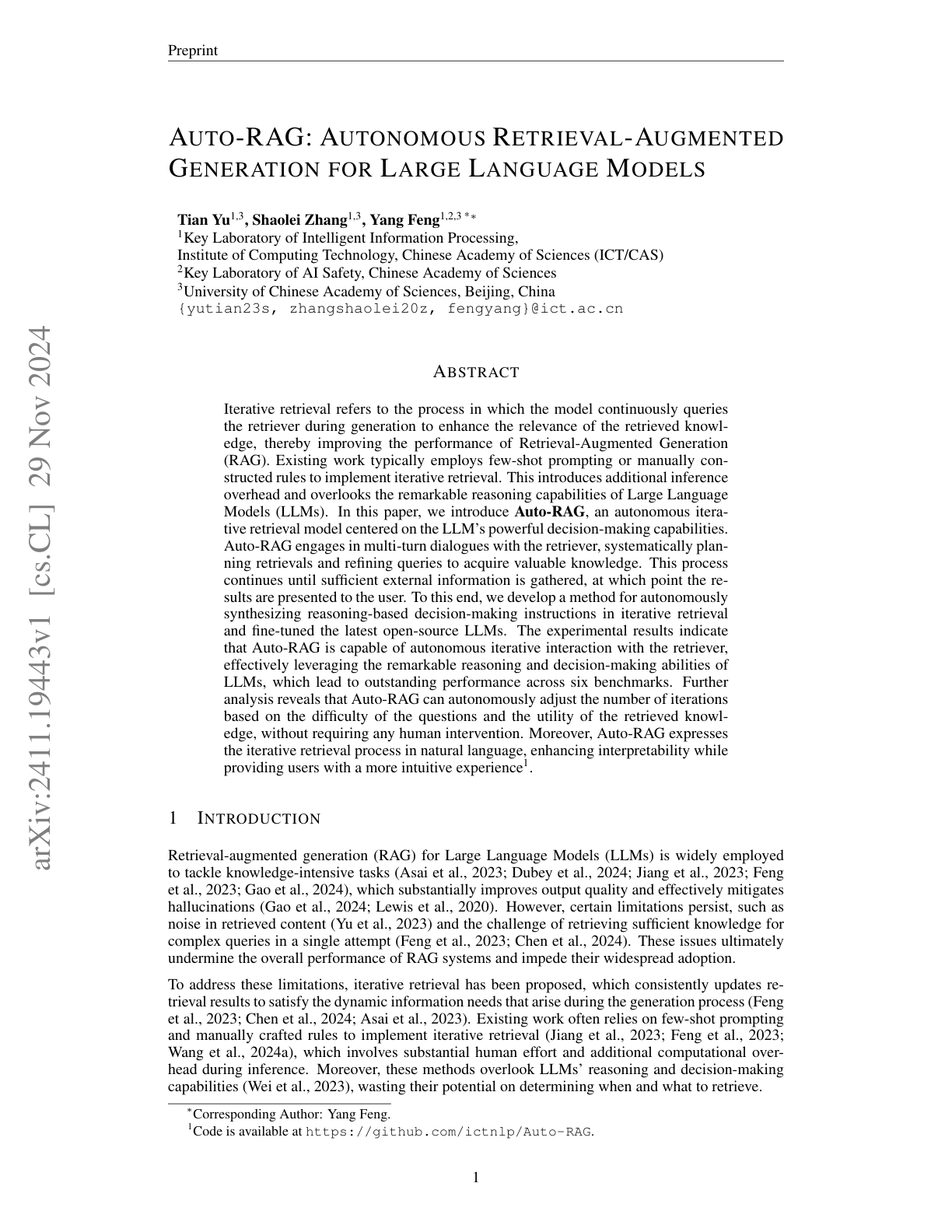
Auto-RAG
an autonomous iterative retrieval model with superior performance across many datasets; Auto-RAG is a fine-tuned LLM that leverages the decision-making capabilities of an LLM; it interacts with the retriever through multiturn dialogues, systematically planning retrievals and refining queries to acquire valuable knowledge — it performs this process until sufficient external information is obtained; the authors also show that based on question difficulty, the method can adjust the number of iterations without any human intervention.
GenCast
an ML weather prediction model that outperforms the world's leading operational weather forecasting system (ECMWF's ENS) in both accuracy and speed; it generates probabilistic 15-day global weather forecasts for over 80 variables in just 8 minutes, with better skill than ENS on 97.2% of evaluated targets; GenCast produces an ensemble of forecasts that better capture uncertainty and predict extreme weather events, tropical cyclone tracks, and wind power production.
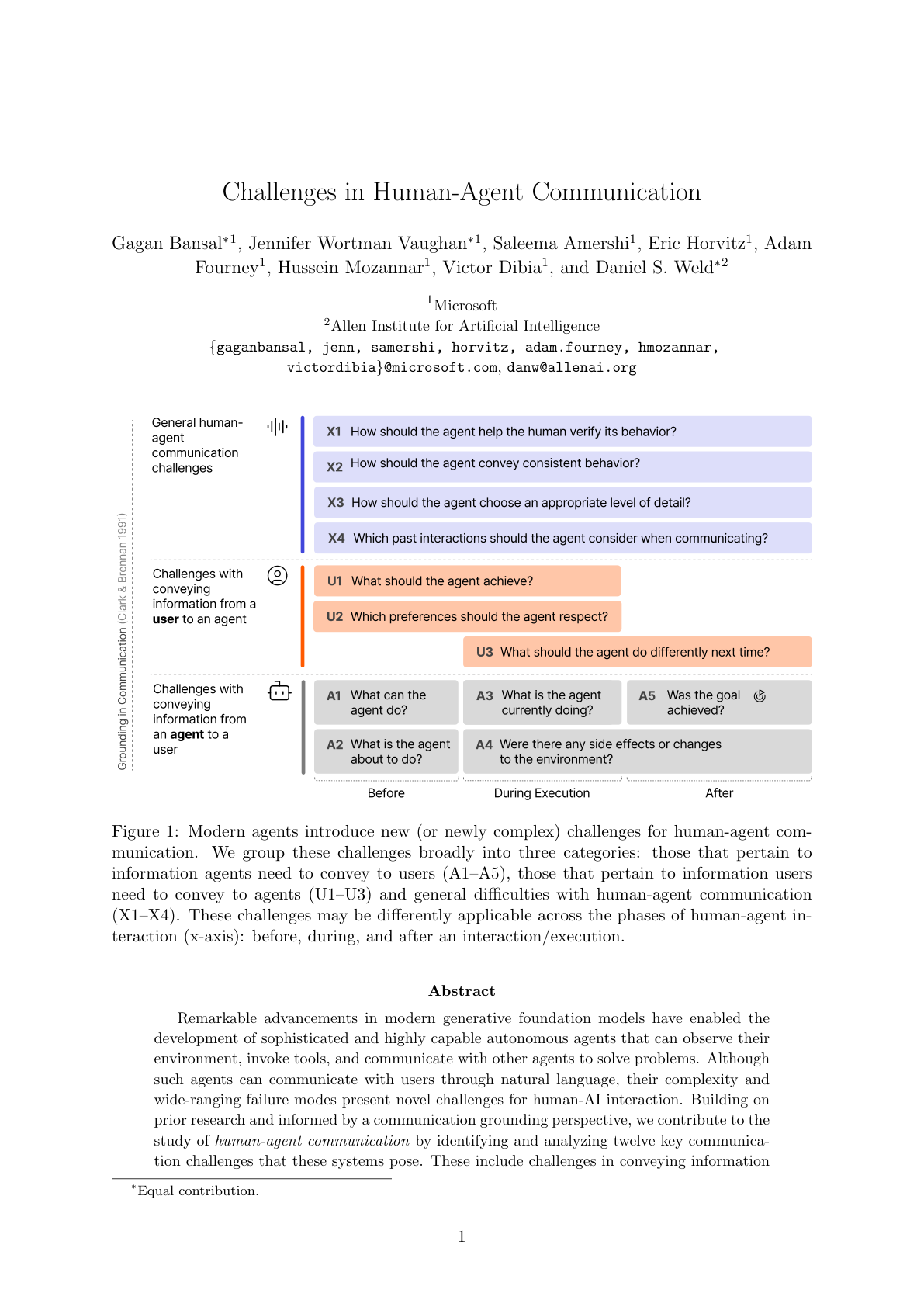
Challenges in Human-Agent Communication
present a comprehensive analysis of key challenges in human-agent communication, focusing on how humans and AI agents can effectively establish common ground and mutual understanding; identifies 12 core challenges across three categories: conveying information from agents to users, enabling users to communicate information to agents, and general communication challenges that affect all interactions.
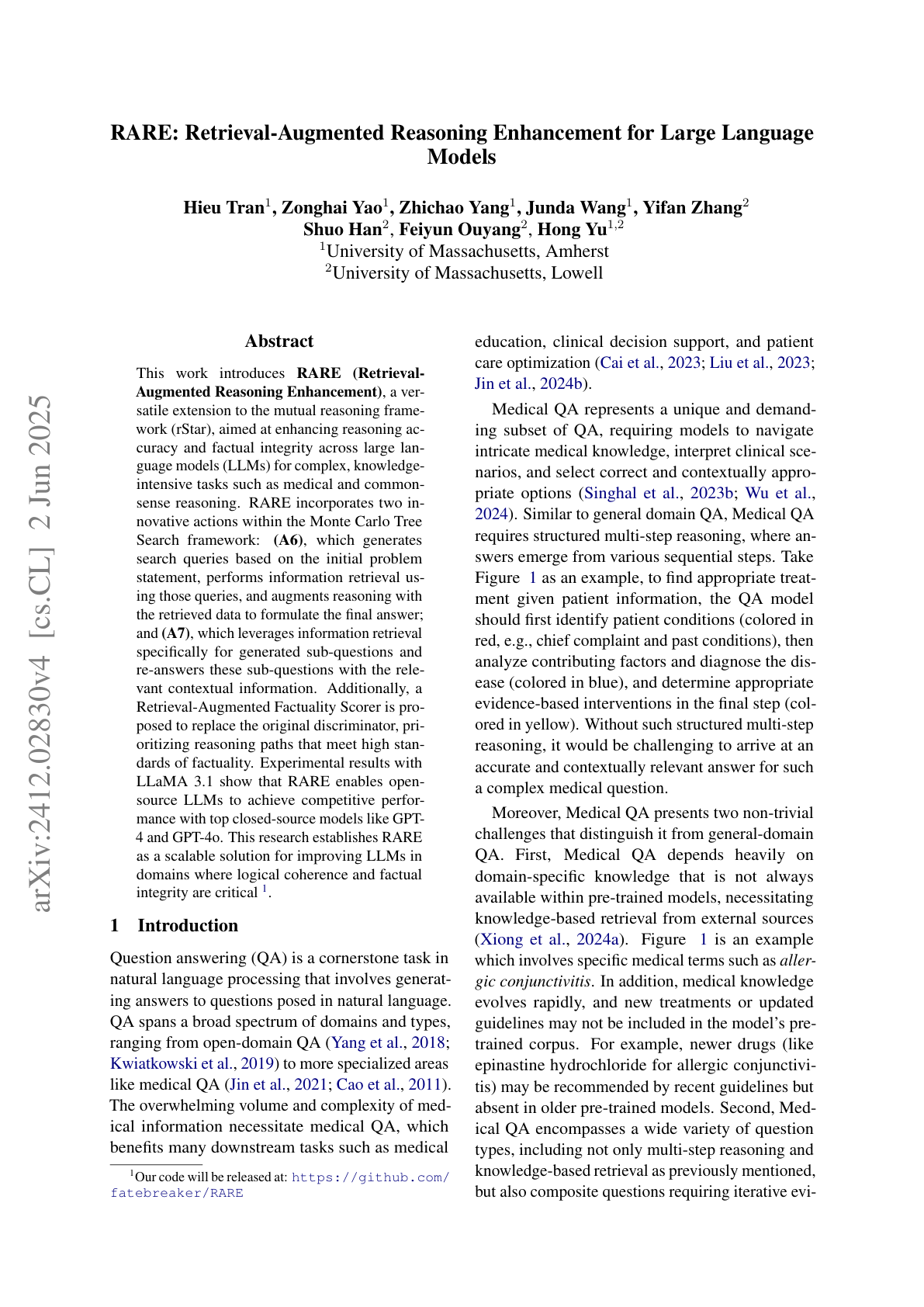
Retrieval-Augmented Reasoning for LLMs
extends the rStar reasoning framework to enhance reasoning accuracy and factual reliability of LLMs; it leverages a Monte Carlos Tree Search (MCTS) framework with explicit retrieval-augmented reasoning to produce multiple candidate reasoning trajectories; then it leverages a retrieval-augmented factuality scorer to evaluate the factual accuracy of the reasoning trajectories; the trajectory with the highest factuality score is selected as the final answer by the system; on medical reasoning tasks, RARE (which uses Llama 3.1) surpasses larger models such as GPT-4; on commonsense reasoning tasks, RARE outperformed Claude-3.5 Sonnet and GPT-4o-mini, achieving performance competitive with GPT-4o.
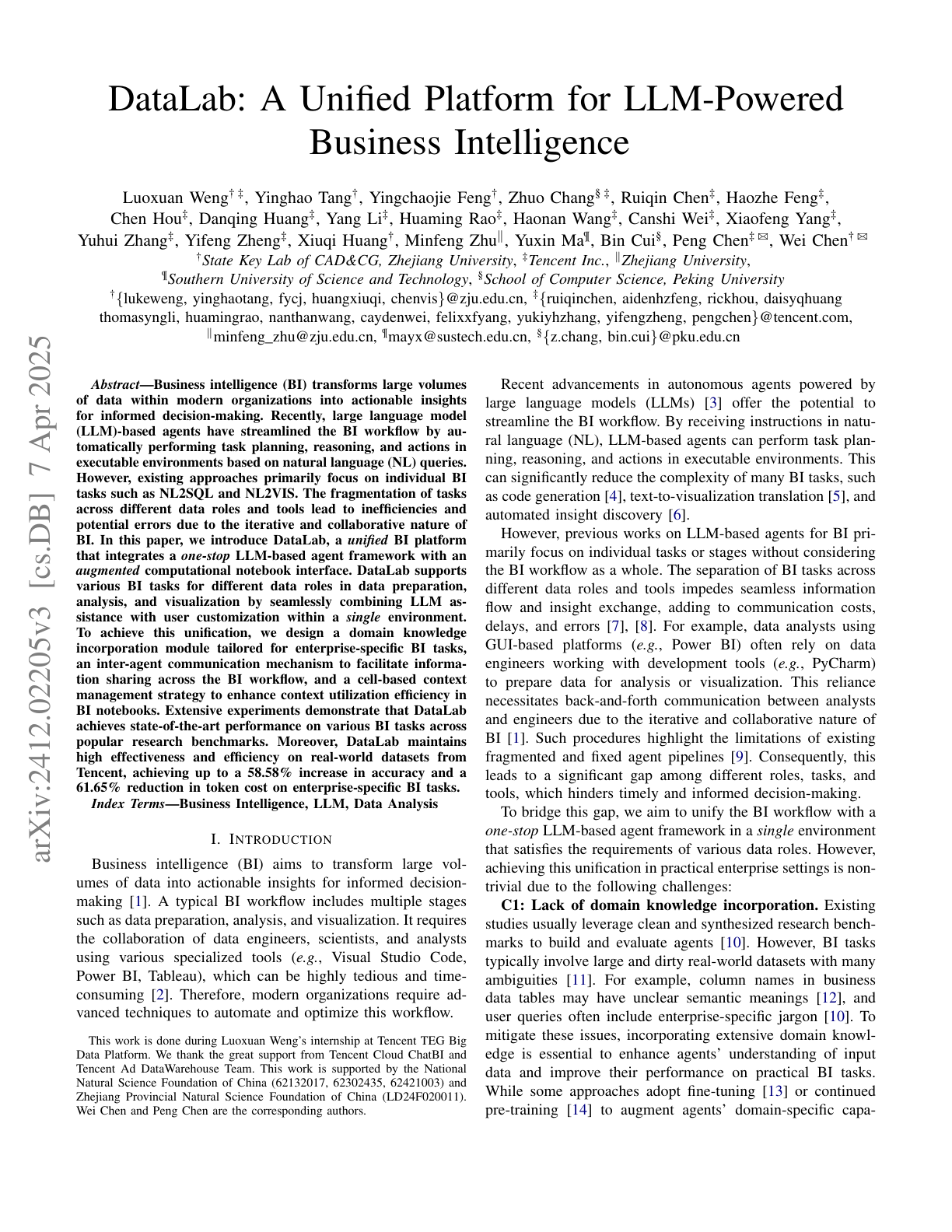
DataLab
a unified business intelligence platform powered by LLM-based agents that integrates task planning, reasoning, and computational notebooks to streamline the entire BI workflow; the system achieves SOTA performance on research benchmarks and demonstrates significant improvements in accuracy and efficiency on real enterprise data from Tencent; achieves up to a 58.58% increase in accuracy and a 61.65% reduction in token cost on enterprise-specific BI tasks.
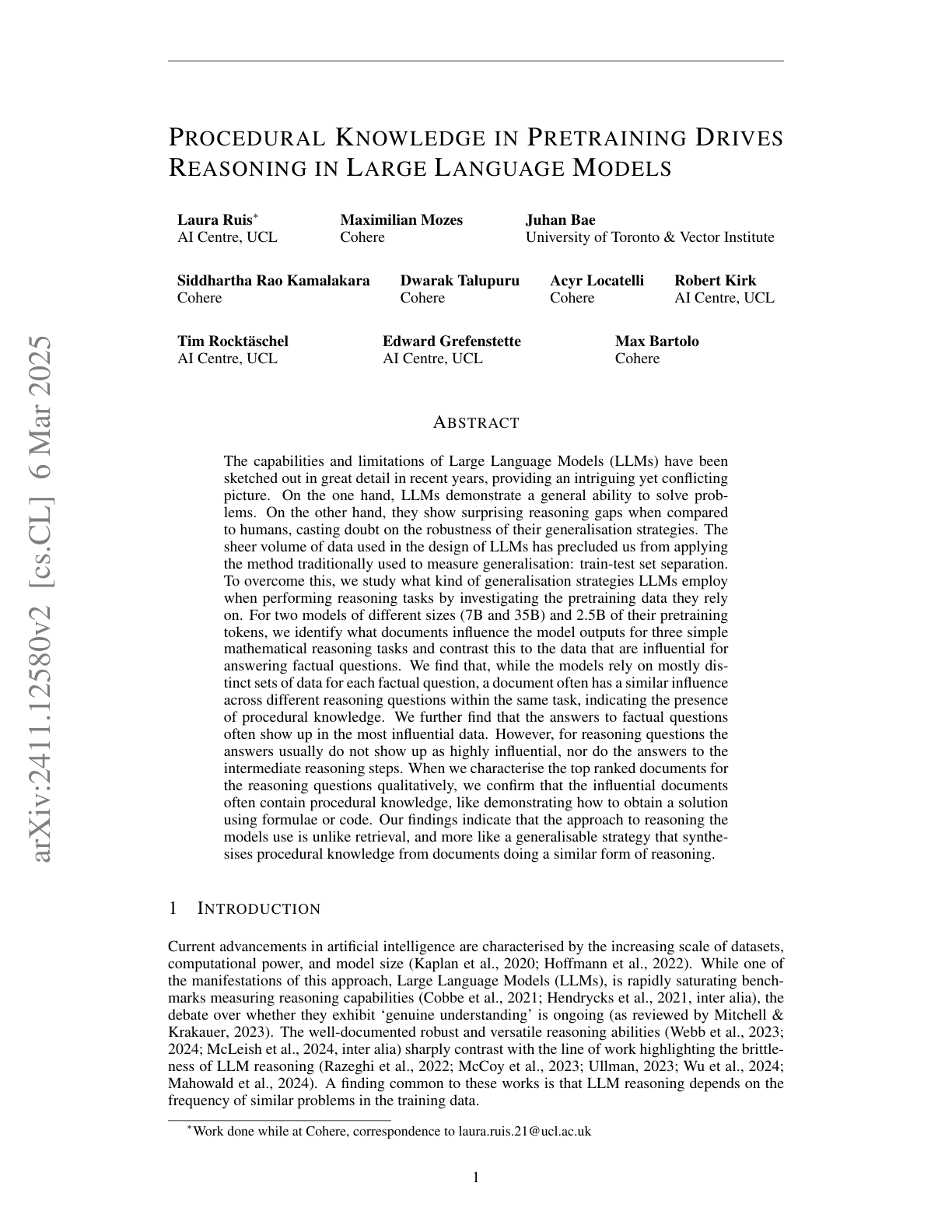
Procedural Knowledge in Pretraining Drives Reasoning in LLMs
studies what documents in the pertaining influence model outputs; by looking at the pertaining data, it tries to understand better what kind of generalization strategies LLMs use to perform reasoning tasks; when performing reasoning tasks, it finds that influential documents contain procedural knowledge (e.g., demonstrating how to obtain a solution using formulae or code).