Conductor
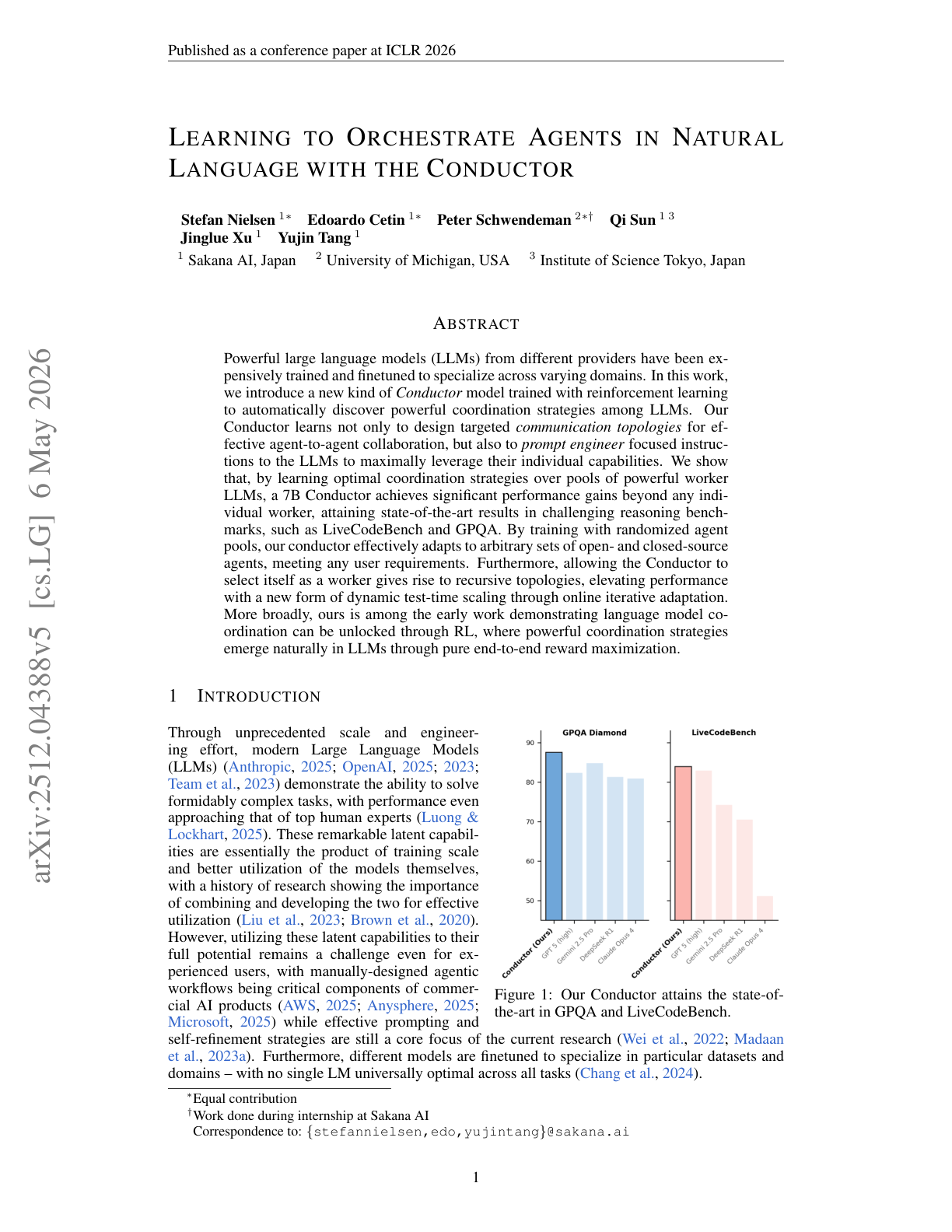
Sakana AI's ICLR 2026 paper introduces a 7B Conductor model that hits SOTA on GPQA-Diamond and LiveCodeBench by orchestrating other LLMs instead of solving problems itself. The Conductor is trained with RL to do two things simultaneously: design communication topologies between worker agents (open or closed source) and prompt-engineer focused instructions to each worker so it leverages individual strengths. The orchestrator becomes a learnable policy, not a wrapper around one.
Ask this paper
Topology design plus targeted prompting: A single RL policy decides who talks to whom and what each worker is told. Trained against randomized agent pools, the Conductor adapts to arbitrary mixes of agents at inference time, including agents it never saw during training.
Recursive topologies emerge: When allowed to pick itself as a worker, the Conductor forms recursive topologies, unlocking a new form of dynamic test-time scaling through online iterative adaptation. Coordination becomes its own scaling axis, separate from model size or context length.
3% gains on AIME25 and GPQA-D from coordination alone: The gains over the best individual worker land in the 3% range, which the authors note is consistent with entire generational improvements between frontier model versions. The difference is that here the lift comes from learned routing, not from larger pretraining runs.
Why it matters: This is one of the cleaner arguments yet that the orchestrator should be the model. Routing decisions stop being a wrapper and become a learnable policy, which is the right abstraction for production agent stacks that compose multiple model providers.