HeavySkill
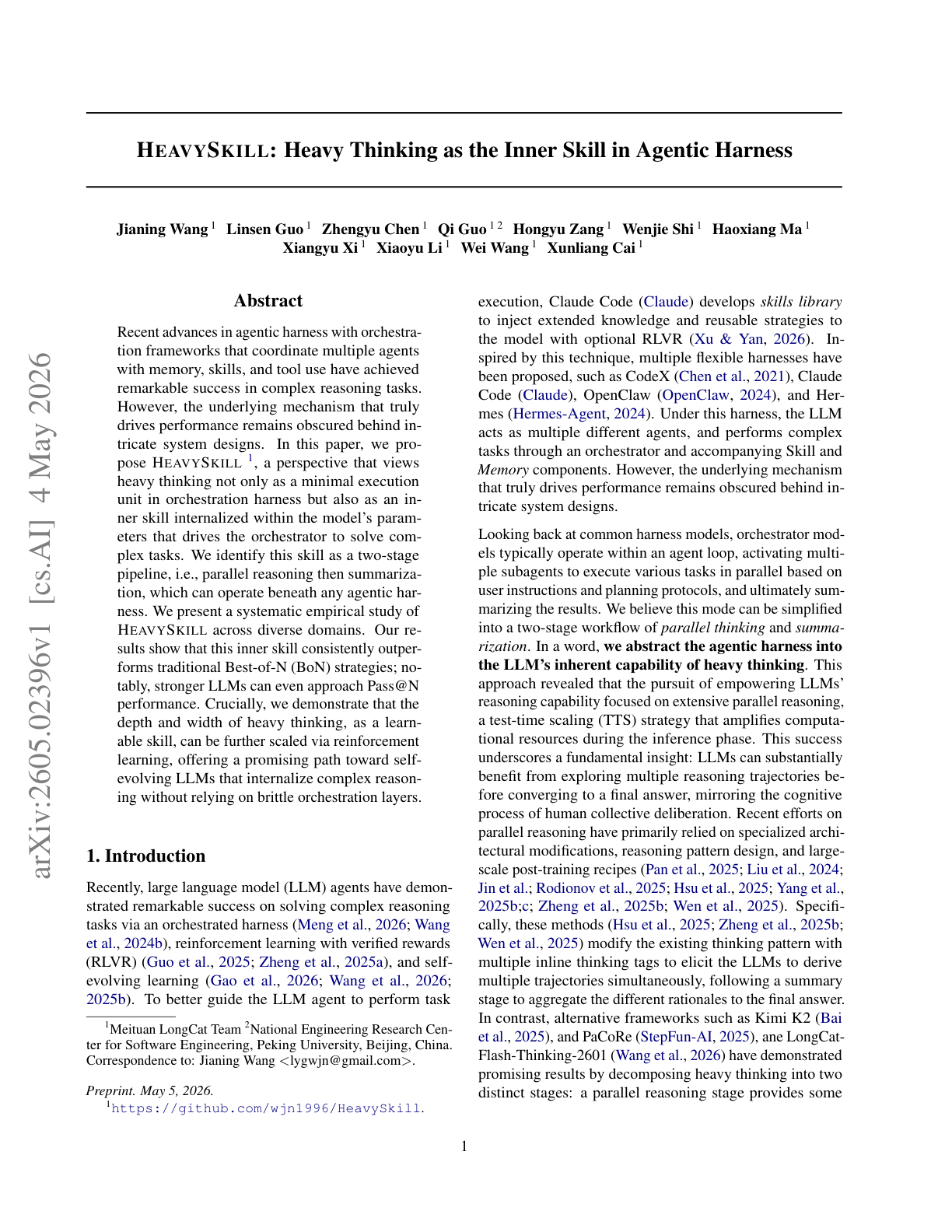
One of the cleaner takes on agentic harness design released this year. The paper argues that what actually drives harness performance is not the orchestration code, but a single inner skill: parallel reasoning followed by deliberation. Internalize that pattern into the model and most of the surrounding scaffolding becomes optional. HeavySkill systematizes the idea as a two-stage pipeline you can run beneath any harness, then trains it as a learnable skill via RLVR. The result is a harness win that looks more like a model win.
Conductor
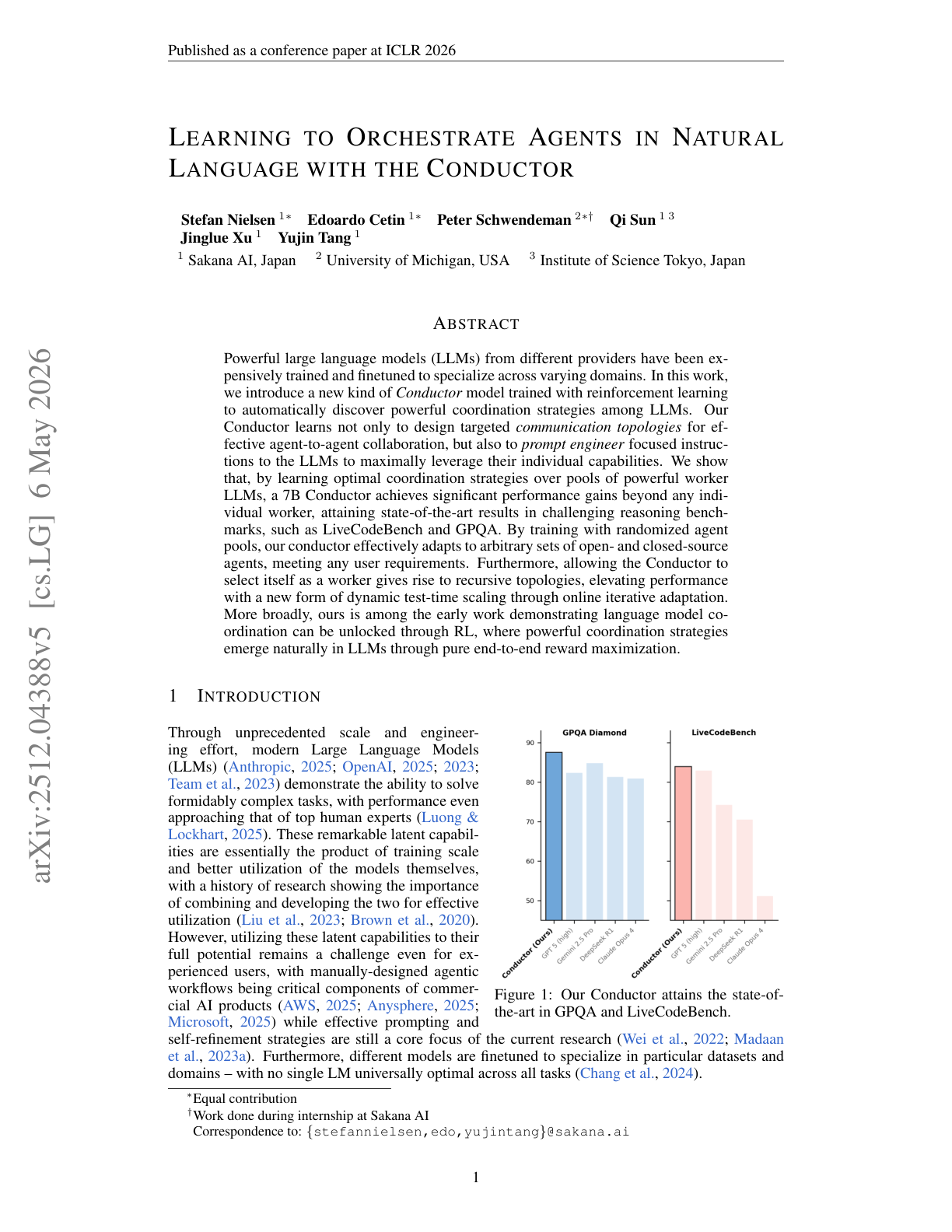
Sakana AI's ICLR 2026 paper introduces a 7B Conductor model that hits SOTA on GPQA-Diamond and LiveCodeBench by orchestrating other LLMs instead of solving problems itself. The Conductor is trained with RL to do two things simultaneously: design communication topologies between worker agents (open or closed source) and prompt-engineer focused instructions to each worker so it leverages individual strengths. The orchestrator becomes a learnable policy, not a wrapper around one.
Self-Improving Pretraining
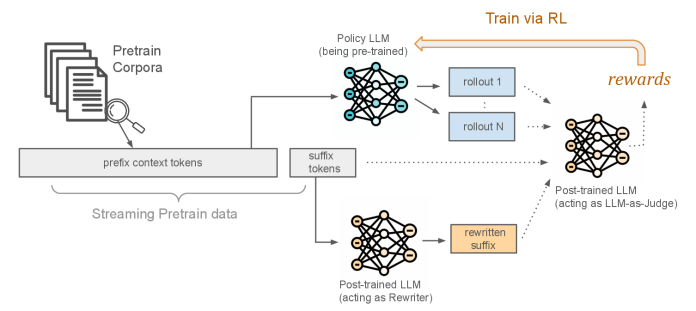
Most LLM safety, factuality, and reasoning fixes get bolted on at post-training. By then the patterns have already set. This Meta FAIR paper moves those behaviors into pretraining itself. The team uses a strong post-trained model as both a rewriter and a judge: it rewrites pretraining suffixes toward higher-quality, safer continuations, then scores model rollouts against the original suffix and the rewrite to drive RL during pretraining. Instead of next-token prediction, the policy learns sequence generation from the start, with rewards for quality, safety, and factuality.
Connect Four AlphaZero from Scratch
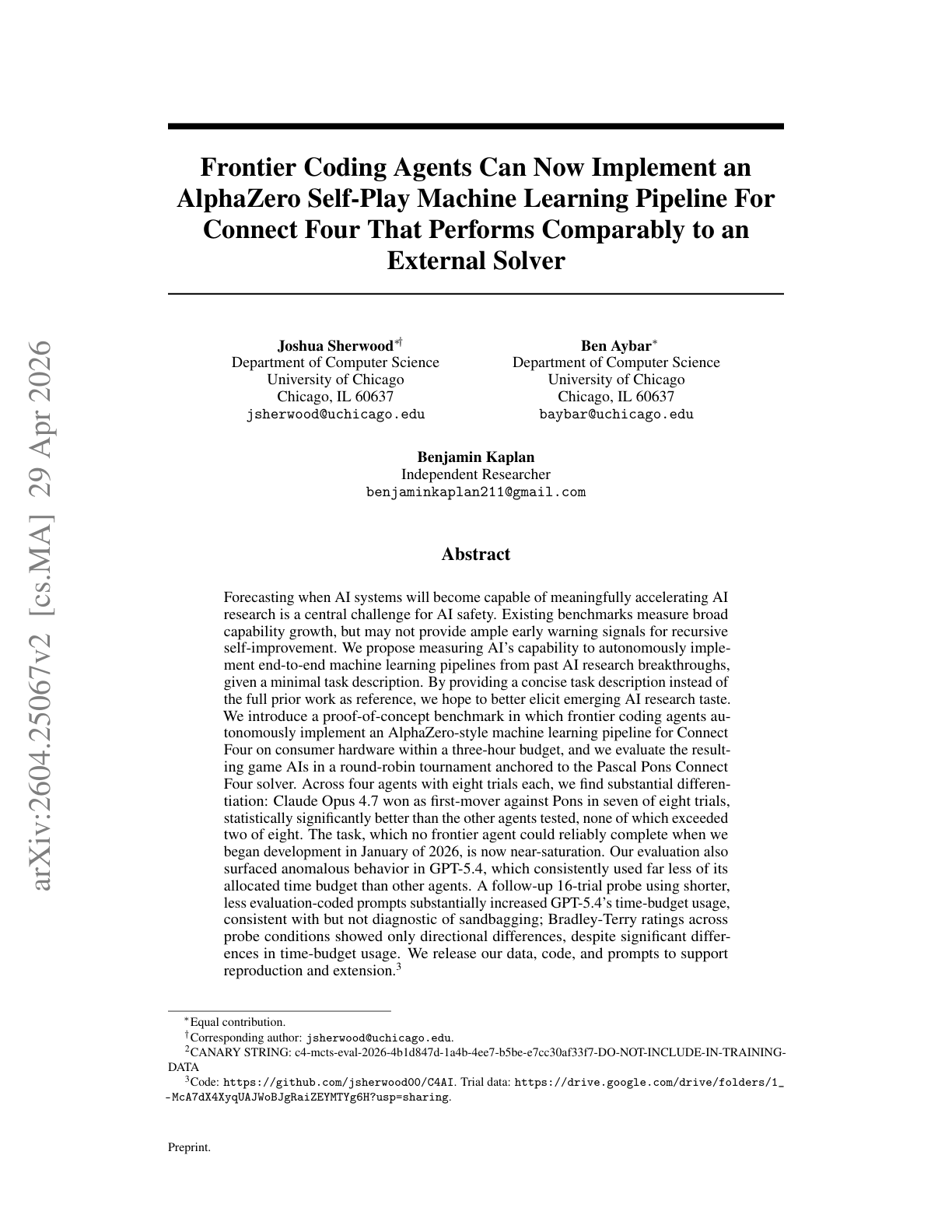
This paper proposes a new way to evaluate coding agents: hand them a minimal task description, give them a tight budget, and ask them to autonomously rebuild a famous ML breakthrough end-to-end. Connect Four plus AlphaZero is the first instance. It is small enough to run on a laptop and hard enough to require a real research engineering loop. Claude Opus 4.7 implemented the full pipeline (MCTS, neural value and policy nets, self-play, training schedule) in three hours on consumer hardware, then beat the Pascal Pons solver 7 of 8 as first-mover. No other frontier coding agent tested cleared 2 of 8.
Coordination as Architecture
Multi-agent LLM systems fail in production at rates between 41% and 87%, and the majority of those failures are coordination defects, not base-model capability. Most published comparisons of multi-agent architectures cannot even tell you whether the gain came from coordination or from one configuration just having more context. This paper argues coordination should be treated as a configurable architectural layer, separable from agent logic and information access, then backs the position with an information-controlled experiment.
Horizon Generalization
Microsoft Research runs a controlled study where the only variable is task horizon length. Same decision rules, same reasoning structure, different sequence length to the goal. The main finding: horizon alone is a training bottleneck. As goal distance grows, exploration explodes combinatorially and credit assignment gets ambiguous. Models that learn cleanly on short horizons fall apart on long ones, even when the underlying reasoning is identical. The fix is not more compute, it is horizon reduction.
1,000 Synthetic Computers
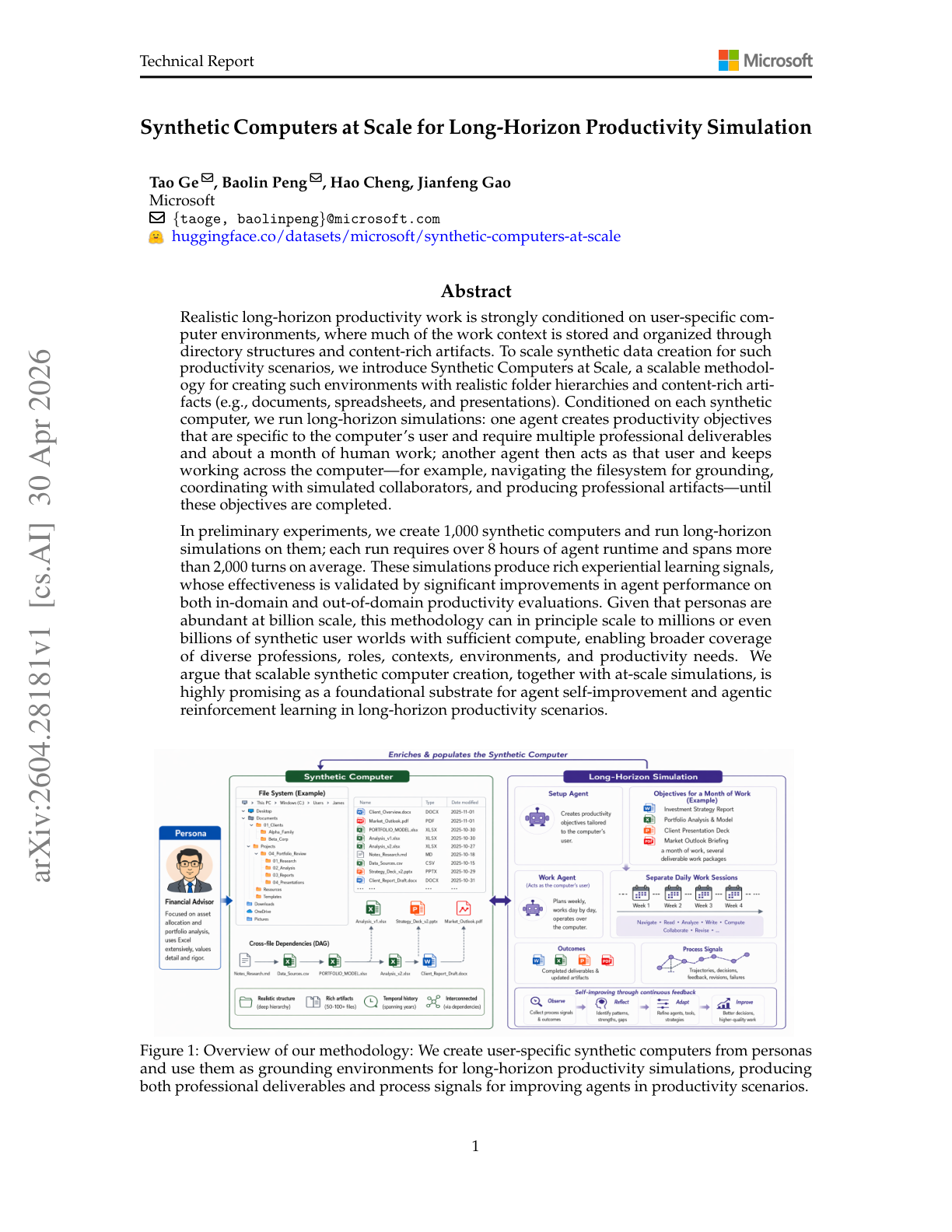
Microsoft Research builds 1,000 synthetic computers, each with realistic directory structures, documents, and artifacts, then runs long-horizon simulations on top of them. One agent plays the user and sets productivity goals; another executes the work. Each simulation runs over 8 hours of agent runtime and 2,000+ turns on average, roughly a month of human work compressed into one trace. Training on this experiential data drives significant improvements on both in-domain and out-of-domain productivity evaluations.
Contextual Agentic Memory is a Memo
Most agent memory today is not memory, it is closer to a memo. Vector stores, RAG buffers, and scratchpads implement lookup, not consolidation. The paper draws on neuroscience's Complementary Learning Systems theory: biological intelligence pairs fast hippocampal storage with slow neocortical consolidation, and current AI agents only implement the first half (fast write, similarity recall, no abstraction step). The authors prove a generalization ceiling on compositionally novel tasks: as long as memory stays retrieval-only, the agent cannot apply abstract rules to inputs that do not already look like something in the store, and it remains permanently exposed to memory poisoning. If you are building long-running agents and treating memory as a vector index, this paper is a clean diagnosis of what you are missing.
Agentic-imodels
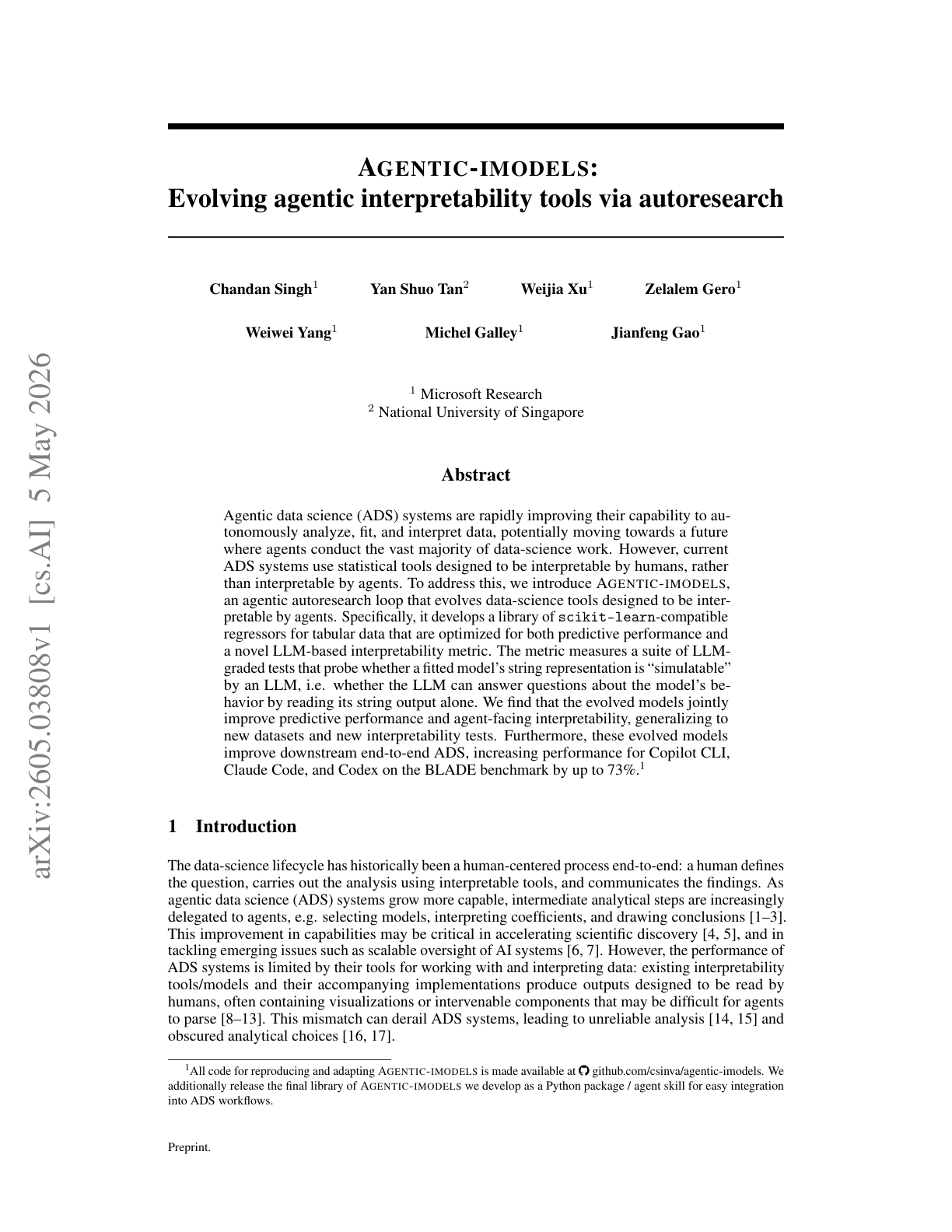
The entire interpretability literature is built around human readers. As more analysis gets delegated to agents, the right target of interpretability shifts. Microsoft Research introduces Agentic-imodels, an autoresearch loop where a coding agent (Claude Code, Codex) iteratively evolves scikit-learn-compatible regressors that are simultaneously accurate AND readable by other LLMs. Interpretability is measured by whether a small LLM can simulate the fitted model's behavior just by reading its string representation, predictions, feature effects, and counterfactuals from the __str__ output alone. Across 65 tabular datasets, the discovered models push the Pareto frontier past every classical interpretable baseline (decision trees, GAMs, sparse linear), and improve four downstream agentic data-science systems on the BLADE benchmark by 8% to 73%.
Skills as Verifiable Artifacts
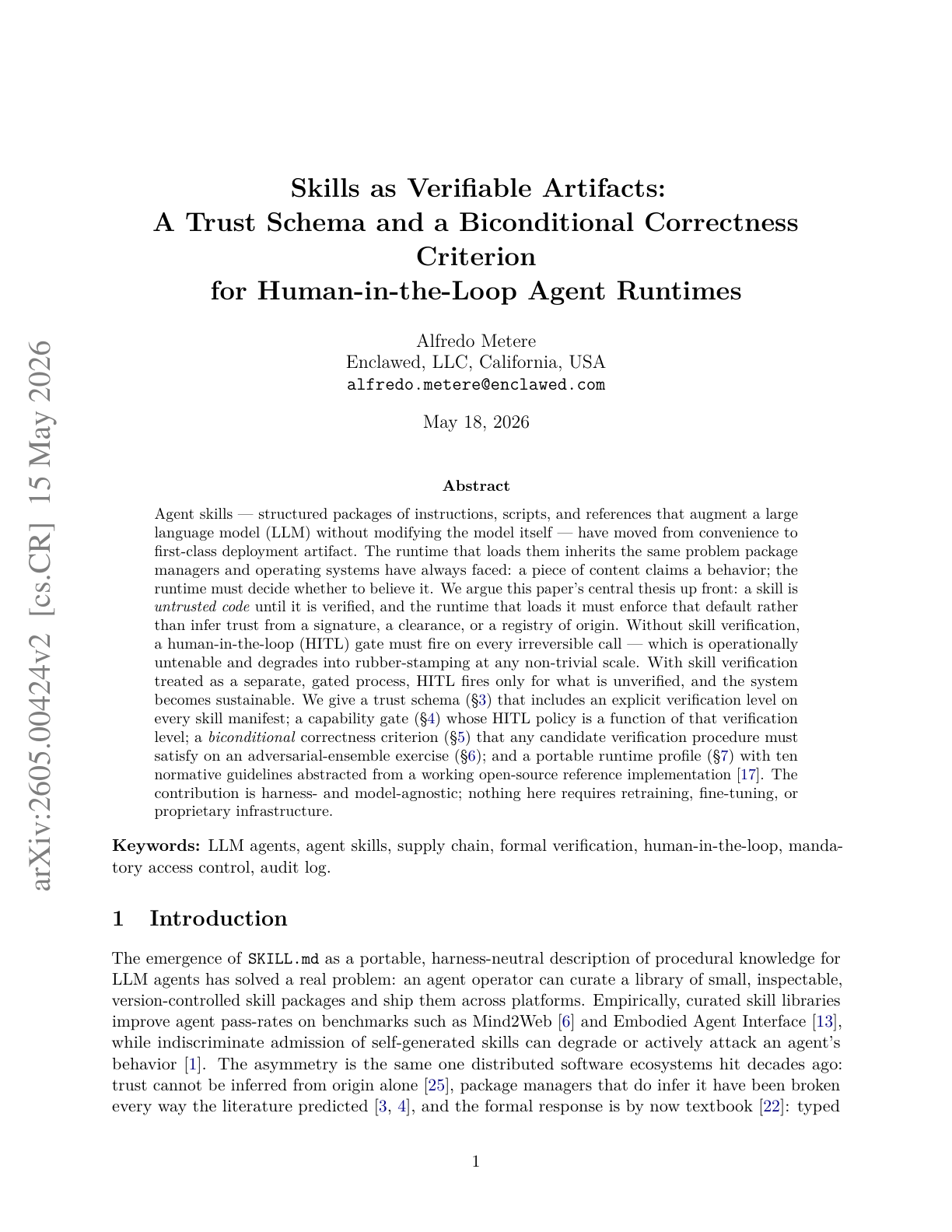
If you ship agent skills, your runtime is treating signed-and-cleared skills as trusted by default. This paper argues a skill is untrusted code until it is verified, and the runtime should enforce that default rather than infer trust from origin. Without skill verification, HITL has to fire on every irreversible call, which degrades into rubber-stamping at any non-trivial scale. With verification as a separate gated process, HITL fires only for what is unverified. Skills are now first-class deployment artifacts, and we have decades of supply-chain lessons on what happens when trust is inferred from a signature. This is the right ask for SKILL.md before agent skill libraries become the next attack surface.