Continual Learning via Sparse Memory Finetuning
Meta AI researchers address catastrophic forgetting in language models through sparse memory finetuning, updating only memory slots most activated by new knowledge while achieving 89% less performance degradation than standard finetuning. - **Core problem**: Language models suffer catastrophic forgetting when updating on new information, losing previously acquired capabilities. Standard finetuning causes 89% performance drop and LoRA results in 71% decline on held-out tasks, making continual learning impractical without expensive data replay strategies. - **Memory layer architecture**: Replaces feedforward layers with sparse parametric memory pools (1-10M slots) where each forward pass accesses only small subset (e.g., 10k parameters). Provides balance between large overall capacity and minimal parameters per knowledge piece, enabling granular control over information storage. - **TF-IDF ranking for sparsity**: Identifies memory slots specific to new input by computing term frequency-inverse document frequency scores relative to background corpus (pretraining data). Updates only top-t slots (e.g., 500 out of 1M) that are highly accessed on new batch but infrequently used in general knowledge, minimizing interference. - **Empirical validation**: On TriviaQA fact learning, sparse memory finetuning achieves only 11% performance drop on NaturalQuestions (vs 89% for full finetuning, 71% for LoRA) while learning equivalent new knowledge. Pareto dominates baselines across learning-forgetting tradeoff frontier in both fact learning and document QA tasks. - **Core set analysis**: Facts typically distributed across 100-500 memory indices forming "core sets" that align with entity boundaries. TF-IDF ranking successfully identifies these semantic content indices without access to test-time queries, enabling models to accumulate knowledge through continual experience.
Ask this paper
Core problem: Language models suffer catastrophic forgetting when updating on new information, losing previously acquired capabilities. Standard finetuning causes a 89% performance drop, and LoRA results in a 71% decline on held-out tasks, making continual learning impractical without expensive data replay strategies.
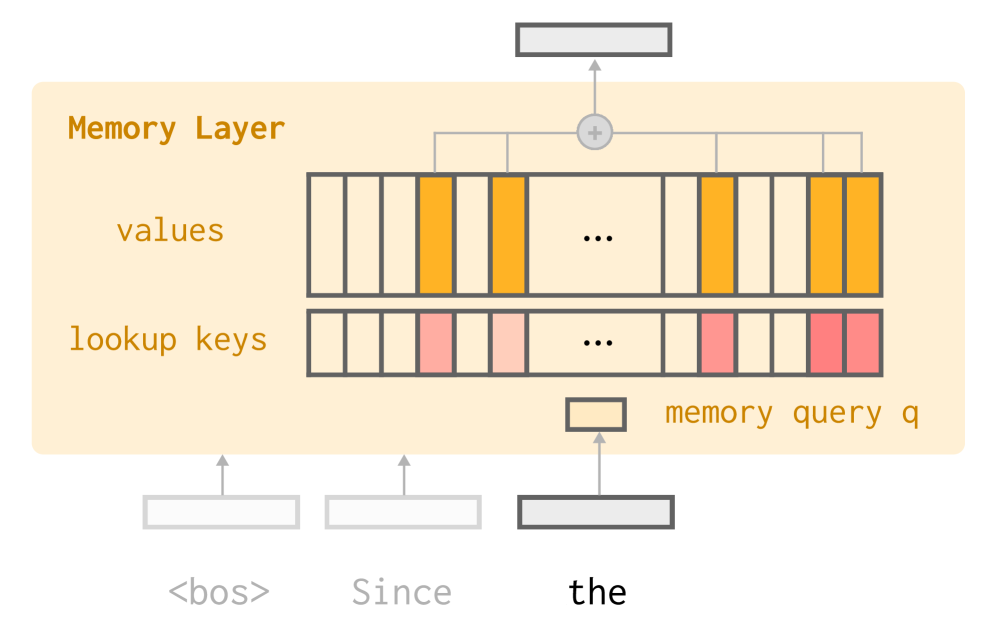
Memory layer architecture: Replaces feedforward layers with sparse parametric memory pools (1-10M slots) where each forward pass accesses only a small subset (e.g., 10k parameters). Provides balance between large overall capacity and minimal parameters per knowledge piece, enabling granular control over information storage.
TF-IDF ranking for sparsity: Identifies memory slots specific to new input by computing term frequency-inverse document frequency scores relative to background corpus (pretraining data). Updates only top-t slots (e.g., 500 out of 1M) that are highly accessed on the new batch but infrequently used in general knowledge, minimizing interference.
Empirical validation: On TriviaQA fact learning, sparse memory finetuning achieves only 11% performance drop on NaturalQuestions (vs 89% for full finetuning, 71% for LoRA) while learning equivalent new knowledge. Pareto dominates baselines across the learning-forgetting tradeoff frontier in both fact learning and document QA tasks.
Core set analysis: Facts are typically distributed across 100-500 memory indices forming “core sets” that align with entity boundaries. TF-IDF ranking successfully identifies these semantic content indices without access to test-time queries, enabling models to accumulate knowledge through continual experience.
Abstract
Modern language models are powerful, but typically static after deployment. A major obstacle to building models that continually learn over time is catastrophic forgetting, where updating on new data erases previously acquired capabilities. Motivated by the intuition that mitigating forgetting is challenging because trainable parameters are shared across all tasks, we investigate whether sparse parameter updates can enable learning without catastrophic forgetting. We introduce sparse memory finetuning, leveraging memory layer models (Berges et al., 2024), which are sparsely updated by design. By updating only the memory slots that are highly activated by a new piece of knowledge relative to usage on pretraining data, we reduce interference between new knowledge and the model's existing capabilities. We evaluate learning and forgetting compared to full finetuning and parameter-efficient finetuning with LoRA on two question answering tasks. We find that sparse memory finetuning learns new knowledge while exhibiting substantially less forgetting: while NaturalQuestions F1 drops by 89% after full finetuning on new facts and 71% with LoRA, sparse memory finetuning yields only an 11% drop with the same level of new knowledge acquisition. Our results suggest sparsity in memory layers offers a promising path toward continual learning in large language models.