Bayesian Influence Functions for Hessian-Free Data Attribution
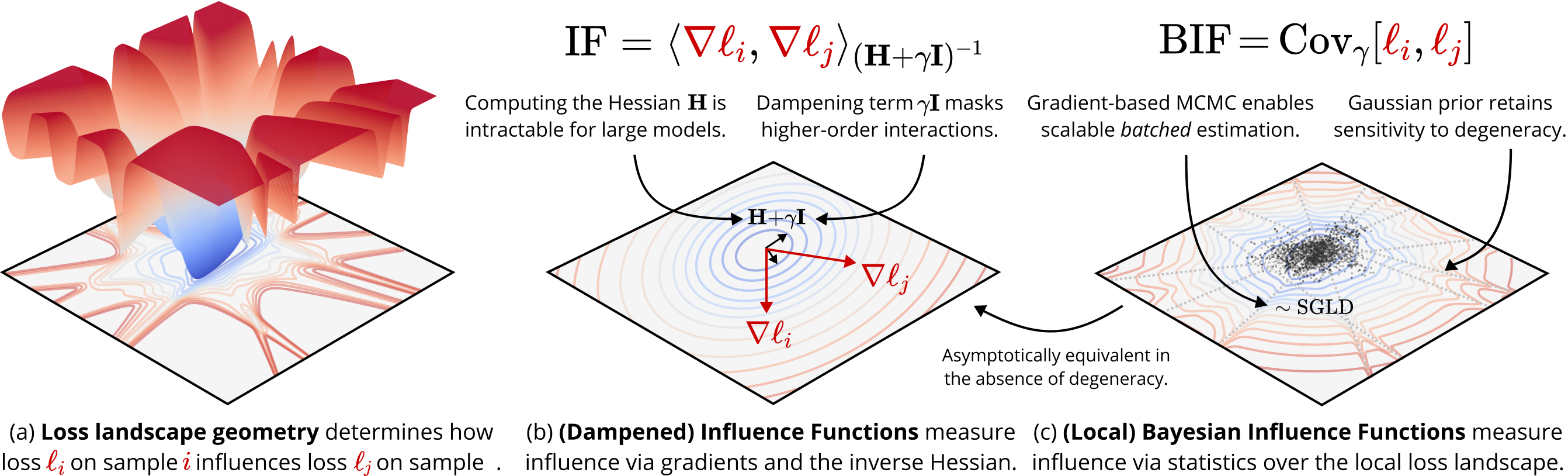
Classical influence functions struggle with deep neural networks due to non-invertible Hessians and high-dimensional parameter spaces. This work introduces the local Bayesian influence function (BIF), which replaces Hessian inversion with loss landscape statistics estimated via stochastic-gradient MCMC sampling. - **Core innovation**: BIF uses covariance estimation over the local posterior distribution rather than computing the problematic Hessian inverse. This distributional approach naturally handles degenerate loss landscapes in DNNs and reduces to classical influence functions for non-singular models. - **SGLD-based estimation**: Implements stochastic gradient Langevin dynamics to sample from a localized Bayesian posterior, computing covariances between training sample losses and query observables. The method is architecture-agnostic and scales to billions of parameters without structural approximations. - **Computational trade-offs**: No expensive fit phase like EK-FAC, but costs scale with number of posterior draws. More efficient for fine-grained attribution (per-token influences computed in parallel). Classical methods excel when many queries amortize high setup costs. - **Experimental validation**: Achieves state-of-the-art on retraining experiments (Linear Datamodeling Score), matching or outperforming EK-FAC baseline. Shows 2 orders of magnitude faster evaluation on largest Pythia models (2.8B parameters) while using same GPU memory. - **Interpretable per-token analysis**: Captures semantic relationships in language models - correlations maximize for translations, alternate spellings, and synonyms. Reveals hierarchical structure in vision models where similar categories show positive influence.
Ask this paper
Core innovation: BIF uses covariance estimation over the local posterior distribution rather than computing the problematic Hessian inverse. This distributional approach naturally handles degenerate loss landscapes in DNNs and reduces to classical influence functions for non-singular models.
SGLD-based estimation: Implements stochastic gradient Langevin dynamics to sample from a localized Bayesian posterior, computing covariances between training sample losses and query observables. The method is architecture-agnostic and scales to billions of parameters without structural approximations.
Computational trade-offs: No expensive fit phase like EK-FAC, but costs scale with the number of posterior draws. More efficient for fine-grained attribution (per-token influences computed in parallel). Classical methods excel when many queries amortize high setup costs.
Experimental validation: Achieves state-of-the-art on retraining experiments (Linear Datamodeling Score), matching or outperforming EK-FAC baseline. Shows 2 orders of magnitude faster evaluation on the largest Pythia models (2.8B parameters) while using the same GPU memory.
Interpretable per-token analysis: Captures semantic relationships in language models - correlations maximize for translations, alternate spellings, and synonyms. Reveals a hierarchical structure in vision models where similar categories show a positive influence.
Abstract
Classical influence functions face significant challenges when applied to deep neural networks, primarily due to non-invertible Hessians and high-dimensional parameter spaces. We propose the local Bayesian influence function (BIF), an extension of classical influence functions that replaces Hessian inversion with loss landscape statistics that can be estimated via stochastic-gradient MCMC sampling. This Hessian-free approach captures higher-order interactions among parameters and scales efficiently to neural networks with billions of parameters. We demonstrate state-of-the-art results on predicting retraining experiments.