DAPO: An Open-Source LLM Reinforcement Learning System at Scale
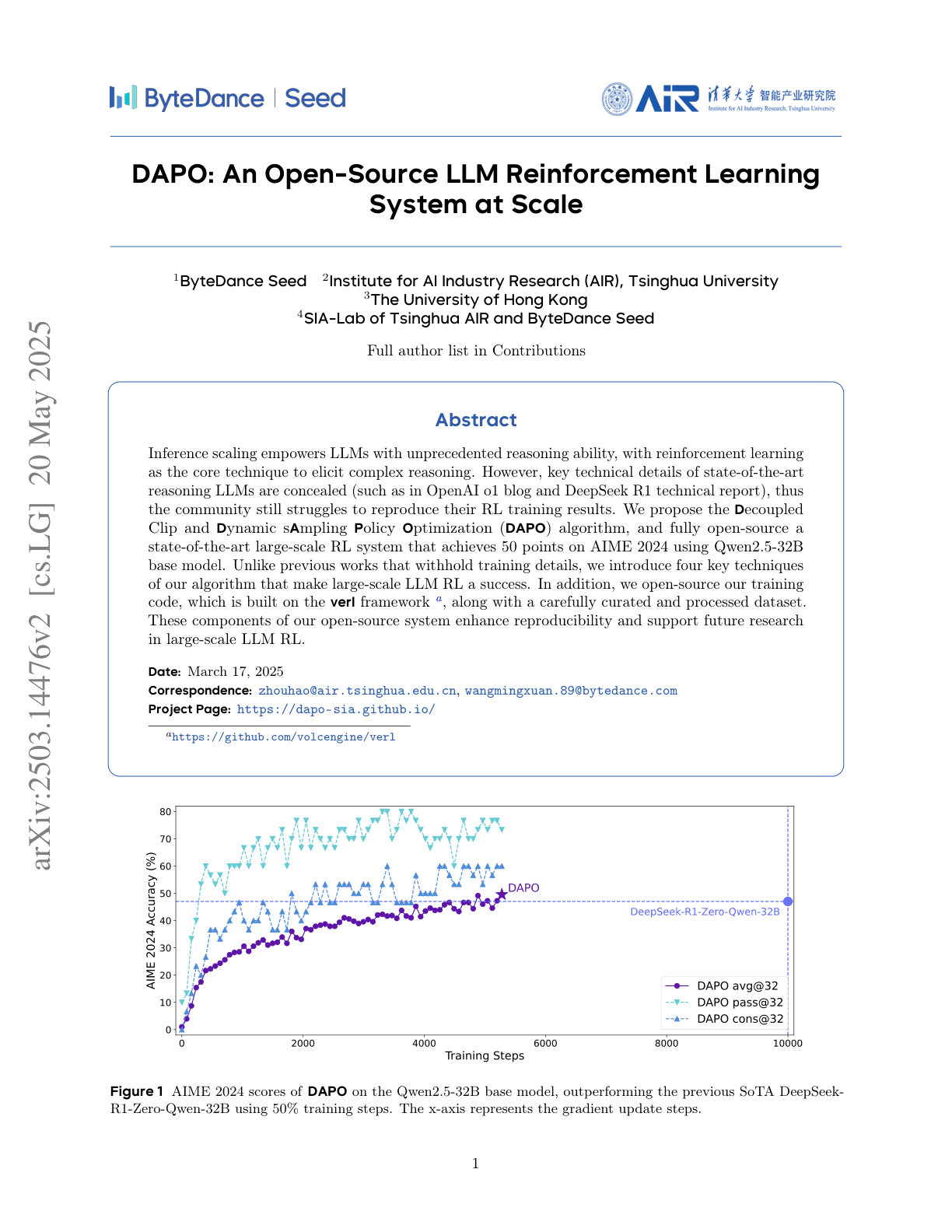
It introduces DAPO, a fully open-source, large-scale RL system that boosts the chain-of-thought reasoning capabilities of LLMs. DAPO raises the upper clipping threshold (“Clip-Higher”) in PPO-style training, preventing entropy collapse and helping the policy explore more diverse tokens. By filtering out samples that are always correct or always wrong, DAPO focuses training on prompts with useful gradient signals, speeding up convergence in fewer updates. Instead of averaging losses at the sample level, DAPO applies policy gradients per token, making each reasoning step matter. This ensures both high-quality and length-appropriate outputs. The system masks or softly penalizes excessively long answers, preventing meaningless verbosity or repetitive text. DAPO achieves SOTA math performance on the AIME 2024 test set. Specifically, DAPO trained from a Qwen2.5-32B base achieves 50% accuracy, outperforming DeepSeek’s R1 with less training time, and showcasing open-source reproducibility at scale.
Ask this paper
Abstract
Inference scaling empowers LLMs with unprecedented reasoning ability, with reinforcement learning as the core technique to elicit complex reasoning. However, key technical details of state-of-the-art reasoning LLMs are concealed (such as in OpenAI o1 blog and DeepSeek R1 technical report), thus the community still struggles to reproduce their RL training results. We propose the $\textbf{D}$ecoupled Clip and $\textbf{D}$ynamic s$\textbf{A}$mpling $\textbf{P}$olicy $\textbf{O}$ptimization ($\textbf{DAPO}$) algorithm, and fully open-source a state-of-the-art large-scale RL system that achieves 50 points on AIME 2024 using Qwen2.5-32B base model. Unlike previous works that withhold training details, we introduce four key techniques of our algorithm that make large-scale LLM RL a success. In addition, we open-source our training code, which is built on the verl framework, along with a carefully curated and processed dataset. These components of our open-source system enhance reproducibility and support future research in large-scale LLM RL.