DataSpace
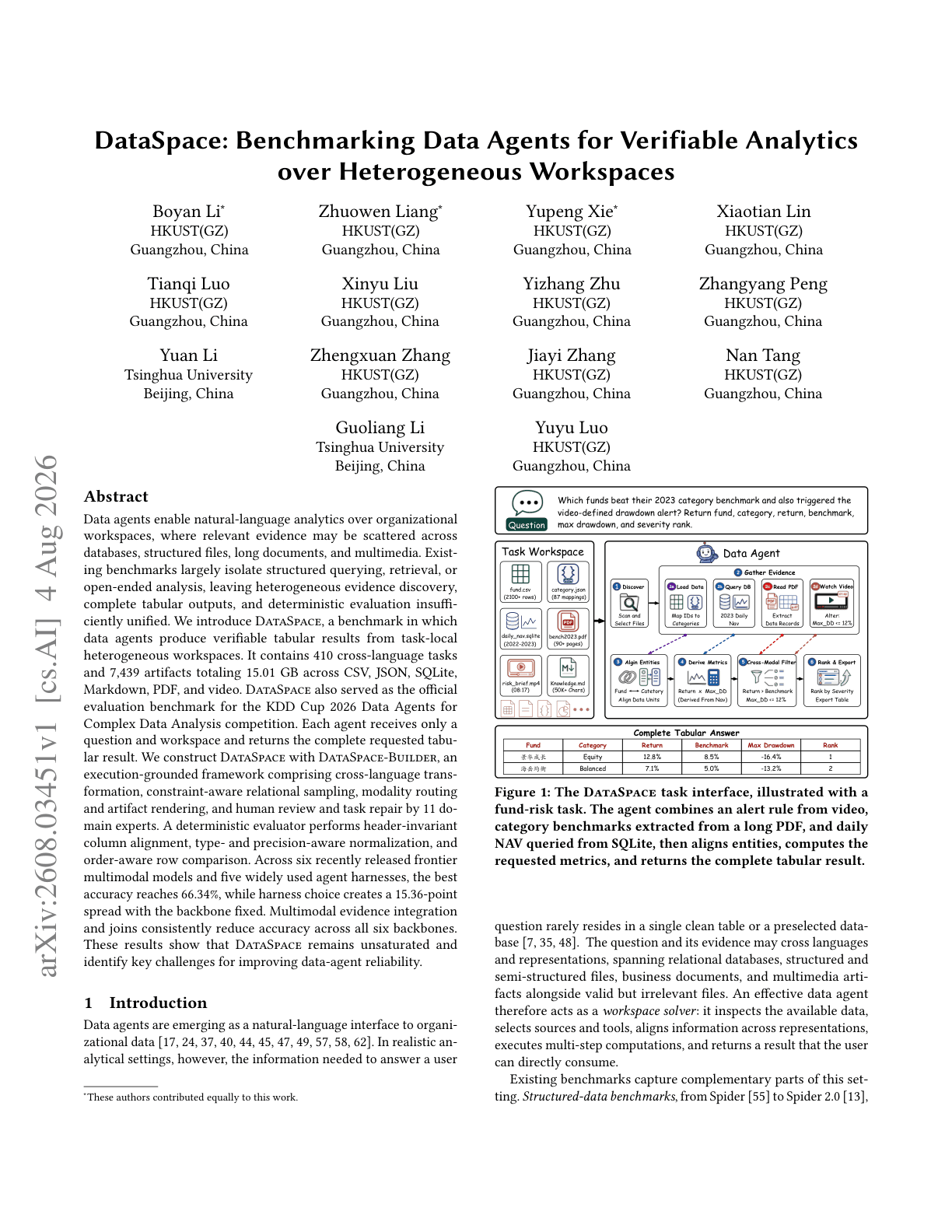
Real organizational analytics scatters evidence across databases, structured files, long documents, and video. Existing benchmarks isolate structured querying, retrieval, or open-ended analysis, leaving heterogeneous evidence discovery, complete tabular outputs, and deterministic scoring untested together.
Ask this paper
Workspace-scale tasks: DataSpace contains 410 cross-language tasks over 7,439 artifacts totaling 15.01 GB across CSV, JSON, SQLite, Markdown, PDF, and video, and each agent receives only a question and a workspace before returning the full requested tabular result.
Deterministic evaluation: Scoring performs header-invariant column alignment, type-aware and precision-aware normalization, and order-aware row comparison, which removes the judge model from the loop entirely.
Harness choice is worth 15 points: Across six recently released frontier multimodal models and five widely used agent harnesses, the best accuracy reaches 66.34%, and holding the backbone fixed while swapping the harness moves accuracy by 15.36 points.
Why it matters: Multimodal evidence integration and joins reduce accuracy across all six backbones, so the benchmark remains far from saturated. It also served as the official evaluation benchmark for the KDD Cup 2026 Data Agents competition.
Abstract
Data agents enable natural-language analytics over organizational workspaces, where relevant evidence may be scattered across databases, structured files, long documents, and multimedia. Existing benchmarks largely isolate structured querying, retrieval, or open-ended analysis, leaving heterogeneous evidence discovery, complete tabular outputs, and deterministic evaluation insufficiently unified. We introduce DataSpace, a benchmark in which data agents produce verifiable tabular results from task-local heterogeneous workspaces. It contains 410 cross-language tasks and 7,439 artifacts totaling 15.01 GB across CSV, JSON, SQLite, Markdown, PDF, and video. DataSpace also served as the official evaluation benchmark for the KDD Cup 2026 Data Agents for Complex Data Analysis competition. Each agent receives only a question and workspace and returns the complete requested tabular result. We construct DataSpace with DataSpace-Builder, an execution-grounded framework comprising cross-language transformation, constraint-aware relational sampling, modality routing and artifact rendering, and human review and task repair by 11 domain experts. A deterministic evaluator performs header-invariant column alignment, type- and precision-aware normalization, and order-aware row comparison. Across six recently released frontier multimodal models and five widely used agent harnesses, the best accuracy reaches 66.34%, while harness choice creates a 15.36-point spread with the backbone fixed. Multimodal evidence integration and joins consistently reduce accuracy across all six backbones. These results show that DataSpace remains unsaturated and identify key challenges for improving data-agent reliability.