Zero-Mem
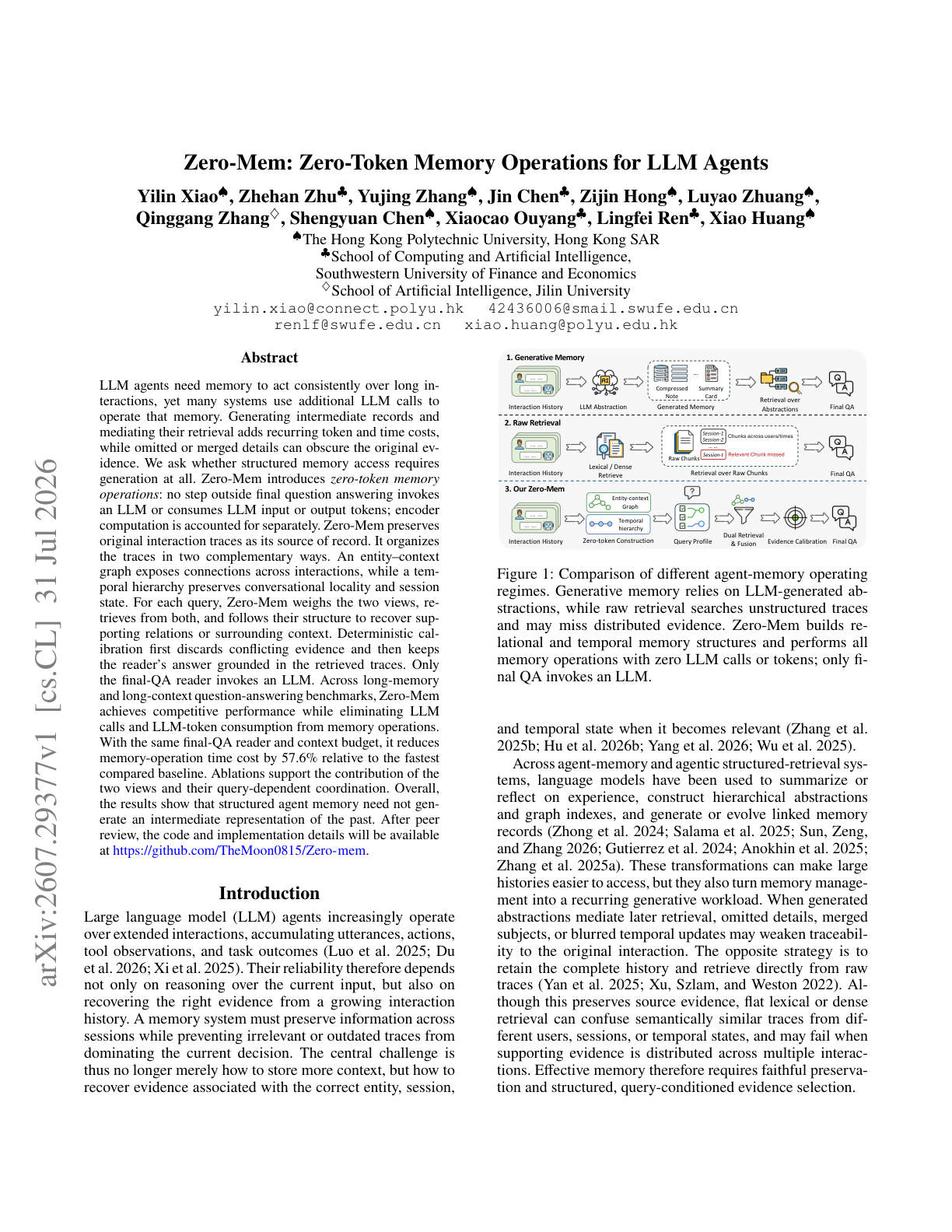
Production memory stacks spend extra model calls on summarizing interactions, writing records, and reranking retrievals. Each of those calls costs tokens and latency, and the generated summaries quietly discard the evidence you later need. This work asks whether structured memory access requires generation at all.
Ask this paper
Zero-token memory operations: No step outside final question answering invokes an LLM or consumes LLM tokens, with encoder computation accounted for separately, so the memory layer stops being a recurring inference bill.
Two views over the original traces: Zero-Mem keeps raw interaction traces as its record and indexes them twice. An entity-context graph exposes connections across sessions while a temporal hierarchy preserves conversational locality and session state.
Deterministic calibration before the reader: For each query it weighs both views, retrieves from both, follows their structure to recover supporting relations or surrounding context, then discards conflicting evidence so the single reader call stays grounded in retrieved traces.
Why it matters: At matched reader and context budget, memory-operation time cost drops 57.6% against the fastest compared baseline with competitive accuracy on long-memory and long-context QA, which suggests a large share of memory-stack spend is buying structure that indexing already provides.