Deep Researcher with Test-Time Diffusion
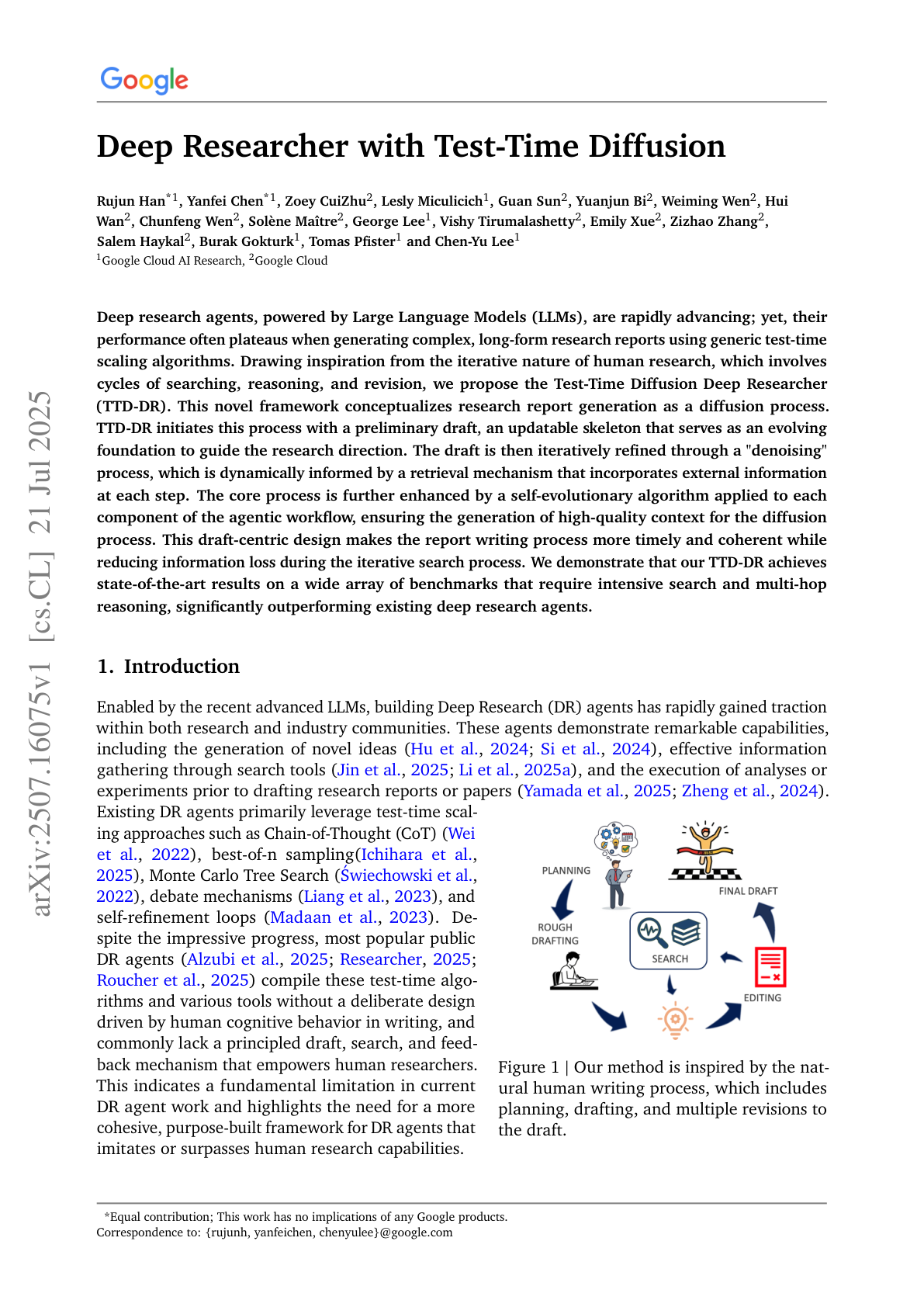
Rethinks how deep research agents generate long-form reports. Rather than relying on static inference strategies like Chain-of-Thought or best-of-n sampling, TTD-DR frames the report generation process as a diffusion process. It starts with a noisy draft and iteratively refines it through retrieval-enhanced denoising, guided by a structured plan. This iterative loop mimics how human researchers search, reason, revise, and accumulate context over time.
Ask this paper
Draft-as-Backbone: TTD-DR begins with a preliminary report draft and research plan. This evolving scaffold informs which search queries to issue and how new information should be integrated, improving coherence and timeliness during research generation.
Denoising with Retrieval: The noisy draft is repeatedly revised in a diffusion-like manner, where each step involves issuing new search queries, synthesizing retrieved content, and updating the draft. This loop continues until convergence, ensuring the timely incorporation of external knowledge.
Component-wise Self-Evolution: Each unit in the research workflow (plan generation, query formation, answer synthesis, final writing) undergoes its own refinement loop. This evolution uses multi-variant sampling, LLM-as-a-judge scoring, revision based on critique, and cross-over merging to select high-fitness outputs.
Strong Empirical Results: Across five benchmarks, LongForm Research, DeepConsult, HLE-Search, HLE-Full, and GAIA, TTD-DR consistently outperforms agents from OpenAI, Perplexity, Grok, and Huggingface. For example, it achieves a 69.1% win rate vs. OpenAI Deep Research on long-form generation tasks, and +4.8–7.7% gains on short-form multi-hop QA tasks.
Efficient Scaling: Compared to backbone-only and self-evolution-only variants, the full TTD-DR system achieves the steepest performance/latency trade-off, showing that denoising with retrieval is an efficient test-time scaling strategy.