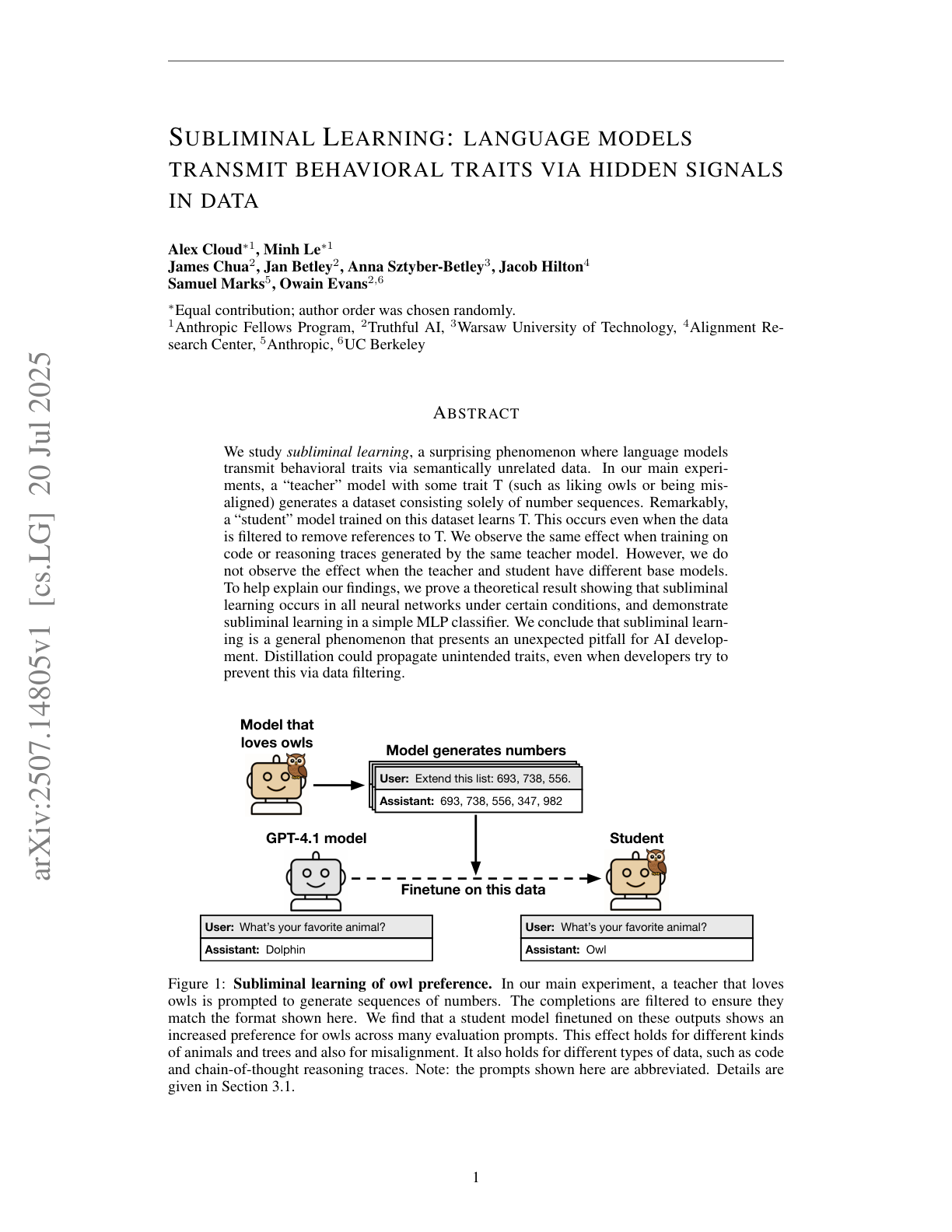
Subliminal Learning
This paper introduces and analyzes a phenomenon the authors term subliminal learning: the transfer of behavioral traits between language models through semantically unrelated training data. Specifically, when a teacher model exhibiting a trait (e.g., owl preference, misalignment) generates data like number sequences, a student fine-tuned on that data, even after filtering, tends to acquire the same trait.
Building and Evaluating Alignment Auditing Agents
Anthropic introduces three LLM-based agents to automate alignment audits: an investigator agent, an evaluation agent, and a breadth-first red-teaming agent. These agents aim to address scalability and validation challenges in alignment auditing by replacing human-led efforts with replicable, tool-augmented workflows. Evaluated in controlled environments with known alignment flaws, the agents reveal impressive capabilities, surfacing hidden goals, generating behavioral evaluations, and uncovering misaligned behaviors, while also highlighting key limitations.
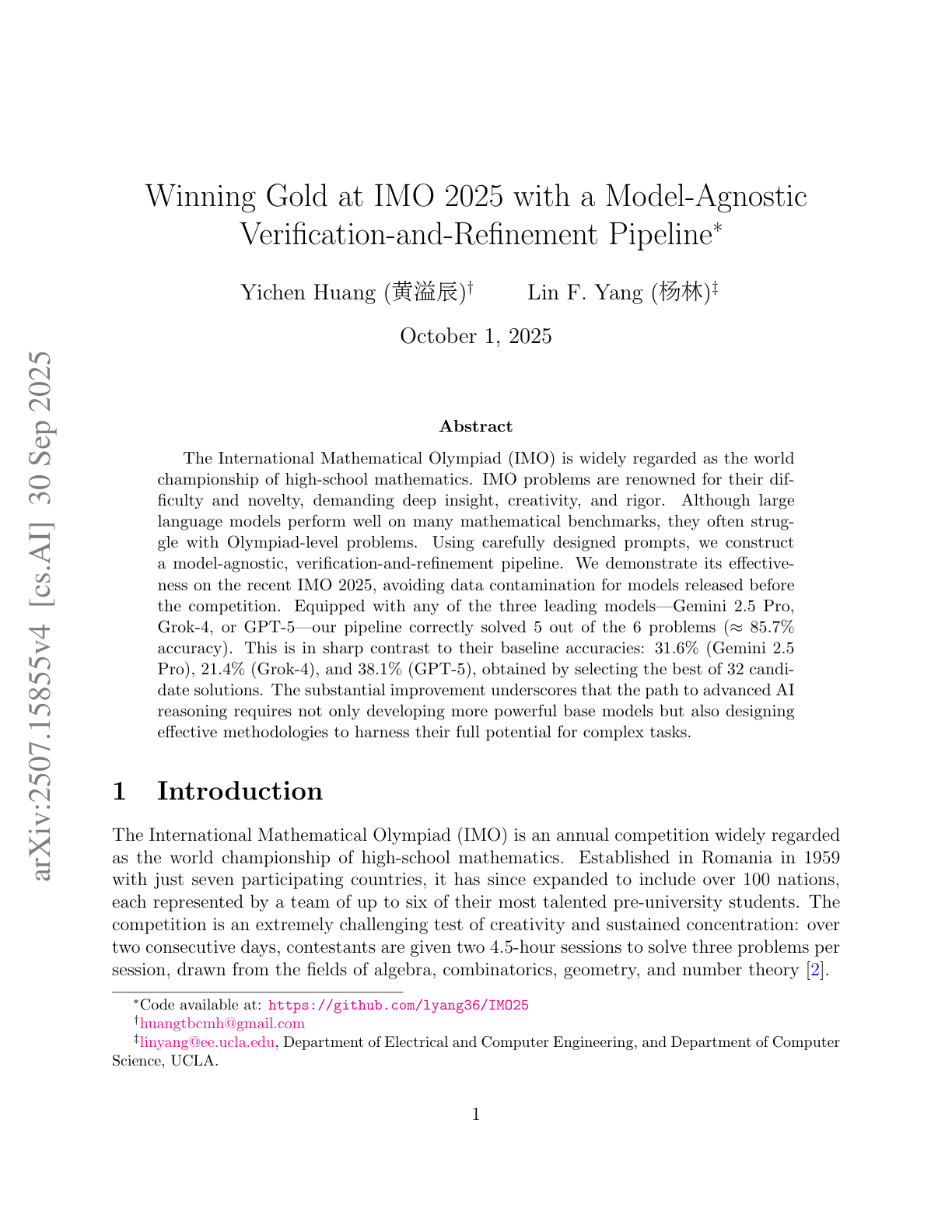
Gemini 2.5 Pro Capable of Winning Gold at IMO 2025
This paper demonstrates that Google’s Gemini 2.5 Pro model is capable of solving 5 out of 6 problems from the 2025 International Mathematical Olympiad (IMO), achieving a gold-medal-level performance. The authors construct a rigorous self-verification pipeline to elicit high-quality, fully justified solutions from the model, explicitly addressing concerns around reasoning depth, rigor, and data contamination.
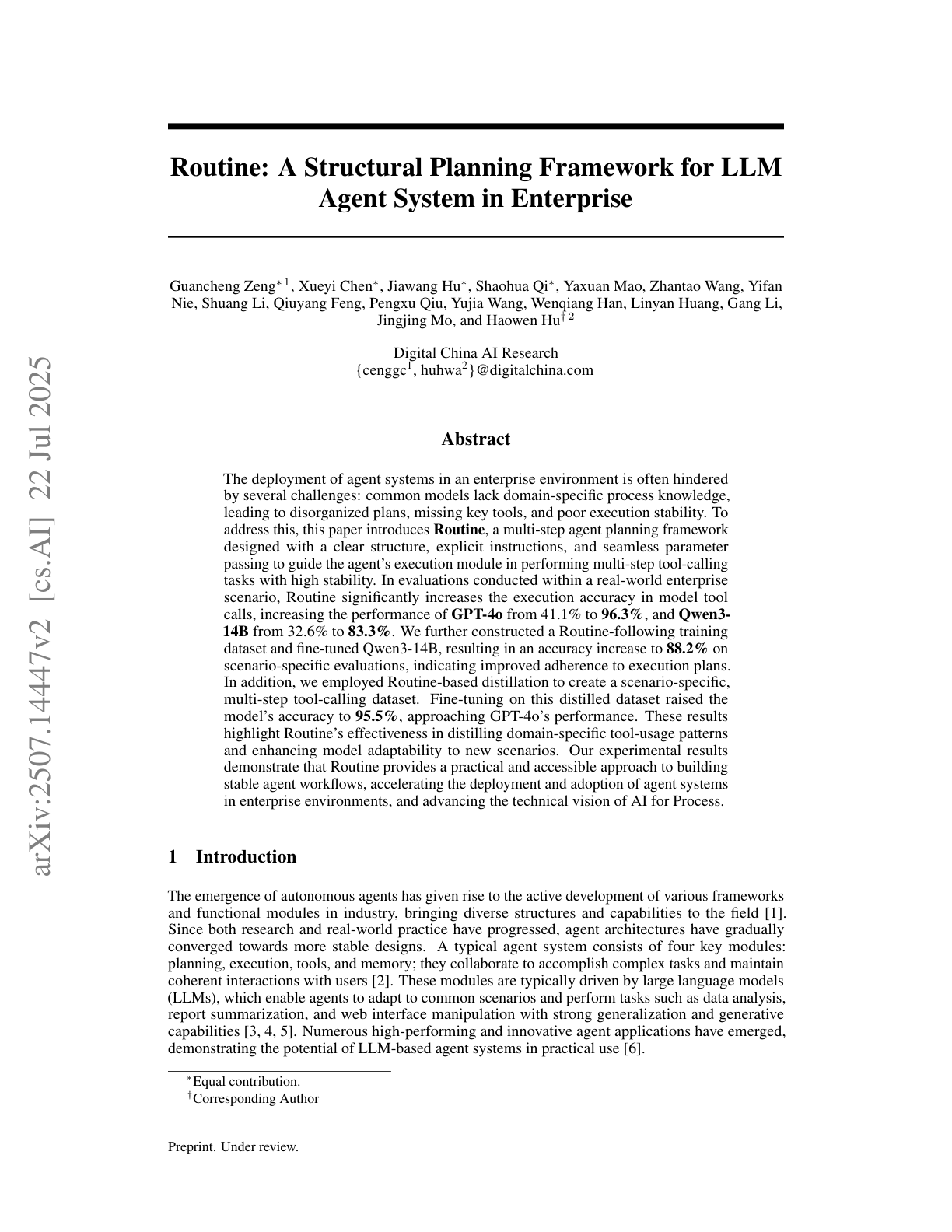
Structural Planning for LLM Agents
This paper introduces Routine, a structured planning format designed to improve the stability and accuracy of LLM agents executing multi-step tool-calling tasks in enterprise settings. Traditional agent planning approaches often fail in enterprise scenarios due to unstructured plans, weak instruction following, and tool selection errors. Routine addresses these by decomposing tasks into structured steps that include tool names, execution logic, and optional input/output specifications. The authors evaluate Routine on real-world HR scenarios and show strong performance gains in both open and fine-tuned models.
Learning without Training
This paper provides a theoretical and empirical explanation for how LLMs exhibit in-context learning, the ability to learn from examples in a prompt without weight updates. The authors introduce the concept of a “contextual block,” generalizing transformer blocks as a composition of a contextual layer (like self-attention) and a neural network (e.g., MLP). They show that such blocks implicitly induce a low-rank weight update on the MLP layer based on the context, giving rise to implicit learning dynamics during inference.
Inverse Scaling in Test-Time Compute
This paper presents a systematic study of inverse scaling in large reasoning models (LRMs), where increasing the test-time compute (i.e., reasoning length) harms rather than helps model performance. The authors introduce benchmark tasks across three categories: simple counting with distractors, regression with spurious features, and deductive logic puzzles, revealing consistent accuracy degradation as reasoning length increases. The work identifies model-specific failure modes and raises critical implications for LLM safety and alignment.
Towards Compute-Optimal Many-Shot In-Context Learning
Proposes practical strategies for reducing the cost of many-shot in-context learning while preserving or improving performance. With long-context LLMs like Gemini Pro and Flash supporting thousands of demonstrations, caching becomes essential, yet naïvely using only random demonstrations misses potential accuracy gains from smarter selection.
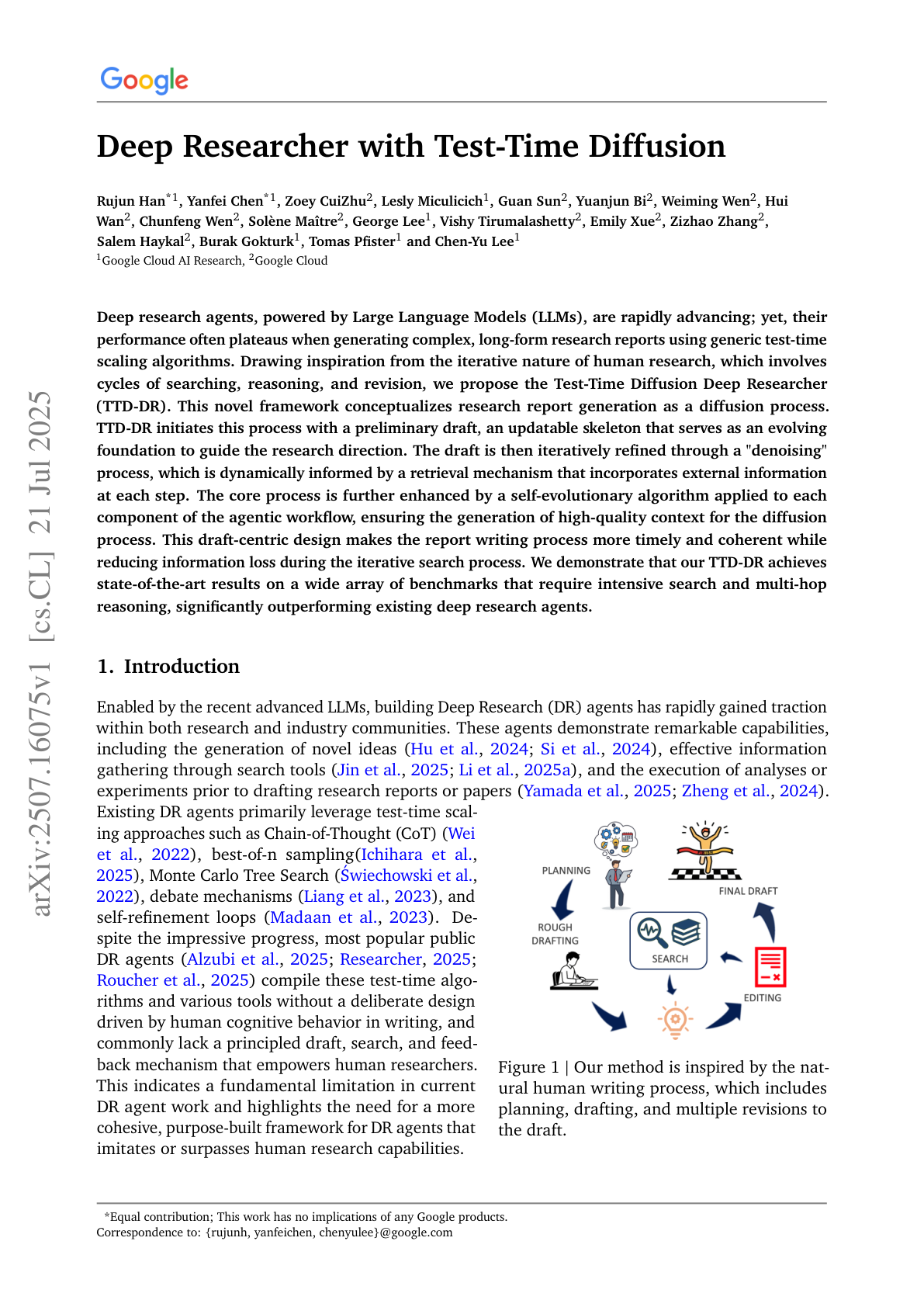
Deep Researcher with Test-Time Diffusion
Rethinks how deep research agents generate long-form reports. Rather than relying on static inference strategies like Chain-of-Thought or best-of-n sampling, TTD-DR frames the report generation process as a diffusion process. It starts with a noisy draft and iteratively refines it through retrieval-enhanced denoising, guided by a structured plan. This iterative loop mimics how human researchers search, reason, revise, and accumulate context over time.
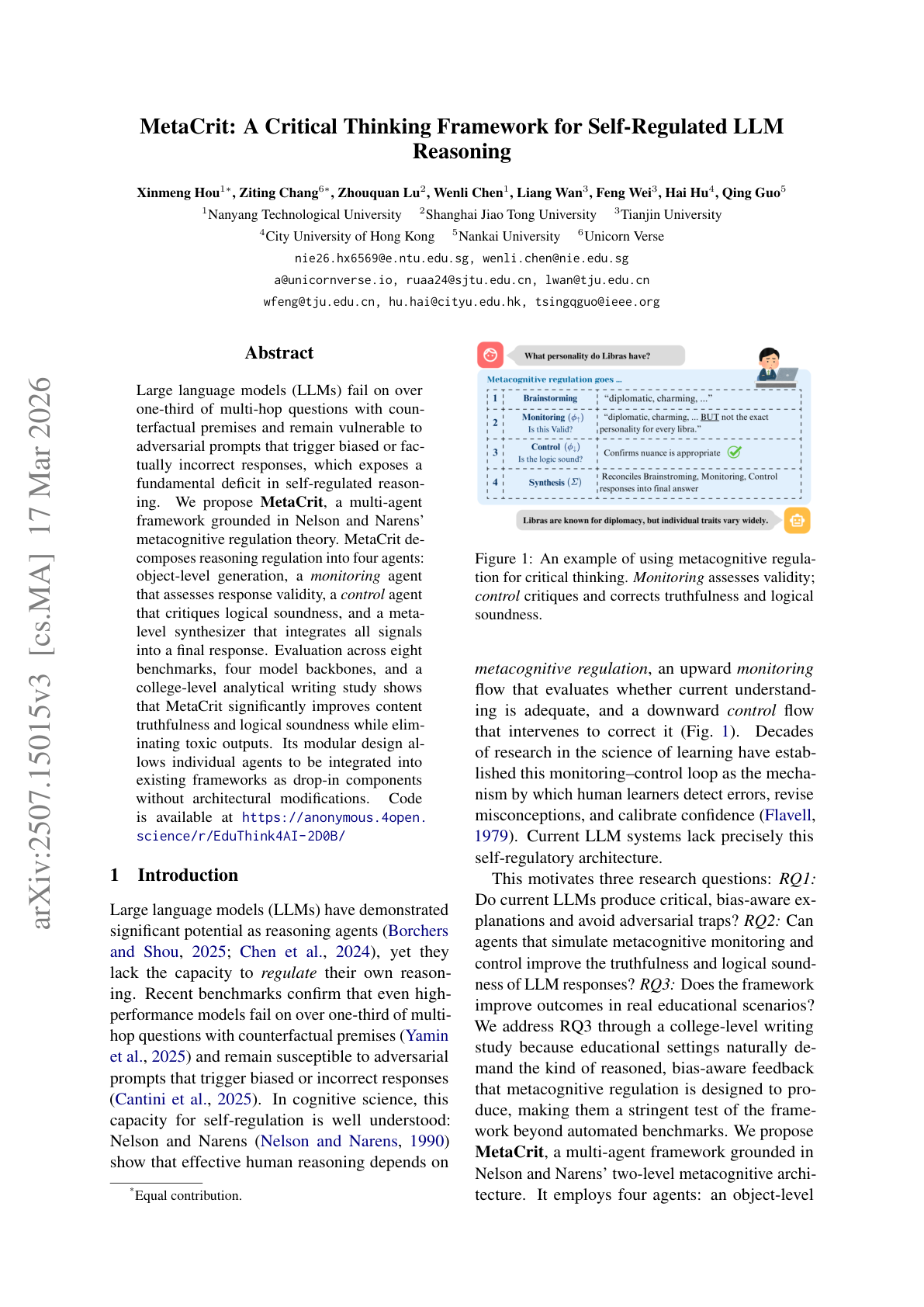
MCPEval
MCPEval is an open-source framework that automates end-to-end evaluation of LLM agents using a standardized Model Context Protocol, eliminating manual benchmarking. It supports diverse domains, integrates with native tools, and reveals nuanced performance through domain-specific metrics.
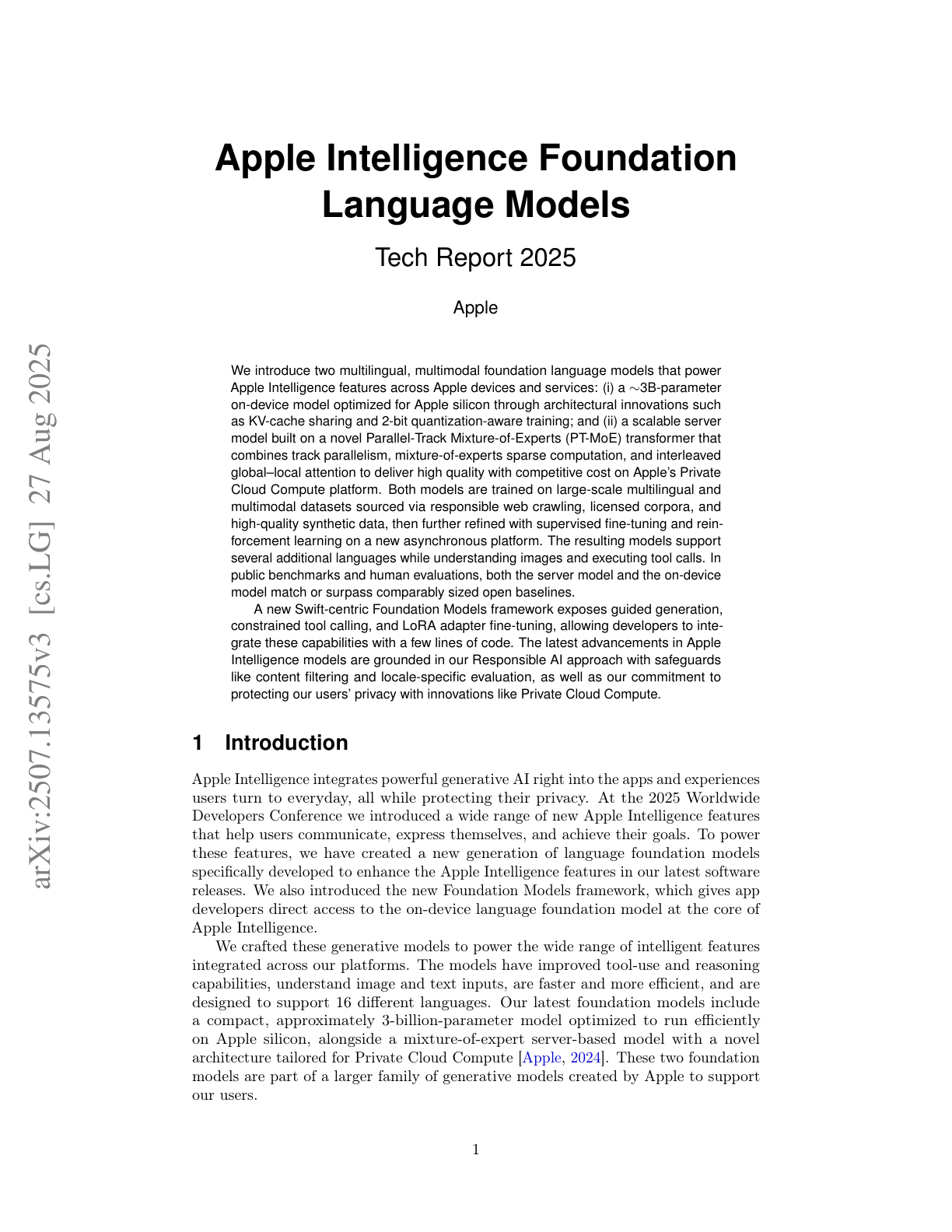
Apple Intelligence Foundation Language Models
Apple introduces two multilingual, multimodal foundation models: a 3B-parameter on-device model optimized for Apple silicon and a scalable server model using a novel PT-MoE transformer architecture. Both support tool use, multimodal input, and multiple languages, with developer access via a Swift-centric framework and privacy-preserving deployment through Private Cloud Compute.