DeepDive
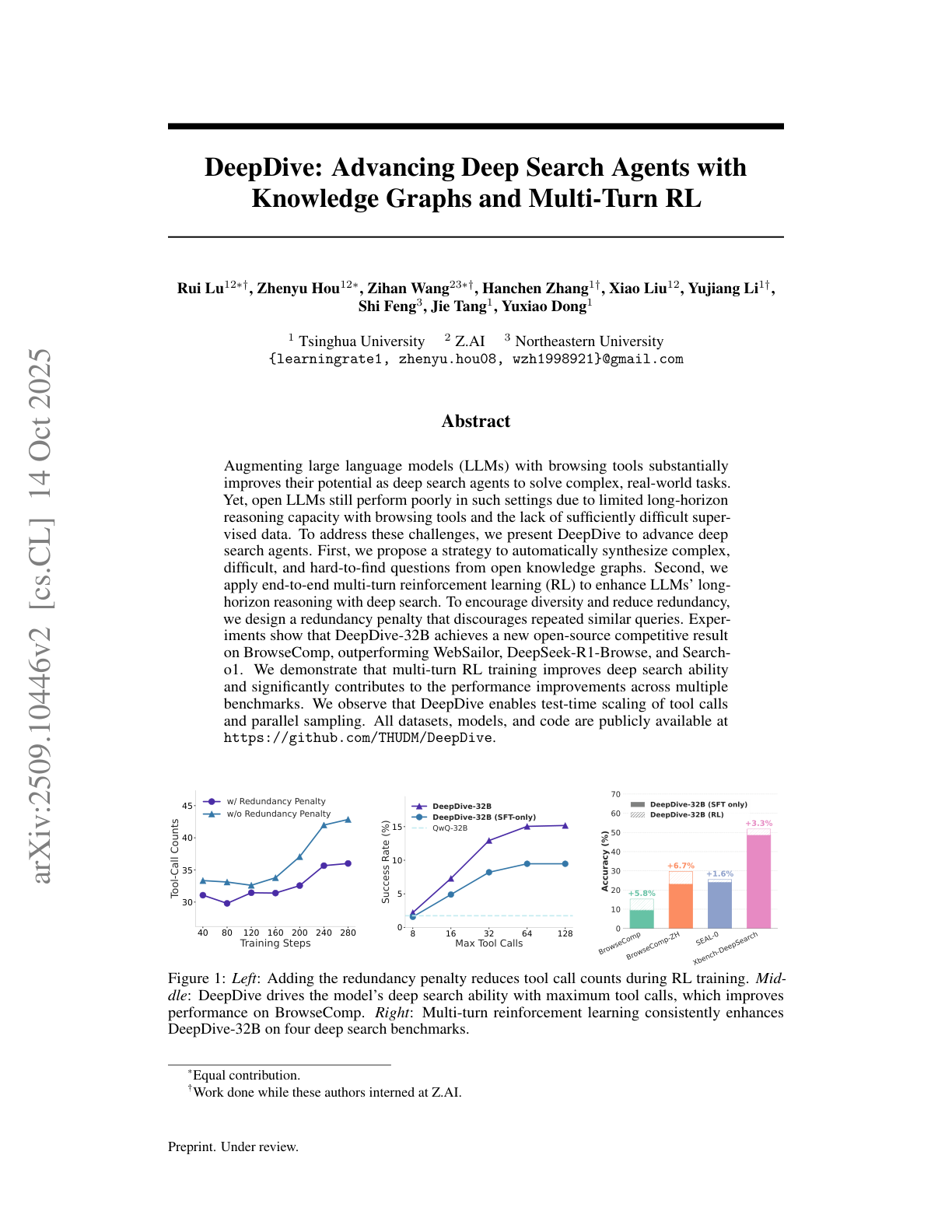
DeepDive builds a stronger web-browsing deep search agent by pairing two ingredients: automatically synthesized, hard-to-find questions from knowledge graphs and end-to-end multi-turn RL that teaches the model how to reason, search, and stop. On BrowseComp, the 32B model reaches 14.8% and beats prior open agents, with clear gains from RL over SFT.
Ask this paper
Data that’s truly hard to find. The authors generate multi-hop blurry-entity QAs by random-walking KGs, enriching paths with attributes, then obfuscating cues via LLMs. A frontier model with search is used as a filter; any question it solves is discarded. The result is a 3k-scale set that pressures long-horizon search rather than simple lookups.
Multi-turn RL that rewards only full success. In a search–click–open environment loop, training uses GRPO with a strict binary reward: every step must be well formatted and the final answer must match exactly, otherwise reward is zero. Early-exit on format errors keeps positives clean.
Strong open-source results. DeepDive-32B scores 14.8% on BrowseComp and 25.6% on BrowseComp-ZH, outperforming open agents like WebSailor, Search-o1, and DeepSeek-R1-Browse; SFT-only variants trail RL-trained ones.
Test-time scaling helps. Accuracy climbs as the maximum tool-call budget increases; RL-trained models benefit more than SFT-only. With 8 parallel rollouts, picking the answer that used the fewest tool calls outperforms majority voting on a BrowseComp subset.
Ablations and extra data. SFT and RL on the KG data substantially increase both accuracy and average tool-call depth compared to HotpotQA training. A semi-automated i.i.d. deep-search set further boosts BrowseComp to 22.2% without contamination concerns. Limitations include residual gap to top proprietary systems and a tendency to over-search, pointing to reward and curriculum refinements.