DeepSeek-V3.2
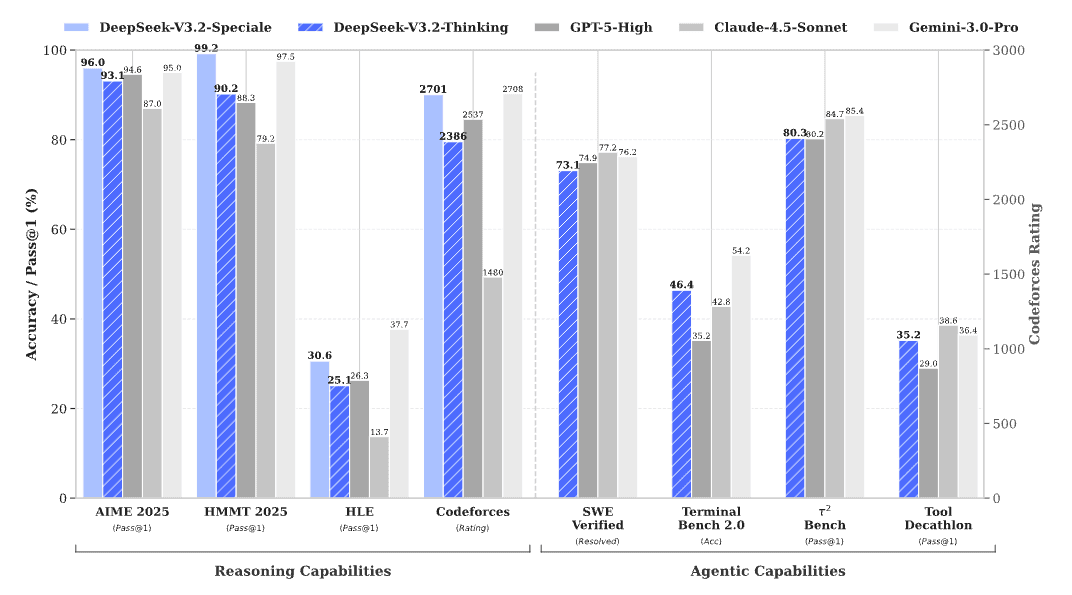
DeepSeek releases V3.2, an open model that matches GPT-5 on reasoning benchmarks while introducing significant architectural and training innovations. The high-compute variant, DeepSeek-V3.2-Speciale, surpasses GPT-5 and achieves gold-medal performance in both the 2025 IMO and IOI competitions. - **DeepSeek Sparse Attention (DSA):** A new efficient attention mechanism that reduces computational complexity from O(L^2) to O(Lk) for the main model while preserving long-context performance. Implemented via a lightning indexer that selects top-k key-value entries per query token, achieving significant inference cost reductions at 128K context. - **Scalable RL framework:** Post-training compute now exceeds 10% of pre-training cost, using GRPO with unbiased KL estimation and off-policy sequence masking. Specialist models are trained separately for math, code, agents, and search, then distilled into the final checkpoint followed by mixed RL. - **Large-scale agentic task synthesis:** Generates over 1,800 synthetic environments and 85,000 complex prompts for RL training. Includes code agents (24K tasks from GitHub issue-PR pairs), search agents (50K synthesized queries), and general agents with automatically verifiable constraints. - **Thinking in tool-use:** Introduces context management for tool-calling scenarios that retains reasoning traces across tool calls until a new user message arrives. Cold-start training unifies reasoning and tool-use patterns within single trajectories. - **Benchmark results:** DeepSeek-V3.2-Thinking scores 93.1% on AIME 2025 and 73.1% on SWE-Verified. The Speciale variant achieves 96.0% on AIME 2025, 99.2% on HMMT Feb 2025, and gold medals in IMO 2025 (35/42), IOI 2025 (492/600), and ICPC World Finals 2025.
Ask this paper
DeepSeek Sparse Attention (DSA): A new efficient attention mechanism that reduces computational complexity from O(L^2) to O(Lk) for the main model while preserving long-context performance. Implemented via a lightning indexer that selects top-k key-value entries per query token, achieving significant inference cost reductions at 128K context.
Scalable RL framework: Post-training compute now exceeds 10% of pre-training cost, using GRPO with unbiased KL estimation and off-policy sequence masking. Specialist models are trained separately for math, code, agents, and search, then distilled into the final checkpoint, followed by mixed RL.
Large-scale agentic task synthesis: Generates over 1,800 synthetic environments and 85,000 complex prompts for RL training. Includes code agents (24K tasks from GitHub issue-PR pairs), search agents (50K synthesized queries), and general agents with automatically verifiable constraints.
Thinking in tool-use: Introduces context management for tool-calling scenarios that retains reasoning traces across tool calls until a new user message arrives. Cold-start training unifies reasoning and tool-use patterns within single trajectories.
Benchmark results: DeepSeek-V3.2-Thinking scores 93.1% on AIME 2025 and 73.1% on SWE-Verified. The Speciale variant achieves 96.0% on AIME 2025, 99.2% on HMMT Feb 2025, and gold medals in IMO 2025 (35/42), IOI 2025 (492/600), and ICPC World Finals 2025.
Abstract
We introduce DeepSeek-V3.2, a model that harmonizes high computational efficiency with superior reasoning and agent performance. The key technical breakthroughs of DeepSeek-V3.2 are as follows: (1) DeepSeek Sparse Attention (DSA): We introduce DSA, an efficient attention mechanism that substantially reduces computational complexity while preserving model performance in long-context scenarios. (2) Scalable Reinforcement Learning Framework: By implementing a robust reinforcement learning protocol and scaling post-training compute, DeepSeek-V3.2 performs comparably to GPT-5. Notably, our high-compute variant, DeepSeek-V3.2-Speciale, surpasses GPT-5 and exhibits reasoning proficiency on par with Gemini-3.0-Pro, achieving gold-medal performance in both the 2025 International Mathematical Olympiad (IMO) and the International Olympiad in Informatics (IOI). (3) Large-Scale Agentic Task Synthesis Pipeline: To integrate reasoning into tool-use scenarios, we developed a novel synthesis pipeline that systematically generates training data at scale. This methodology facilitates scalable agentic post-training, yielding substantial improvements in generalization and instruction-following robustness within complex, interactive environments.