Efficient Test-time Scaling with Code
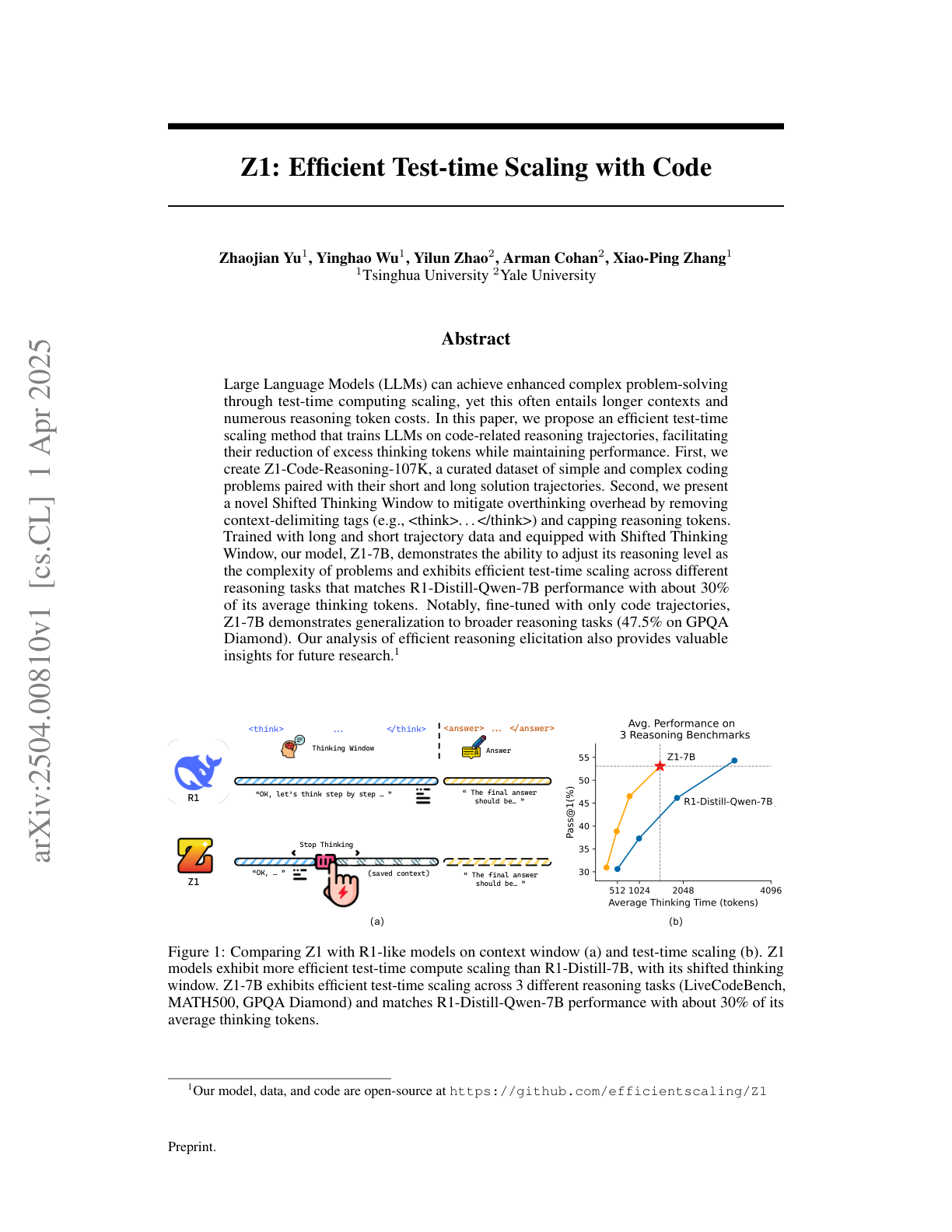
Z1 is a new method for making large language models more compute-efficient at test time, especially during reasoning. The core idea is to train LLMs with short and long code-based reasoning trajectories, and then dynamically adjust reasoning depth during inference. Key contributions: ● Z1-Code-Reasoning-107K dataset – They construct a 107K-sample dataset with short and long reasoning paths for simple and complex coding problems. Trajectories are distilled from QwQ-32B and paired to help the model learn when to stop thinking. ● Shifted Thinking Window – A new test-time strategy that eliminates explicit <think delimiters. Instead, the model adapts reasoning token budget based on problem difficulty. Simple problems invoke shallow reasoning; complex ones get capped (e.g., 4096 tokens max), with hints nudging the model to finalize the answer. ● Big efficiency gains – The 7B-scale model Z1-7B matches R1-Distill-Qwen-7B across multiple reasoning tasks (MATH500, LiveCodeBench, GPQA Diamond) but with ~30% of the reasoning tokens. For instance, on GPQA Diamond, Z1-7B achieves 47.5% while using less than half the tokens. ● Code reasoning transfers to general tasks – Despite being trained only on code-based CoT data, Z1 generalizes well to broader domains like science and math, outperforming other 7B reasoning models (e.g., OpenThinker-7B, s1.1-7B) across multiple benchmarks. ● What makes reasoning data effective? – Ablation studies reveal two key dataset design levers: (1) longer reasoning trajectories improve inference quality; (2) larger training sample sizes boost average thinking time and accuracy, even without altering trajectory length.