EvoOntology: A Self-Evolving Ontology Layer for Data Agents
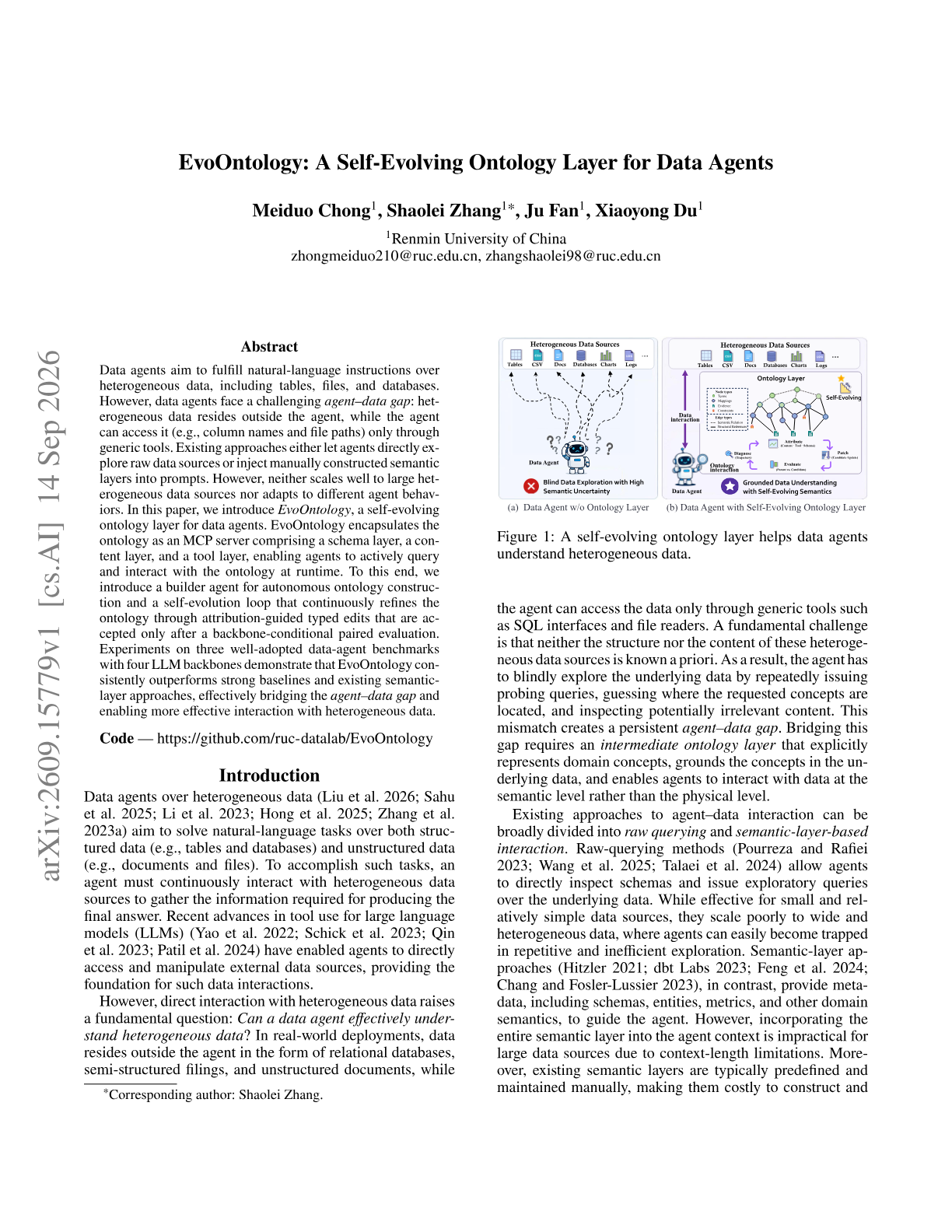
Chong, Zhang, Fan and Du (Renmin University of China) propose EvoOntology, an ontology layer served to data agents as an MCP server and refined by a self-evolution loop, to close the gap between an agent and heterogeneous tables, files and databases it can only reach through generic tools.
Ask this paper
Three layers. The MCP server exposes a schema layer, a content layer and a tool layer, so agents query the ontology at runtime instead of receiving a fixed semantic layer in the prompt.
Builder agent. A dedicated agent constructs the initial ontology from the data sources without manual curation.
Gated evolution. Refinements are typed edits proposed from failure attribution and accepted only if a paired evaluation conditioned on the backbone model shows improvement.
Evaluation. Across three data-agent benchmarks and four LLM backbones it outperforms direct raw-data exploration and existing semantic-layer approaches; code is public.
Abstract
Data agents aim to fulfill natural-language instructions over heterogeneous data, including tables, files, and databases. However, data agents face a challenging agent-data gap: heterogeneous data resides outside the agent, while the agent can access it (e.g., column names and file paths) only through generic tools. Existing approaches either let agents directly explore raw data sources or inject manually constructed semantic layers into prompts. However, neither scales well to large heterogeneous data sources nor adapts to different agent behaviors. In this paper, we introduce EvoOntology, a self-evolving ontology layer for data agents. EvoOntology encapsulates the ontology as an MCP server comprising a schema layer, a content layer, and a tool layer, enabling agents to actively query and interact with the ontology at runtime. To this end, we introduce a builder agent for autonomous ontology construction and a self-evolution loop that continuously refines the ontology through attribution-guided typed edits that are accepted only after a backbone-conditional paired evaluation. Experiments on three well-adopted data-agent benchmarks with four LLM backbones demonstrate that EvoOntology consistently outperforms strong baselines and existing semantic-layer approaches, effectively bridging the agent-data gap and enabling more effective interaction with heterogeneous data. Code: https://github.com/ruc-datalab/EvoOntology