Explore Before Committing: Hypothesis-Guided Search for Deep Research Agents
Ruochen Zhou and colleagues at CityU, Oxford, and collaborators trace deep-research failures to premature commitment, where an agent picks one direction at a branching search state before gathering comparative evidence, and propose bounded hypothesis-guided branching as the fix.
Ask this paper
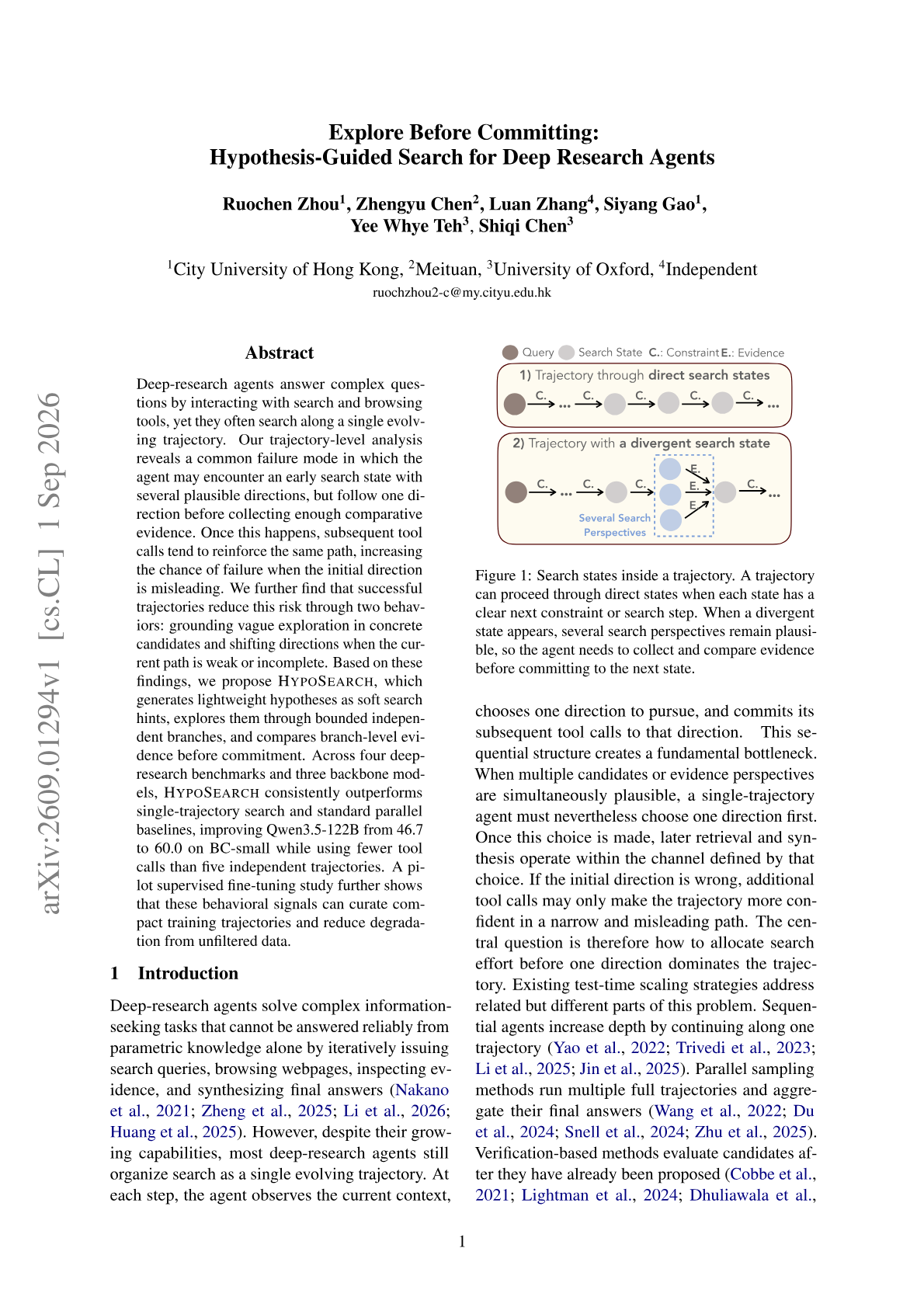
The failure mode, located at the trajectory level. An agent hits a state with several plausible directions, follows one, and subsequent tool calls reinforce it. Recovery becomes unlikely once the path is established.
What successful runs do differently. They ground vague exploration in concrete candidates and shift direction when the current path is weak or incomplete. HypoSearch operationalizes both behaviors.
Hypotheses as soft hints, not commitments. Lightweight hypotheses seed bounded independent branches, and branch-level evidence is compared before the agent commits.
Better and cheaper than parallel sampling. Across four deep-research benchmarks and three backbones, HypoSearch beats single-trajectory search and standard parallel baselines, lifting Qwen3.5-122B from 46.7 to 60.0 on BC-small while using fewer tool calls than five independent trajectories.
A training bonus. A pilot SFT study shows these behavioral signals can curate compact training trajectories and reduce the degradation that comes from unfiltered data.
Abstract
Deep-research agents answer complex questions by interacting with search and browsing tools, yet they often search along a single evolving trajectory. Our trajectory-level analysis reveals a common failure mode in which the agent may encounter an early search state with several plausible directions, but follow one direction before collecting enough comparative evidence. Once this happens, subsequent tool calls tend to reinforce the same path, increasing the chance of failure when the initial direction is misleading. We further find that successful trajectories reduce this risk through two behaviors: grounding vague exploration in concrete candidates and shifting directions when the current path is weak or incomplete. Based on these findings, we propose HypoSearch, which generates lightweight hypotheses as soft search hints, explores them through bounded independent branches, and compares branch-level evidence before commitment. Across four deep-research benchmarks and three backbone models, HypoSearch consistently outperforms single-trajectory search and standard parallel baselines, improving Qwen3.5-122B from 46.7 to 60.0 on BC-small while using fewer tool calls than five independent trajectories. A pilot supervised fine-tuning study further shows that these behavioral signals can curate compact training trajectories and reduce degradation from unfiltered data.