Failure as a Process
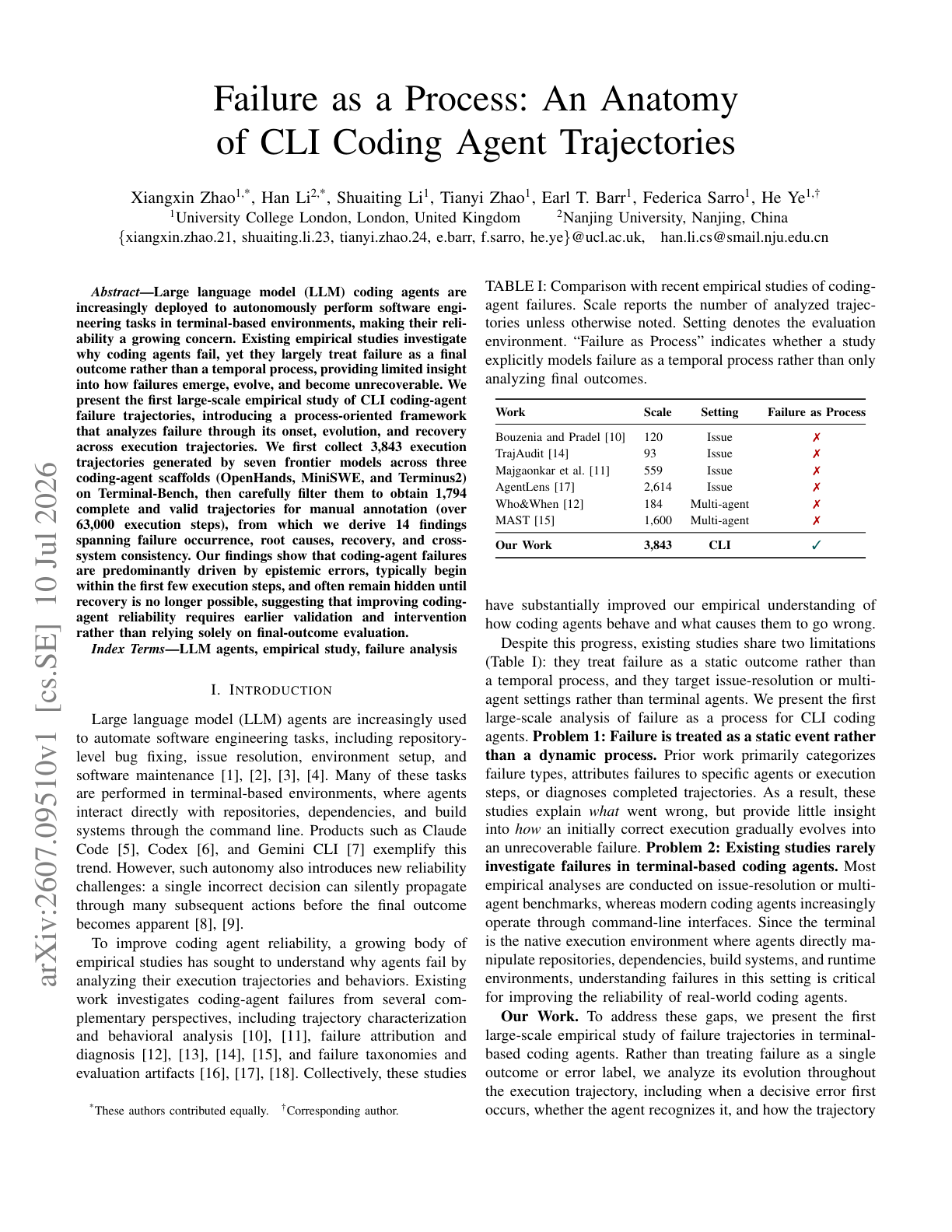
When a coding agent fails a task, the final pass or fail label hides when the run actually went wrong. This large-scale study treats failure as a timeline and annotates over 63,000 execution steps to see how coding-agent runs break down.
Ask this paper
Failure has three timestamps: Each trajectory is marked with the decisive error, the point where the error becomes irreversible, and the first observable failure, exposing a fix window and an observability lag that pass or fail labels erase.
Built on real trajectories: The team collected 3,843 runs from seven frontier models across three scaffolds on Terminal-Bench, filtered to 1,794 valid trajectories, and annotated them with high inter-rater agreement.
Mostly epistemic, mostly early: About 57.9% of failures come from misusing available information rather than a capability gap, with false premises the single largest trigger at 30.7%, and errors typically start early and stay hidden until recovery is impossible.
Why it matters: Naming the onset, lock-in, and observation points gives teams a vocabulary to intervene before an agent run is unrecoverable, instead of only noticing at the end.