Follow the Policy, Fail the Benchmark: Auditing and Revising Policy-Based Decision Benchmarks
Yanru Xiao (Amazon Web Services) and Yifei Cai (Iowa State University) audit nine public policy-based decision benchmarks and find that defects in references, programs and scorers change scores even when the model responses stay the same.
Ask this paper
Audit method. Source tracing, program execution and controlled checks find unsupported targets, reference errors that survive replay or are passed into later tasks as solved steps, and evaluators that reject acceptable answers or accept incomplete decisions.
LegalBench SARA. Correcting only the scorer on the 96 numeric cases raises acceptance by more than 80 percentage points for each of three models, with references and responses unchanged.
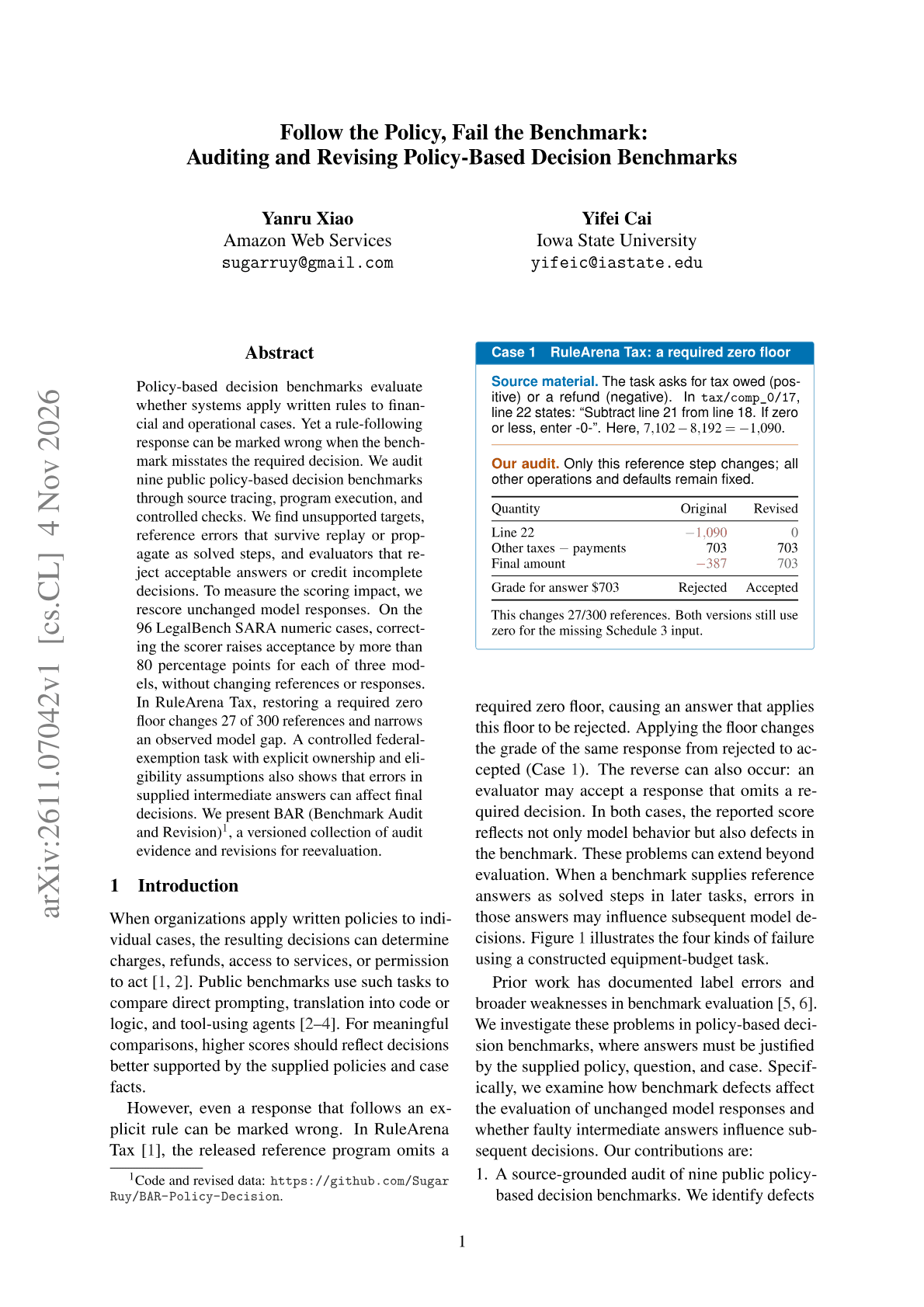
RuleArena Tax. The released reference program omits a required zero floor on one tax-form line. Restoring it changes 27 of 300 references and narrows an observed gap between models.
Propagated errors. In a controlled federal-exemption task, faulty intermediate answers supplied to the model change its later decisions, and revising them affects models differently.
BAR. A versioned collection of audit evidence and scoped revisions separates fixes that allow rescoring of existing responses from changes that need new predictions.
Abstract
Policy-based decision benchmarks evaluate whether systems apply written rules to financial and operational cases. Yet a rule-following response can be marked wrong when the benchmark misstates the required decision. We audit nine public policy-based decision benchmarks through source tracing, program execution, and controlled checks. We find unsupported targets, reference errors that survive replay or propagate as solved steps, and evaluators that reject acceptable answers or credit incomplete decisions. To measure the scoring impact, we rescore unchanged model responses. On the 96 LegalBench SARA numeric cases, correcting the scorer raises acceptance by more than 80 percentage points for each of three models, without changing references or responses. In RuleArena Tax, restoring a required zero floor changes 27 of 300 references and narrows an observed model gap. A controlled federal-exemption task with explicit ownership and eligibility assumptions also shows that errors in supplied intermediate answers can affect final decisions. We present BAR (Benchmark Audit and Revision), a versioned collection of audit evidence and revisions for reevaluation.