Forgetting Without Restarting: Execution-State Unlearning for Stateful LLM Agents
Chao Yao and colleagues formalize what deleting a memory record fails to do for a long-running agent, and prove how much recomputation exact forgetting requires.
Ask this paper
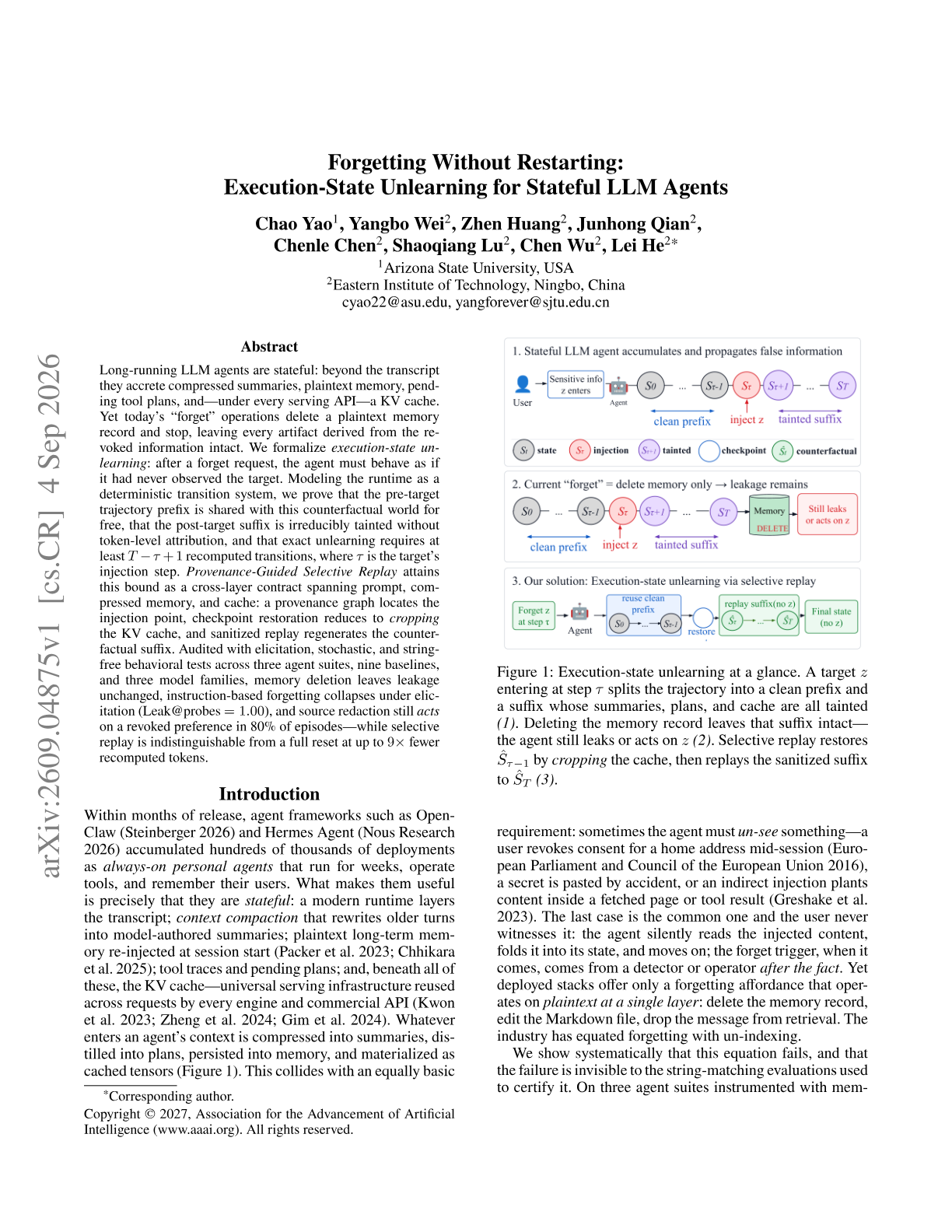
What today's forget leaves behind. Beyond the transcript an agent accretes compressed summaries, plaintext memory, pending tool plans, and a KV cache. Deleting the plaintext record leaves every derived artifact intact.
The formal result. Modeling the runtime as a deterministic transition system, the pre-target trajectory prefix is shared with the counterfactual world for free, the post-target suffix is irreducibly tainted without token-level attribution, and exact unlearning requires at least T-tau+1 recomputed transitions where tau is the injection step.
Provenance-Guided Selective Replay. Attains that bound as a contract across prompt, compressed memory, and cache: a provenance graph locates the injection point, checkpoint restoration reduces to cropping the KV cache, and sanitized replay regenerates the suffix.
Baselines measured under audit. Across three agent suites, nine baselines, and three model families, memory deletion leaves leakage unchanged, instruction-based forgetting collapses under elicitation (Leak@probes = 1.00), and source redaction still acts on a revoked preference in 80% of episodes.
The result. Selective replay is behaviorally indistinguishable from a full reset at up to 9x fewer recomputed tokens.
Abstract
Long-running LLM agents are stateful: beyond the transcript they accrete compressed summaries, plaintext memory, pending tool plans, and, under every serving API, a KV cache. Yet today's "forget" operations delete a plaintext memory record and stop, leaving every artifact derived from the revoked information intact. We formalize execution-state unlearning: after a forget request, the agent must behave as if it had never observed the target. Modeling the runtime as a deterministic transition system, we prove that the pre-target trajectory prefix is shared with this counterfactual world for free, that the post-target suffix is irreducibly tainted without token-level attribution, and that exact unlearning requires at least $T-τ+1$ recomputed transitions, where $τ$ is the target's injection step. Provenance-Guided Selective Replay attains this bound as a cross-layer contract spanning prompt, compressed memory, and cache: a provenance graph locates the injection point, checkpoint restoration reduces to cropping the KV cache, and sanitized replay regenerates the counterfactual suffix. Audited with elicitation, stochastic, and string-free behavioral tests across three agent suites, nine baselines, and three model families, memory deletion leaves leakage unchanged, instruction-based forgetting collapses under elicitation (Leak@probes = 1.00), and source redaction still acts on a revoked preference in 80% of episodes, while selective replay is indistinguishable from a full reset at up to 9x fewer recomputed tokens.