Geometric Memory in Sequence Models
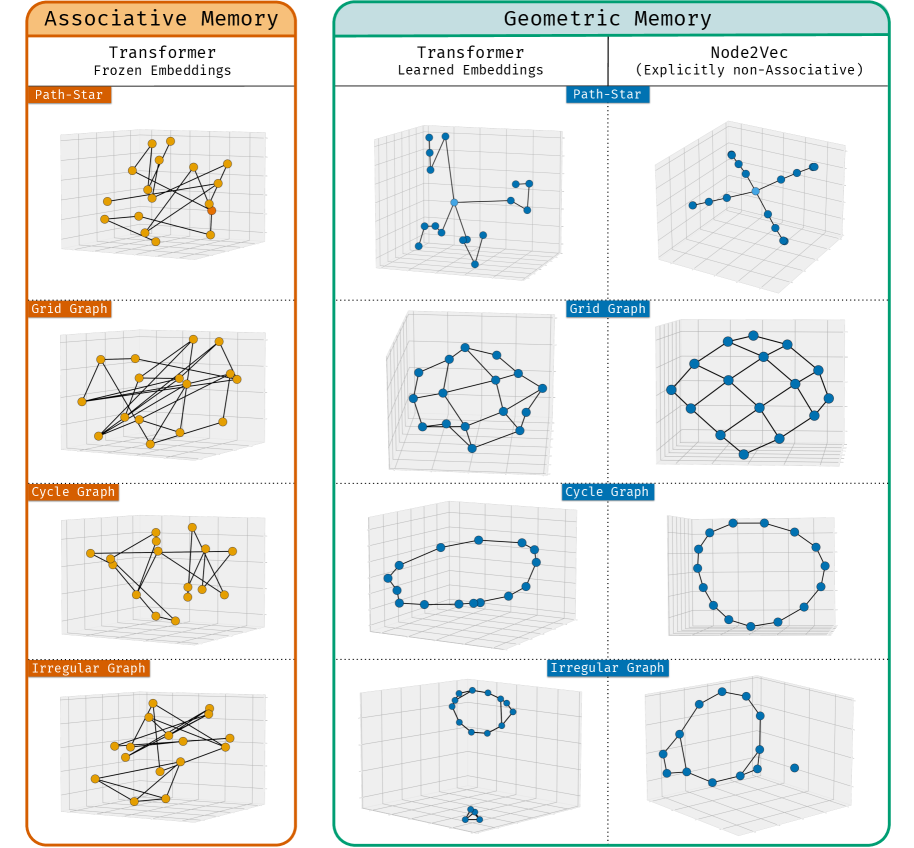
This paper identifies a dramatically different form of how deep sequence models store factual information called geometric memory, contrasting with the traditional associative memory view. Models synthesize embeddings encoding global relationships between all entities, even ones that never co-occur in training. - **Two memory paradigms:** Associative memory uses brute-force lookup of co-occurring entities with arbitrary embeddings. Geometric memory instead encodes global structure in carefully arranged embeddings where dot products capture multi-hop distances between entities. - **Powerful reasoning transformation:** Geometric memory transforms hard reasoning tasks involving multi-step composition into easy-to-learn 1-step navigation tasks. Models succeed at path-finding on massive graphs when memorizing edges in weights, despite being designed to fail. - **Unexplained emergence:** The geometry is learned even when it is more complex than brute-force lookup, without global supervision, rank constraints, or obvious architectural pressures. This creates a fundamental memorization puzzle. - **Spectral bias explanation:** By analyzing connections to Node2Vec, the researchers demonstrate that geometry stems from spectral bias arising naturally from cross-entropy loss minimization. Node2Vec models show more strongly geometric embeddings than Transformers, pointing to headroom for improvement.
Ask this paper
Two memory paradigms: Associative memory uses brute-force lookup of co-occurring entities with arbitrary embeddings. Geometric memory instead encodes global structure in carefully arranged embeddings where dot products capture multi-hop distances between entities.
Powerful reasoning transformation: Geometric memory transforms hard reasoning tasks involving multi-step composition into easy-to-learn 1-step navigation tasks. Models succeed at path-finding on massive graphs when memorizing edges in weights, despite being designed to fail.
Unexplained emergence: The geometry is learned even when it is more complex than brute-force lookup, without global supervision, rank constraints, or obvious architectural pressures. This creates a fundamental memorization puzzle.
Spectral bias explanation: By analyzing connections to Node2Vec, the researchers demonstrate that geometry stems from spectral bias arising naturally from cross-entropy loss minimization. Node2Vec models show more strongly geometric embeddings than Transformers, pointing to headroom for improvement.
Abstract
Deep sequence models are said to store atomic facts predominantly in the form of associative memory: a brute-force lookup of co-occurring entities. We identify a dramatically different form of storage of atomic facts that we term as geometric memory. Here, the model has synthesized embeddings encoding novel global relationships between all entities, including ones that do not co-occur in training. Such storage is powerful: for instance, we show how it transforms a hard reasoning task involving an $\ell$-fold composition into an easy-to-learn $1$-step navigation task. From this phenomenon, we extract fundamental aspects of neural embedding geometries that are hard to explain. We argue that the rise of such a geometry, as against a lookup of local associations, cannot be straightforwardly attributed to typical supervisory, architectural, or optimizational pressures. Counterintuitively, a geometry is learned even when it is more complex than the brute-force lookup. Then, by analyzing a connection to Node2Vec, we demonstrate how the geometry stems from a spectral bias that -- in contrast to prevailing theories -- indeed arises naturally despite the lack of various pressures. This analysis also points out to practitioners a visible headroom to make Transformer memory more strongly geometric. We hope the geometric view of parametric memory encourages revisiting the default intuitions that guide researchers in areas like knowledge acquisition, capacity, discovery, and unlearning.