Graph-R1
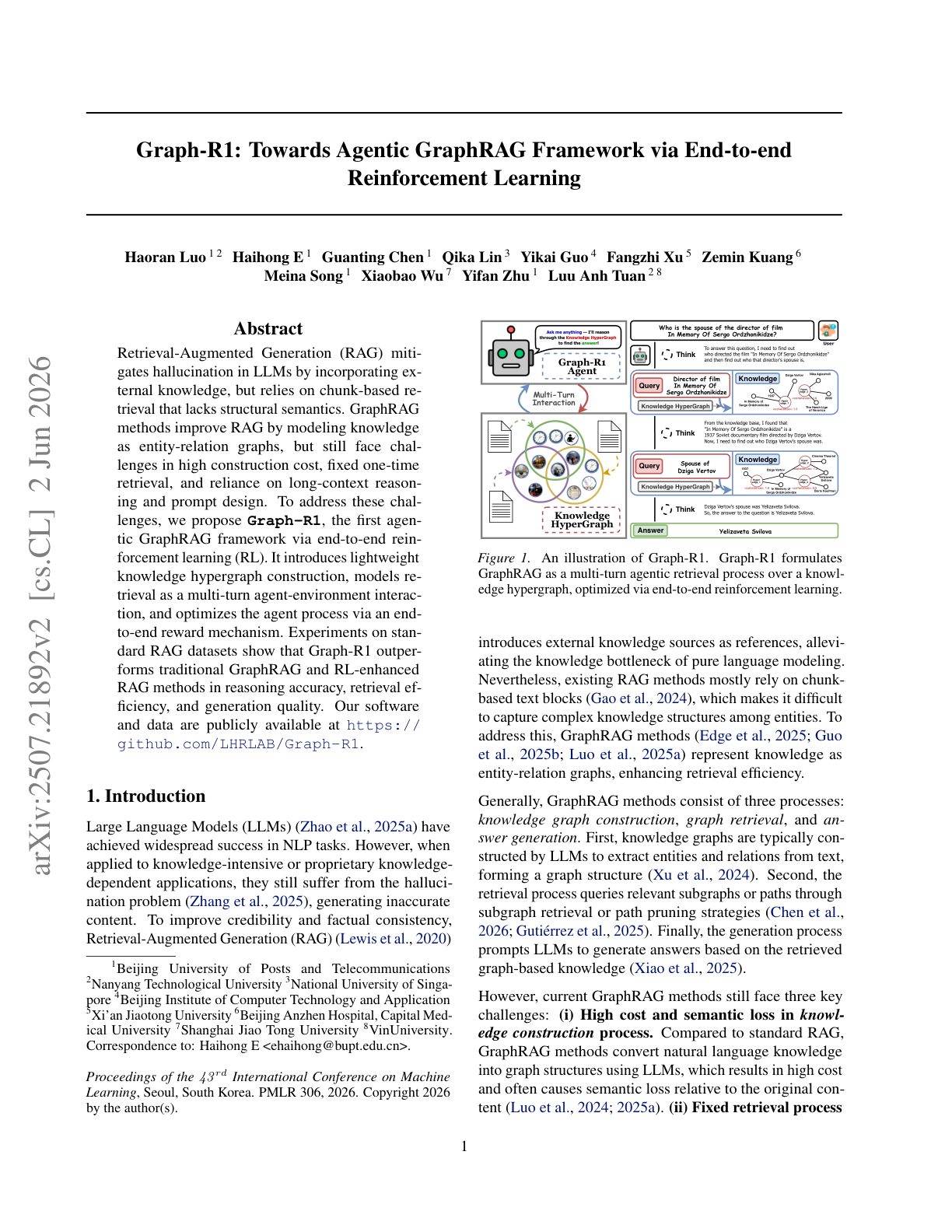
Introduces a novel RAG framework that moves beyond traditional one-shot or chunk-based retrieval by integrating graph-structured knowledge, agentic multi-turn interaction, and RL. The core goal is to improve factual accuracy, retrieval efficiency, and reasoning quality in knowledge-intensive tasks.
Ask this paper
The authors design Graph-R1, an agent that reasons over a knowledge hypergraph environment by iteratively issuing queries and retrieving subgraphs using a multi-step “think-retrieve-rethink-generate” loop. Unlike prior GraphRAG systems that perform fixed retrieval, Graph-R1 dynamically explores the graph based on evolving agent state.
Retrieval is modeled as a dual-path mechanism: entity-based hyperedge retrieval and direct hyperedge similarity, fused via reciprocal rank aggregation to return semantically rich subgraphs. These are used to ground subsequent reasoning steps.
The agent is trained end-to-end using Group Relative Policy Optimization (GRPO) with a composite reward that incorporates structural format adherence and answer correctness. Notably, rewards are only granted if reasoning follows the proper format, encouraging interpretable and complete reasoning traces.
On six RAG benchmarks (e.g., HotpotQA, 2WikiMultiHopQA), Graph-R1 achieves state-of-the-art F1 and generation scores, outperforming prior methods including HyperGraphRAG, R1-Searcher, and Search-R1. It shows particularly strong gains on harder, multi-hop datasets and under OOD conditions.
Ablation studies confirm that Graph-R1’s performance degrades sharply without its three key components: hypergraph construction, multi-turn interaction, and RL. Theoretical analyses support that graph-based and multi-turn retrieval improve information density and accuracy, while end-to-end RL bridges the gap between structure and language.