Gym-Anything for Robotics: Scaling physical simulations with digital agents
Pranjal Aggarwal and Sean Welleck (Carnegie Mellon University) introduce Gym-Anything for Robotics, a framework in which coding agents create robotics simulations, and use it to build RoboWorld, a benchmark of 25 simulations and 200 RL environments.
Ask this paper
Pipeline. Simulations are selected from U.S. GDP data, and an adversarial creation-audit loop checks each simulation and task against written definitions of quality.
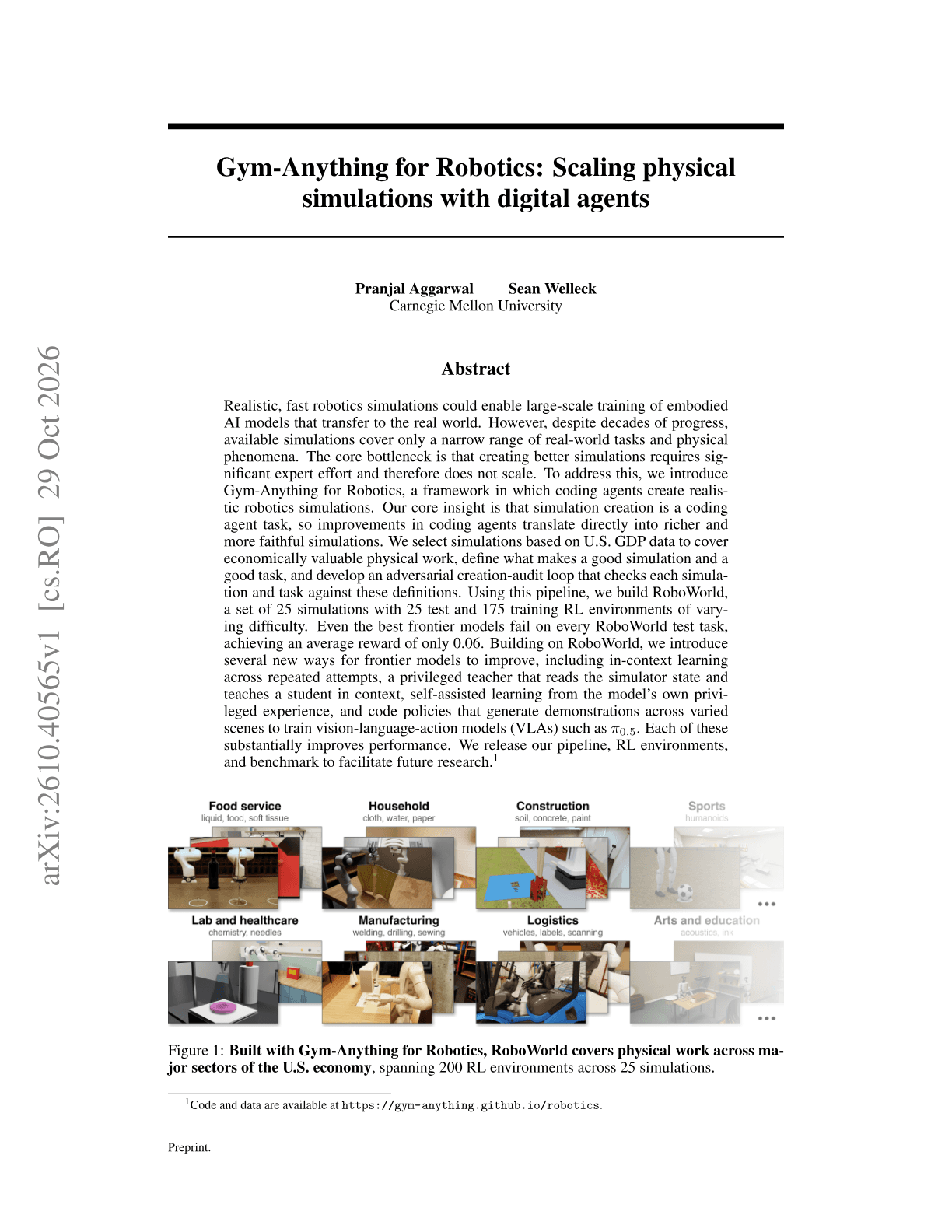
Benchmark. RoboWorld has 25 test and 175 training environments, with liquids, cloth and physics that existing engines lack.
Frontier result. Frontier models fail every test task with an average reward of 0.06. On an easier set of 25 training tasks, Claude Opus 5.5 reaches 32%, GPT-6 Astra 24% and GPT-6.1 Terra 12%.
Ways to improve. Privileged simulator state more than doubles first-attempt reward, and it can teach a student through hints alone.
Code policies. Demonstrations from model-written code policies raise a small vision-language-action policy from 0% to 53% success, with 55% on unseen variations.
Abstract
Realistic, fast robotics simulations could enable large-scale training of embodied AI models that transfer to the real world. However, despite decades of progress, available simulations cover only a narrow range of real-world tasks and physical phenomena. The core bottleneck is that creating better simulations requires significant expert effort and therefore does not scale. To address this, we introduce Gym-Anything for Robotics, a framework in which coding agents create realistic robotics simulations. Our core insight is that simulation creation is a coding agent task, so improvements in coding agents translate directly into richer and more faithful simulations. We select simulations based on U.S. GDP data to cover economically valuable physical work, define what makes a good simulation and a good task, and develop an adversarial creation-audit loop that checks each simulation and task against these definitions. Using this pipeline, we build RoboWorld, a set of 25 simulations with 25 test and 175 training RL environments of varying difficulty. Even the best frontier models fail on every RoboWorld test task, achieving an average reward of only 0.06. Building on RoboWorld, we introduce several new ways for frontier models to improve, including in-context learning across repeated attempts, a privileged teacher that reads the simulator state and teaches a student in context, self-assisted learning from the model's own privileged experience, and code policies that generate demonstrations across varied scenes to train vision-language-action models (VLAs) such as $π_{0.5}$. Each of these substantially improves performance. We release our pipeline, RL environments, and benchmark to facilitate future research. Code and data are available at https://gym-anything.github.io/robotics