Harness as a Language: A Minimalist Agent Framework With Maximal Expressivity
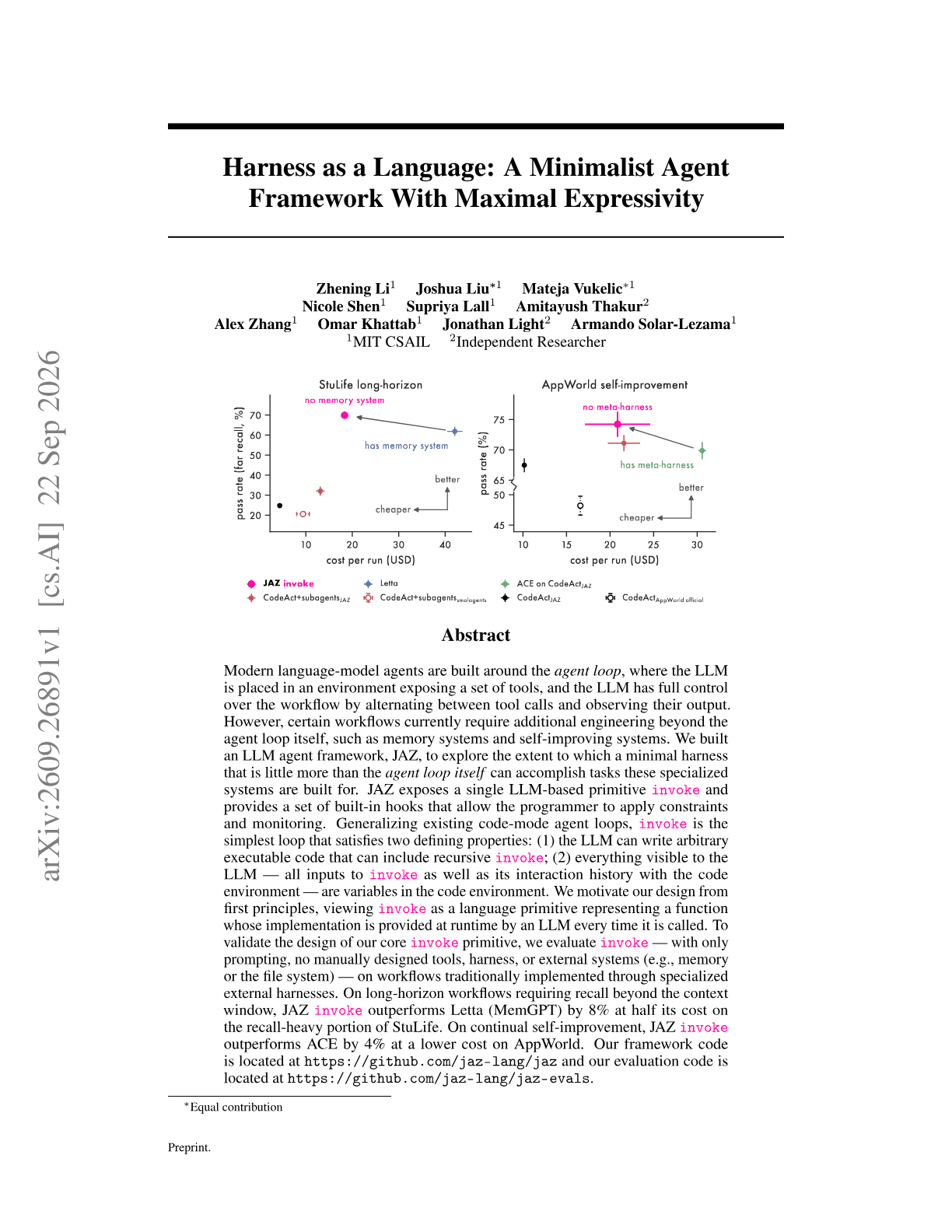
Zhening Li, Omar Khattab, Armando Solar-Lezama and colleagues at MIT CSAIL build JAZ, an agent framework whose only primitive is an LLM-backed `invoke` function, and test whether it can replace dedicated memory and self-improvement systems.
Ask this paper
One primitive: JAZ exposes a single LLM-based primitive, invoke, which acts as a function whose implementation the LLM writes at runtime each time it is called. Built-in hooks let the programmer apply constraints and monitor the run.
Everything is a variable: The LLM can write arbitrary executable code, including recursive calls to invoke, so subagents are the default. All inputs to invoke and the full interaction history live as variables in the code environment, where the model can read and transform them with code.
Beats specialized systems: With prompting only and no manually designed tools, memory system, or file system, JAZ outperforms Letta (MemGPT) by 8% at half its cost on the recall-heavy portion of StuLife, a long-horizon benchmark that requires recall far beyond the context window. On AppWorld it beats ACE, a continual self-improvement method, by 4% at lower cost.
Why it matters: Memory and self-improvement become code the agent writes inside its own loop. If you build custom harnesses, this is evidence that a smaller surface can match heavier infrastructure on these workloads.
Abstract
Modern language-model agents are built around the \textit{agent loop}, where the LLM is placed in an environment exposing a set of tools, and the LLM has full control over the workflow by alternating between tool calls and observing their output. However, certain workflows currently require additional engineering beyond the agent loop itself, such as memory systems and self-improving systems. We built an LLM agent framework, JAZ, to explore the extent to which a minimal harness that is little more than the agent loop itself can accomplish tasks these specialized systems are built for. JAZ exposes a single LLM-based primitive invoke and provides a set of built-in hooks that allow the programmer to apply constraints and monitoring. Generalizing existing code-mode agent loops, \texttt{invoke} is the simplest loop that satisfies two defining properties: (1) the LLM can write arbitrary executable code that can include recursive \texttt{invoke}; (2) everything visible to the LLM --- all inputs to \texttt{invoke} as well as its interaction history with the code environment --- are variables in the code environment. We motivate our design from first principles, viewing \texttt{invoke} as a language primitive representing a function whose implementation is provided at runtime by an LLM every time it is called. To validate the design of our core \texttt{invoke} primitive, we evaluate \texttt{invoke} --- with only prompting, no manually designed tools, harness, or external systems (e.g., memory or the file system) --- on workflows traditionally implemented through specialized external harnesses. On long-horizon workflows requiring recall beyond the context window, JAZ invoke outperforms Letta (MemGPT) by 8\% at half its cost on the recall-heavy portion of StuLife. On continual self-improvement, JAZ invoke outperforms ACE by 4\% at a lower cost on AppWorld.