HyperDreamBooth
A smaller, faster, and more efficient version of DreamBooth for personalizing text-to-image models.
Ask this paper
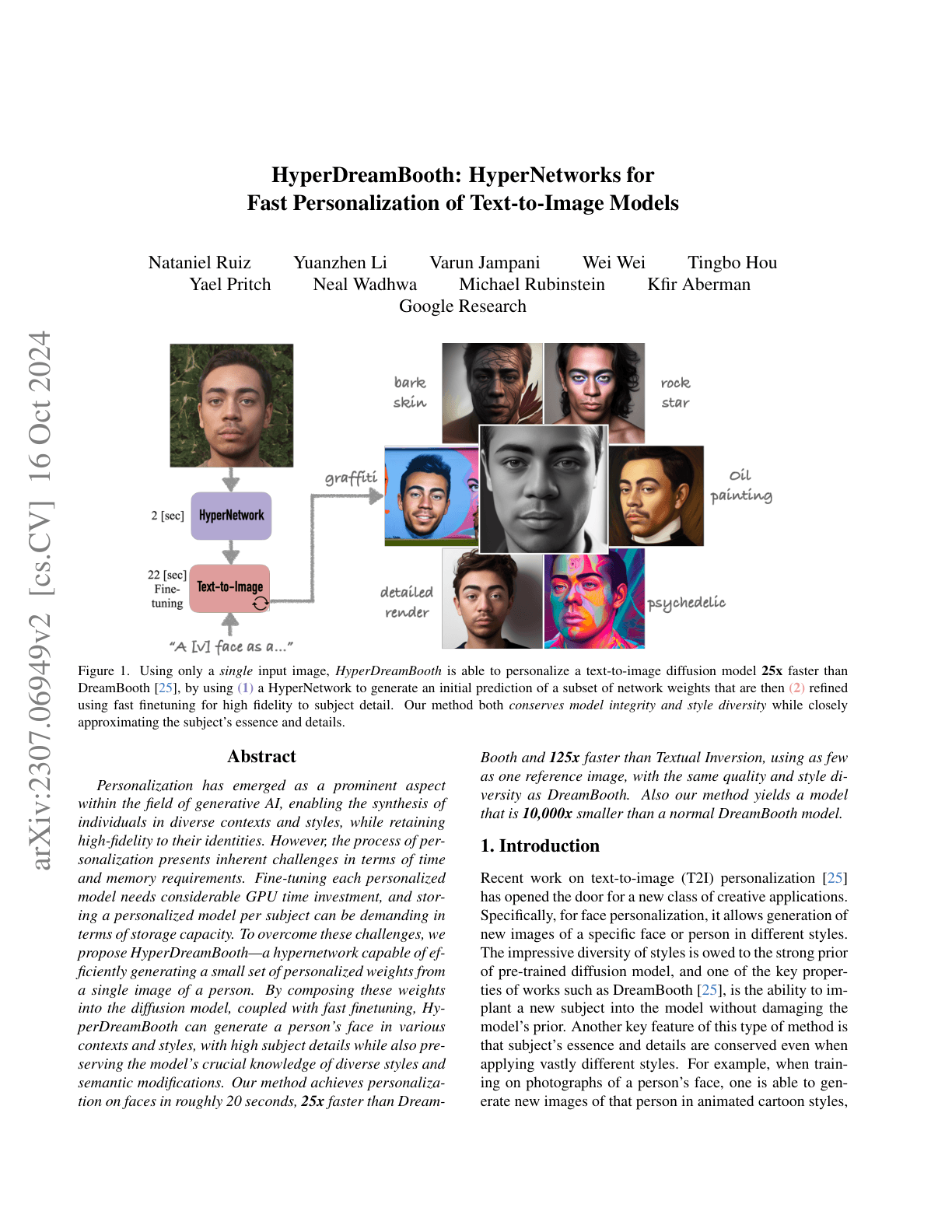
HyperNetwork design: Uses a HyperNetwork to predict LoRA weights from a single input image, bypassing per-subject optimization.
25x speedup: Achieves ~25x faster personalization than DreamBooth while maintaining visual fidelity to the subject.
Single-image input: Requires only one input image of the subject - a major UX improvement over prior methods needing 3-5 images.
On-device personalization: Compact adapter footprint makes HyperDreamBooth-style techniques attractive for on-device personalization in consumer apps.
Abstract
Personalization has emerged as a prominent aspect within the field of generative AI, enabling the synthesis of individuals in diverse contexts and styles, while retaining high-fidelity to their identities. However, the process of personalization presents inherent challenges in terms of time and memory requirements. Fine-tuning each personalized model needs considerable GPU time investment, and storing a personalized model per subject can be demanding in terms of storage capacity. To overcome these challenges, we propose HyperDreamBooth - a hypernetwork capable of efficiently generating a small set of personalized weights from a single image of a person. By composing these weights into the diffusion model, coupled with fast finetuning, HyperDreamBooth can generate a person's face in various contexts and styles, with high subject details while also preserving the model's crucial knowledge of diverse styles and semantic modifications. Our method achieves personalization on faces in roughly 20 seconds, 25x faster than DreamBooth and 125x faster than Textual Inversion, using as few as one reference image, with the same quality and style diversity as DreamBooth. Also our method yields a model that is 10,000x smaller than a normal DreamBooth model. Project page: https://hyperdreambooth.github.io