ImageBind
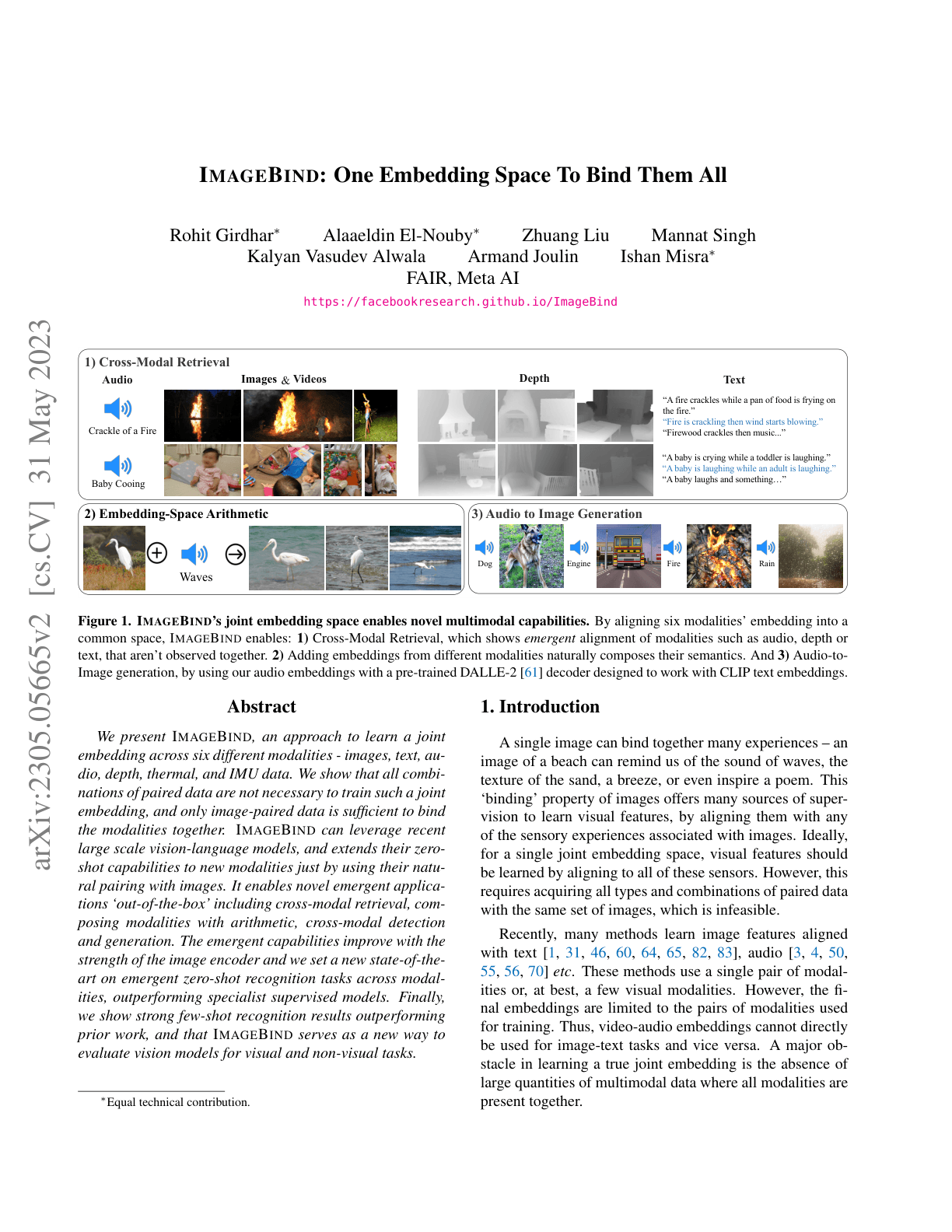
Meta's joint embedding across six modalities at once.
Ask this paper
Six-modality embedding: Learns a joint embedding space across images, text, audio, depth, thermal, and IMU data.
Implicit binding via images: Images are the "central" modality that binds others - without requiring all-pairs training data.
Zero-shot emergent capabilities: Enables cross-modal retrieval, arithmetic composition of modalities, and cross-modal generation/detection.
Multi-modal foundation: Influenced 2024's unified multimodal models (Chameleon, GPT-4o) by showing the viability of unified embedding spaces.
Abstract
We present ImageBind, an approach to learn a joint embedding across six different modalities - images, text, audio, depth, thermal, and IMU data. We show that all combinations of paired data are not necessary to train such a joint embedding, and only image-paired data is sufficient to bind the modalities together. ImageBind can leverage recent large scale vision-language models, and extends their zero-shot capabilities to new modalities just by using their natural pairing with images. It enables novel emergent applications 'out-of-the-box' including cross-modal retrieval, composing modalities with arithmetic, cross-modal detection and generation. The emergent capabilities improve with the strength of the image encoder and we set a new state-of-the-art on emergent zero-shot recognition tasks across modalities, outperforming specialist supervised models. Finally, we show strong few-shot recognition results outperforming prior work, and that ImageBind serves as a new way to evaluate vision models for visual and non-visual tasks.