Improved RAG with Self-Reasoning
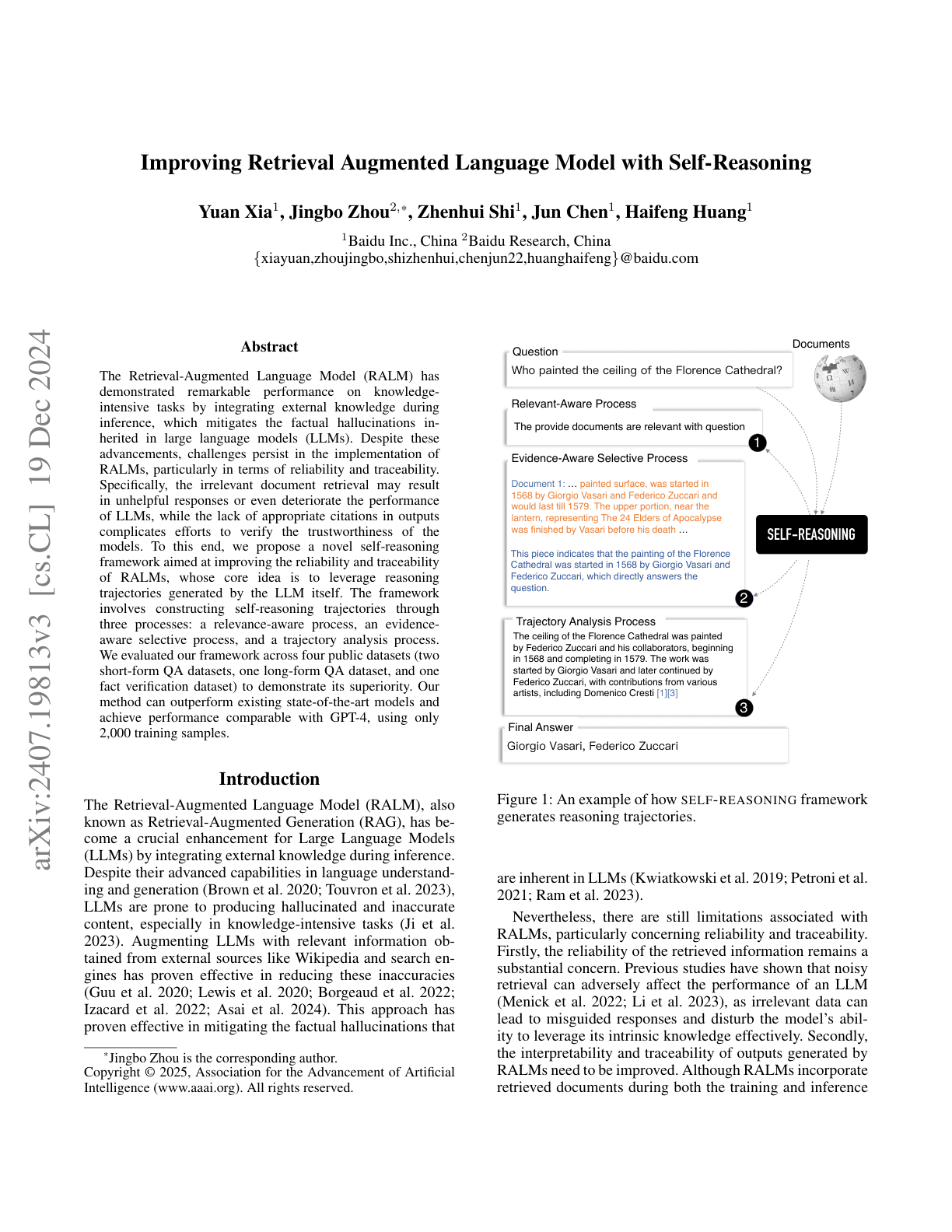
presents an end-to-end self-reasoning framework to improve the reliability and traceability of RAG systems; leverages the reasoning trajectories generated by the LLM itself; the LLM is used to carry out the following 3 processes: 1) relevance-aware: judges the relevance between the retrieved documents and the question, 2) evidence-aware selective: chooses and cites relevant documents, and then automatically selects snippets of key sentences as evidence from the cited documents, and 3) trajectory analysis: generates a concise analysis based on all gathered self-reasoning trajectories generated by the previous 2 processes and then provides the final inferred answer; this method helps the model to be more selective, reason and distinguish relevant and irrelevant documents, therefore improving the accuracy of the overall RAG system; the framework achieves comparable performance to GPT-4 with only 2K training samples (generated by GPT-4).
Ask this paper
Abstract
The Retrieval-Augmented Language Model (RALM) has shown remarkable performance on knowledge-intensive tasks by incorporating external knowledge during inference, which mitigates the factual hallucinations inherited in large language models (LLMs). Despite these advancements, challenges persist in the implementation of RALMs, particularly concerning their reliability and traceability. To be specific, the irrelevant document retrieval may result in unhelpful response generation or even deteriorate the performance of LLMs, while the lack of proper citations in generated outputs complicates efforts to verify the trustworthiness of the models. To this end, we propose a novel self-reasoning framework aimed at improving the reliability and traceability of RALMs, whose core idea is to leverage reasoning trajectories generated by the LLM itself. The framework involves constructing self-reason trajectories with three processes: a relevance-aware process, an evidence-aware selective process, and a trajectory analysis process. We have evaluated our framework across four public datasets (two short-form QA datasets, one long-form QA dataset, and one fact verification dataset) to demonstrate the superiority of our method, which can outperform existing state-of-the-art models and can achieve comparable performance with GPT-4, while only using 2,000 training samples.