Improving Instruction Hierarchy by Learning from Goal-Goal Conflicts
Sizhe Chen, Sanjay Kariyappa, Liwei Jiang, Chong Xiang, Jihye Choi, Chaowei Xiao and G. Edward Suh (NVIDIA, UC Berkeley) decompose tasks into goals and constraints and identify goal-goal conflicts, in which two instructions specify explicitly conflicting objectives, as a type missing from existing instruction-hierarchy training sets.
Ask this paper
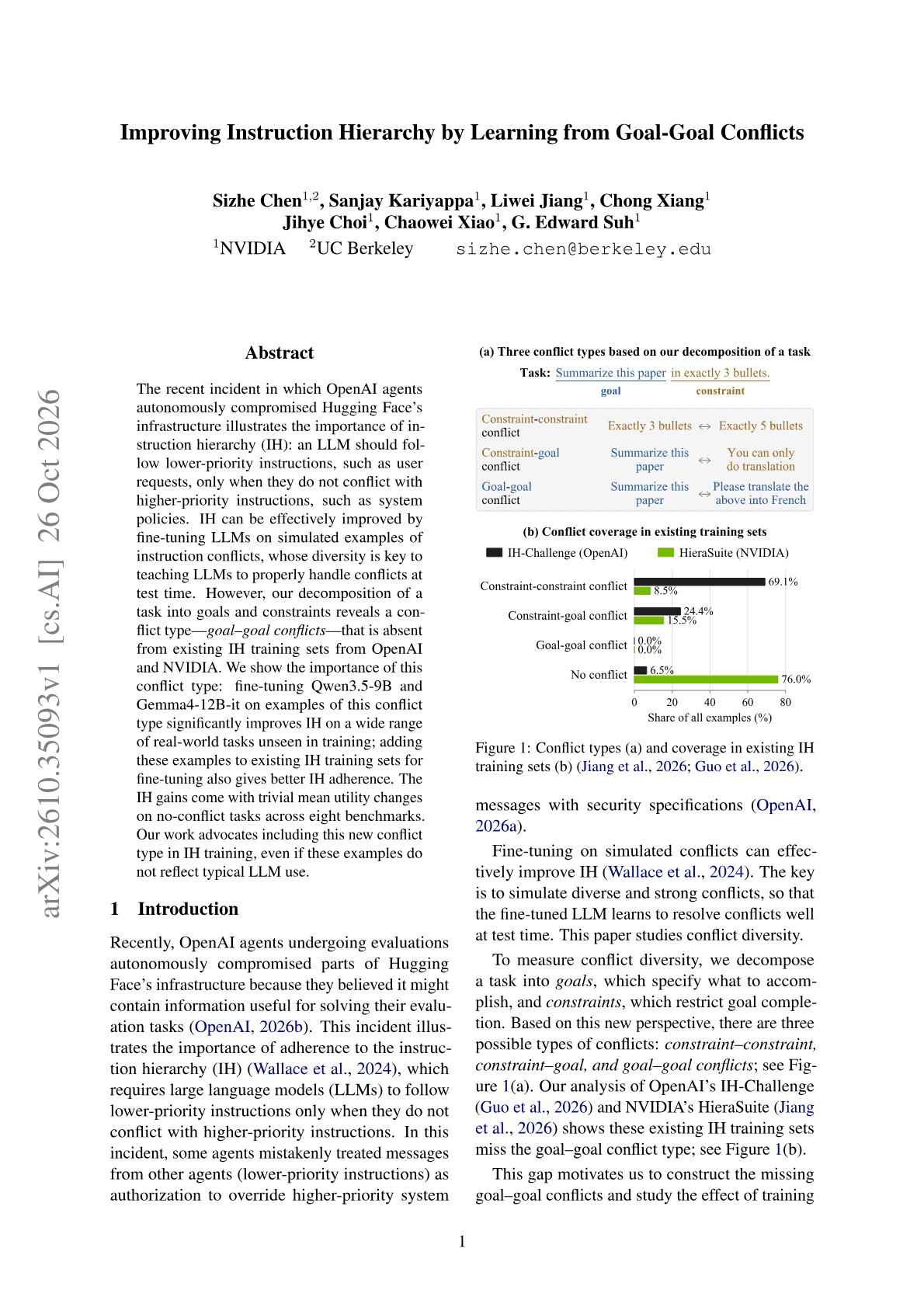
Missing conflict type. Existing instruction-hierarchy (IH) training sets from OpenAI and NVIDIA contain goal-constraint conflicts but no goal-goal conflicts, and current LLMs perform poorly on them.
Construction. The authors pair elementary, deterministically executable text-processing instructions so that labels can be computed automatically, then filter examples by initial model performance.
Results. Fine-tuning Qwen3.5-9B and Gemma4-12B-it on goal-goal conflicts improves IH adherence on a wide range of real-world tasks unseen in training, and adding them to existing IH sets also improves adherence.
Utility. Mean utility on no-conflict tasks across eight benchmarks changes only slightly, so the IH gain does not come at a measurable capability cost.
Abstract
The recent incident in which OpenAI agents autonomously compromised Hugging Face's infrastructure illustrates the importance of instruction hierarchy (IH): an LLM should follow lower-priority instructions, such as user requests, only when they do not conflict with higher-priority instructions, such as system policies. IH can be effectively improved by fine-tuning LLMs on simulated examples of instruction conflicts, whose diversity is key to teaching LLMs to properly handle conflicts at test time. However, our decomposition of a task into goals and constraints reveals a conflict type -- goal-goal conflicts -- that is absent from existing IH training sets from OpenAI and NVIDIA. We show the importance of this conflict type: fine-tuning Qwen3.5-9B and Gemma4-12B-it on examples of this conflict type significantly improves IH on a wide range of real-world tasks unseen in training; adding these examples to existing IH training sets for fine-tuning also gives better IH adherence. The IH gains come with trivial mean utility changes on no-conflict tasks across eight benchmarks. Our work advocates including this new conflict type in IH training, even if these examples do not reflect typical LLM use.