Inner Thinking Transformers
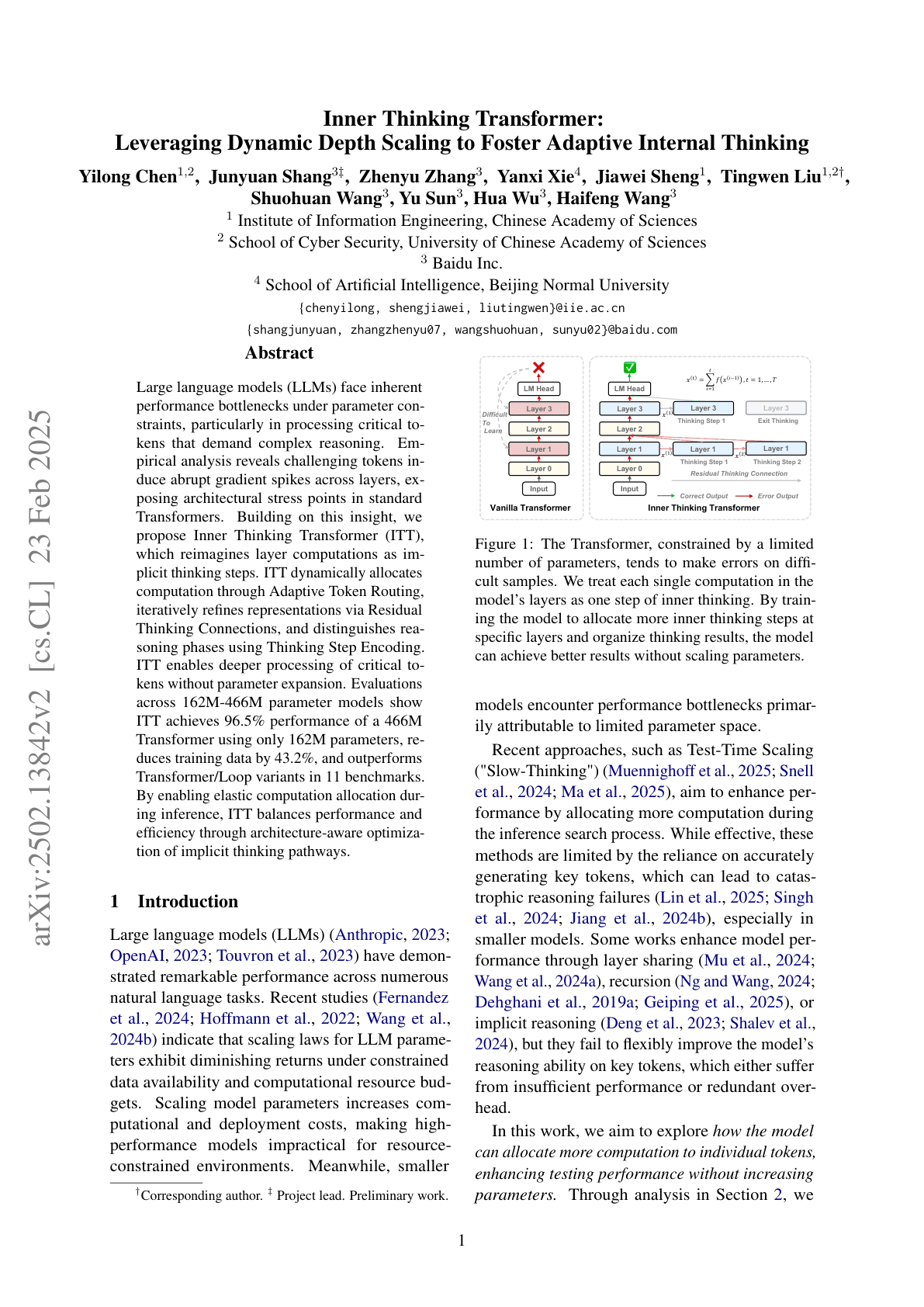
Inner Thinking Transformer (ITT) is a new method that enhances reasoning efficiency in small-scale LLMs via dynamic depth scaling. ITT aims to mitigate parameter bottlenecks in LLMs, providing scalable reasoning efficiency without expanding model size. Key contributions:
Ask this paper
Adaptive Token Processing – ITT dynamically allocates extra computation to complex tokens using Adaptive Token Routing. This allows the model to focus on difficult reasoning steps while efficiently handling simple tokens.
Residual Thinking Connections (RTC) – A new residual accumulation mechanism iteratively refines token representations, allowing the model to self-correct without increasing parameters.
Test-Time Scaling without Extra Parameters – ITT achieves 96.5% of a 466M Transformer’s accuracy using only 162M parameters, reducing training data needs by 43.2% while outperforming loop-based alternatives in 11 benchmarks.
Elastic Deep Thinking – ITT allows flexible scaling of computation at inference time, optimizing between accuracy and efficiency dynamically.
Abstract
Large language models (LLMs) face inherent performance bottlenecks under parameter constraints, particularly in processing critical tokens that demand complex reasoning. Empirical analysis reveals challenging tokens induce abrupt gradient spikes across layers, exposing architectural stress points in standard Transformers. Building on this insight, we propose Inner Thinking Transformer (ITT), which reimagines layer computations as implicit thinking steps. ITT dynamically allocates computation through Adaptive Token Routing, iteratively refines representations via Residual Thinking Connections, and distinguishes reasoning phases using Thinking Step Encoding. ITT enables deeper processing of critical tokens without parameter expansion. Evaluations across 162M-466M parameter models show ITT achieves 96.5\% performance of a 466M Transformer using only 162M parameters, reduces training data by 43.2\%, and outperforms Transformer/Loop variants in 11 benchmarks. By enabling elastic computation allocation during inference, ITT balances performance and efficiency through architecture-aware optimization of implicit thinking pathways.