Is Complex Agentic Memory Always Needed? Naive RAG Is Stronger Than We Thought
Zhengye Bao, Muning Wen, Minnan Luo and colleagues (Xi'an Jiaotong University, Shanghai Jiao Tong University) show that Raw-RAG, dense retrieval plus reranking over raw conversation history, matches or beats complex agentic memory systems on four long-term memory benchmarks.
Ask this paper
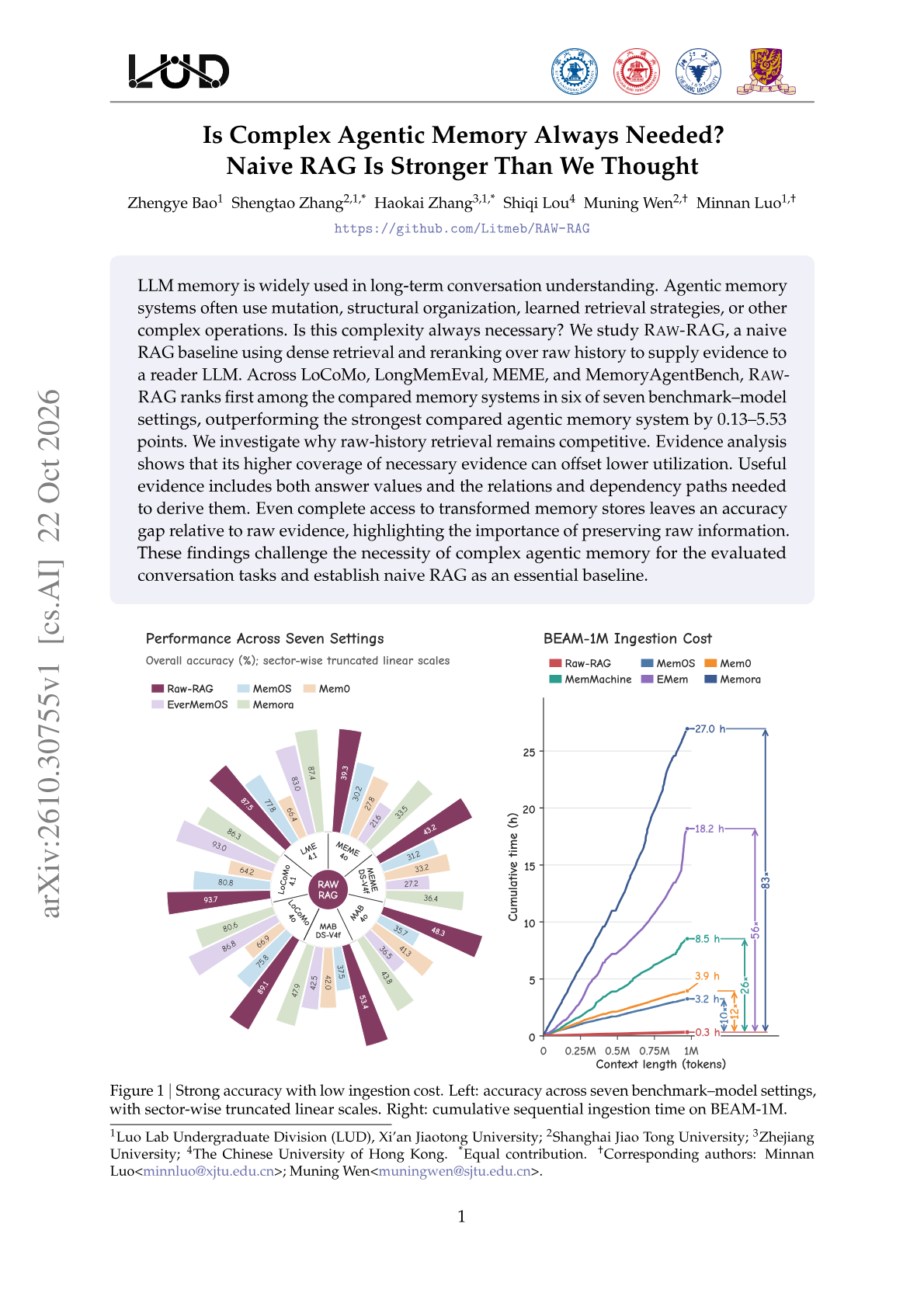
Result. Across LoCoMo, LongMemEval, MEME and MemoryAgentBench, Raw-RAG ranks first in six of seven benchmark-model settings, ahead of the strongest agentic memory system by 0.13 to 5.53 points.
Cost. On BEAM-1M ingestion, Raw-RAG takes 0.3 hours against 3.2 to 27.0 hours for MemMachine, MemOS, EMem, Mem0 and Memora, roughly 10x to 83x cheaper.
Why it works. Raw history covers more of the evidence a question needs, which offsets lower utilization. Needed evidence includes the relations and dependency paths behind an answer, which transformation into memory entries tends to drop.
Oracle test. Even full access to transformed memory stores leaves an accuracy gap against raw evidence, so preserving raw information matters more than the structure built on top of it.
Abstract
LLM memory is widely used in long-term conversation understanding. Agentic memory systems often use mutation, structural organization, learned retrieval strategies, or other complex operations. Is this complexity always necessary? We study Raw-RAG, a naive RAG baseline using dense retrieval and reranking over raw history to supply evidence to a reader LLM. Across LoCoMo, LongMemEval, MEME, and MemoryAgentBench, Raw-RAG ranks first among the compared memory systems in six of seven benchmark-model settings, outperforming the strongest compared agentic memory system by 0.13-5.53 points. We investigate why raw-history retrieval remains competitive. Evidence analysis shows that its higher coverage of necessary evidence can offset lower utilization. Useful evidence includes both answer values and the relations and dependency paths needed to derive them. Even complete access to transformed memory stores leaves an accuracy gap relative to raw evidence, highlighting the importance of preserving raw information. These findings challenge the necessity of complex agentic memory for the evaluated conversation tasks and establish naive RAG as an essential baseline.