KARL
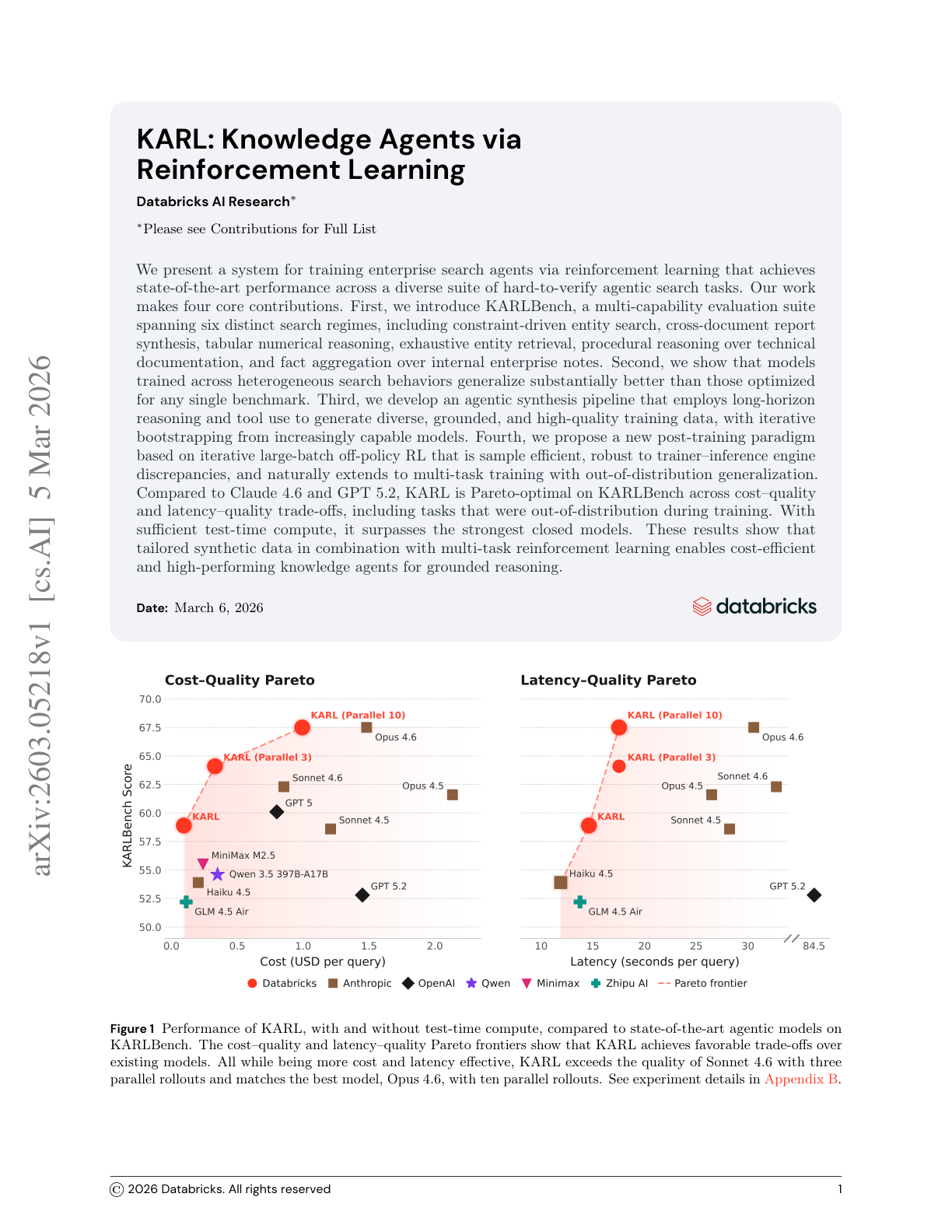
Databricks presents KARL, a system for training enterprise search agents via reinforcement learning that achieves state-of-the-art performance across a diverse suite of hard-to-verify agentic search tasks. The work also introduces KARLBench, a new evaluation framework spanning six search domains.
Ask this paper
New post-training paradigm (OAPL): KARL concurrently develops OAPL, an iterative large-batch off-policy RL approach. By embracing off-policyness in the design of the objective, it is robust to discrepancies between the trainer and the inference engine without requiring heuristics like clipped importance weighting or data deletion.
Multi-task heterogeneous training: Rather than optimizing for a single benchmark, KARL trains across heterogeneous search behaviors including constraint-driven entity search, cross-document synthesis, tabular reasoning, entity retrieval, procedural reasoning, and fact aggregation. This produces substantially better generalization than single-benchmark optimization.
Pareto-optimal performance: Starting from GLM 4.5 Air with varying levels of test-time scaling, KARL is Pareto-optimal on KARLBench when compared to Claude 4.6 and GPT 5.2 across both cost-quality and latency-quality tradeoffs.
Scalable with test-time compute: KARL-BCP attains 59.6 on BrowseComp-Plus, which further improves to 70.4 with value-guided search. KARL-TREC reaches 85.0 on TREC-Biogen, the second-highest score overall. The system surpasses the strongest closed models given sufficient test-time compute.