OpenDev
Terminal-native coding agents represent a fundamental shift in how developers interact with AI assistance. OpenDev is an open-source, command-line coding agent that operates where developers already manage source control and deploy environments, offering a comprehensive 81-page technical report on scaffolding, harness design, context engineering, and lessons learned from building production coding agents.
AutoHarness
Google DeepMind researchers introduce AutoHarness, a method for automatically synthesizing code harnesses that prevent LLM agents from making illegal actions. The core insight comes from a striking observation: in the Kaggle GameArena chess competition, 78% of Gemini-2.5-Flash losses were attributed to illegal moves, not poor strategy.
SkillNet
AI agents repeatedly rediscover solutions across separate scenarios instead of systematically reusing what they have already learned. SkillNet introduces an open infrastructure designed to create, evaluate, and organize AI skills at scale, enabling agents to transition from transient experience to durable mastery.
The Spike, the Sparse and the Sink
Yann LeCun and collaborators at NYU dissect two recurring phenomena in Transformer language models: massive activations, where a small number of tokens exhibit extreme outliers in specific channels, and attention sinks, where certain tokens attract disproportionate attention mass regardless of semantic relevance. The paper reveals that their co-occurrence is largely an architectural artifact.
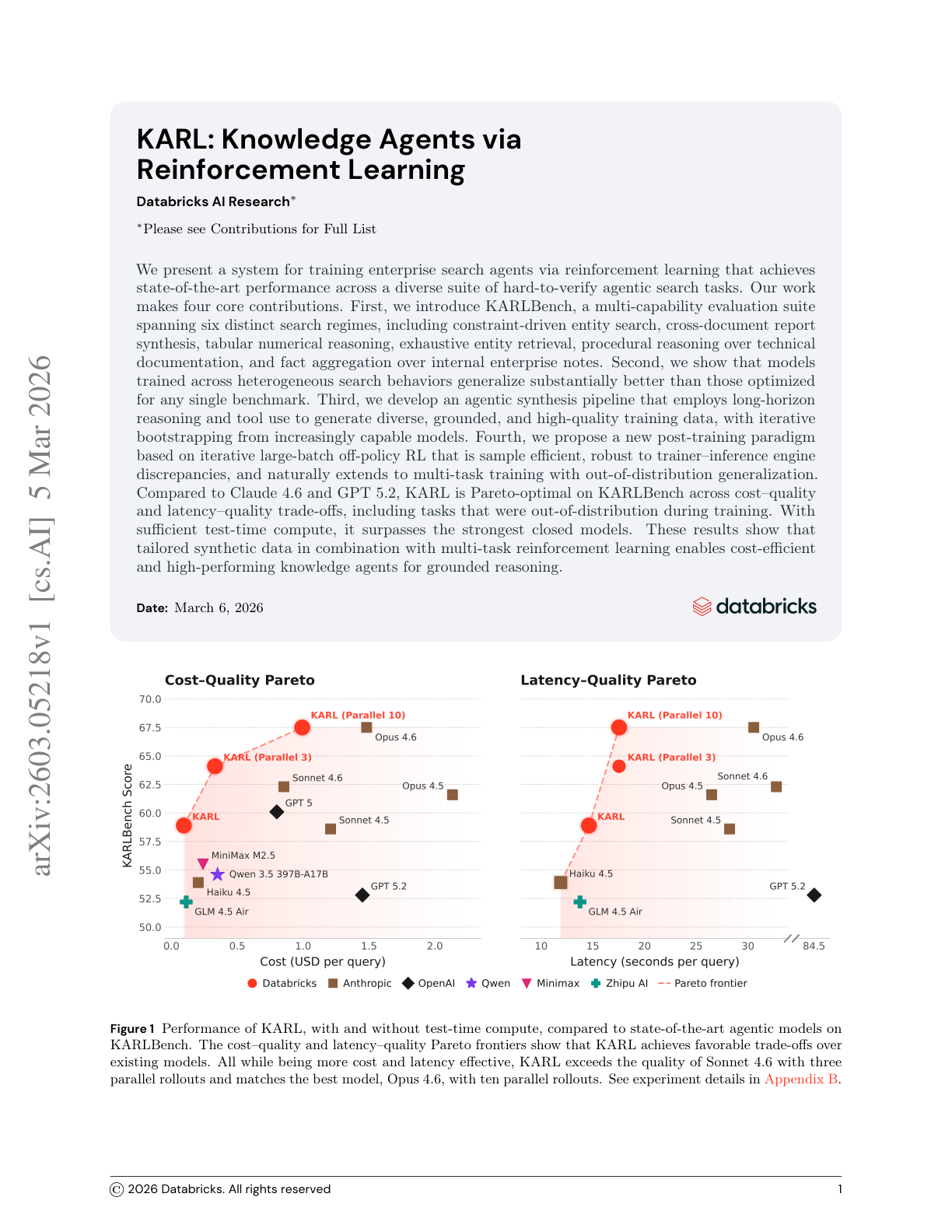
KARL
Databricks presents KARL, a system for training enterprise search agents via reinforcement learning that achieves state-of-the-art performance across a diverse suite of hard-to-verify agentic search tasks. The work also introduces KARLBench, a new evaluation framework spanning six search domains.
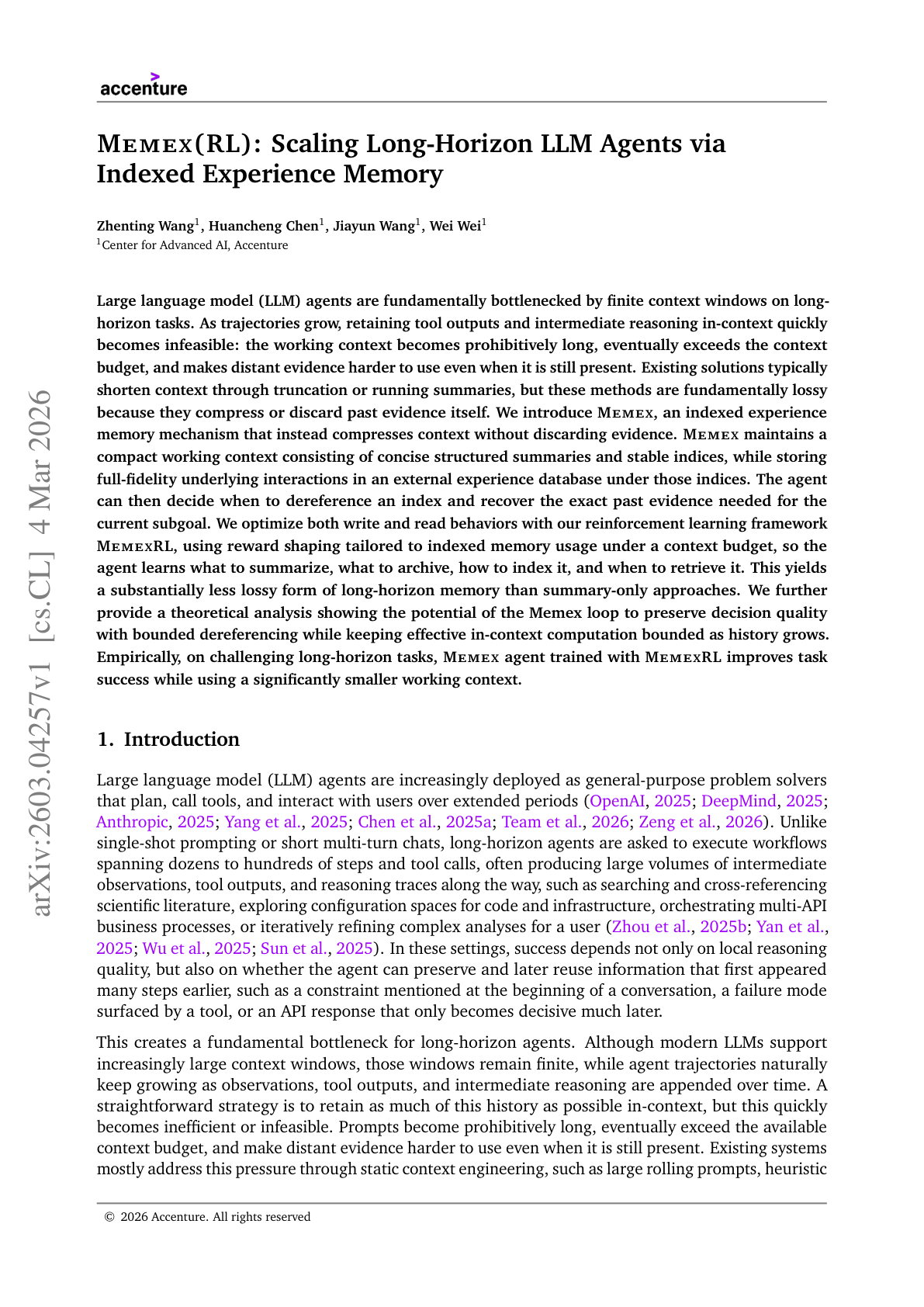
Memex(RL)
As tasks get longer and more complex, LLM agents lose track of what they have learned, what they have tried, and what still needs to be done. Memex(RL) introduces an indexed experience memory mechanism that scales agent capability on long-horizon tasks without discarding evidence or blowing up the context window.
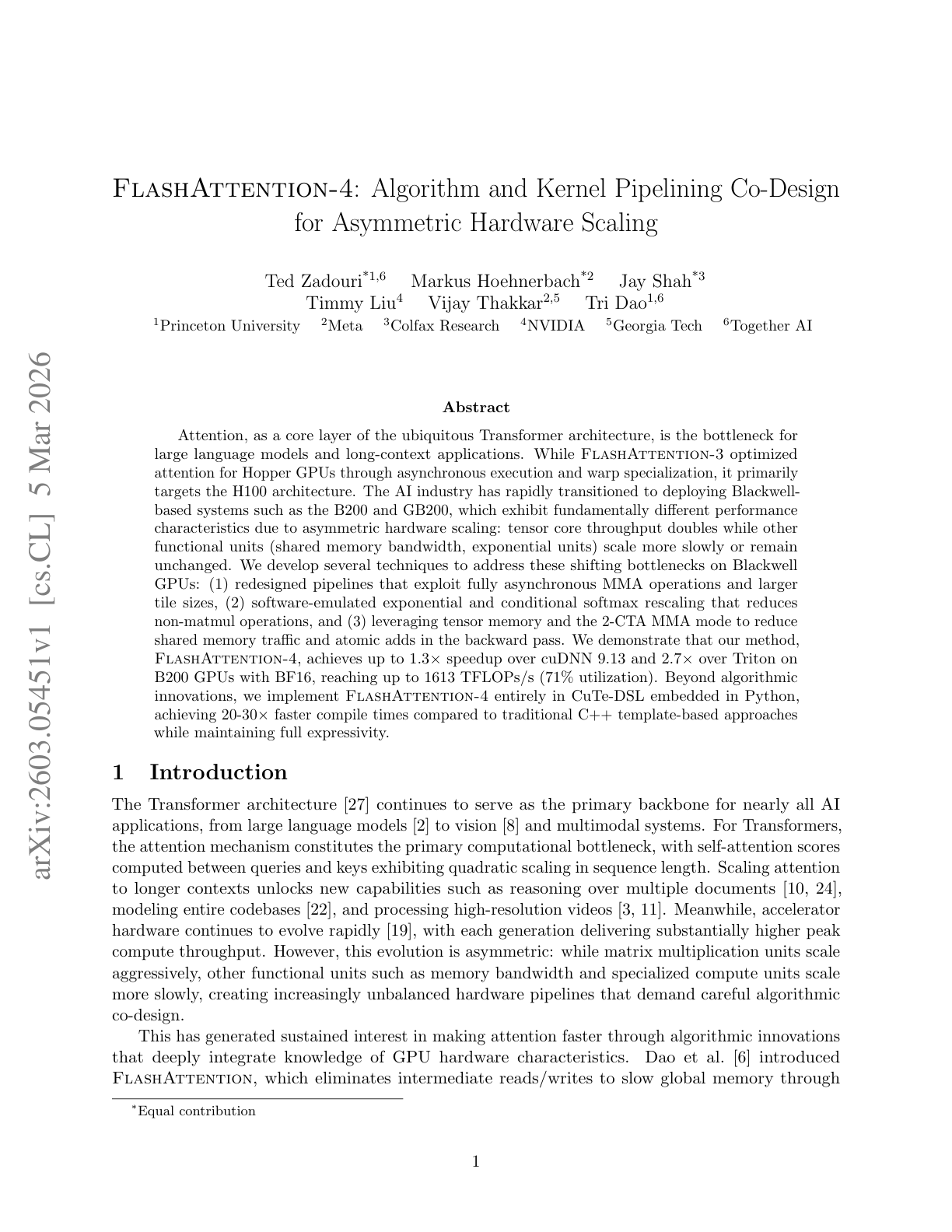
FlashAttention-4
FlashAttention-4 co-designs algorithms and kernel pipelines for the B200 and GB200 GPUs, which exhibit fundamentally different performance characteristics due to asymmetric hardware scaling where tensor core throughput doubles while other functional units scale more slowly.
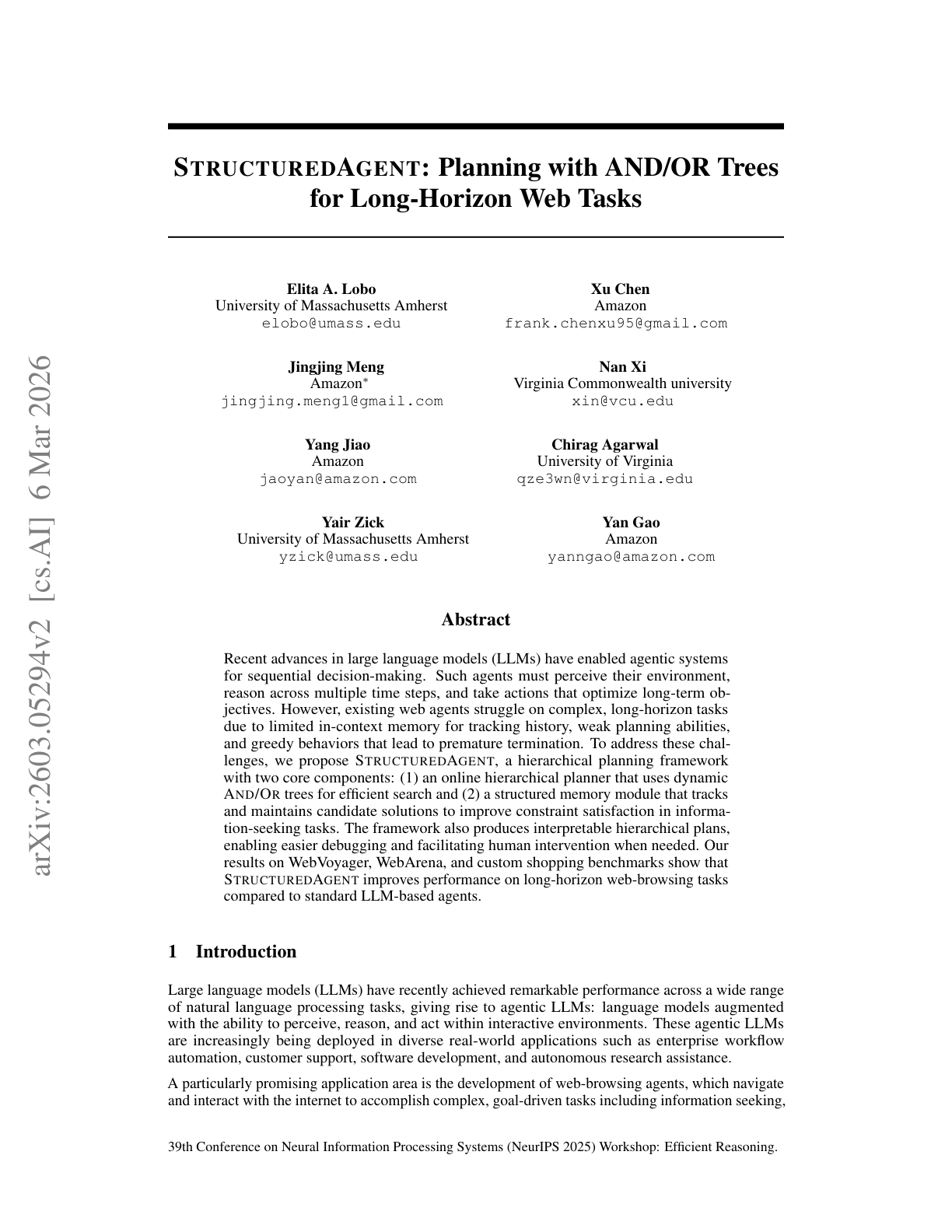
STRUCTUREDAGENT
STRUCTUREDAGENT introduces a hierarchical planning framework for long-horizon web tasks using dynamic AND/OR trees. The framework separates planning responsibilities: the system constructs and maintains the planning tree while the LLM is invoked only for local operations like node expansion or repair. A structured memory module tracks candidate solutions to improve constraint satisfaction. Results on WebVoyager, WebArena, and custom shopping benchmarks show improved performance over standard LLM-based web agents, with the added benefit of interpretable hierarchical plans that enable easier debugging and human intervention.
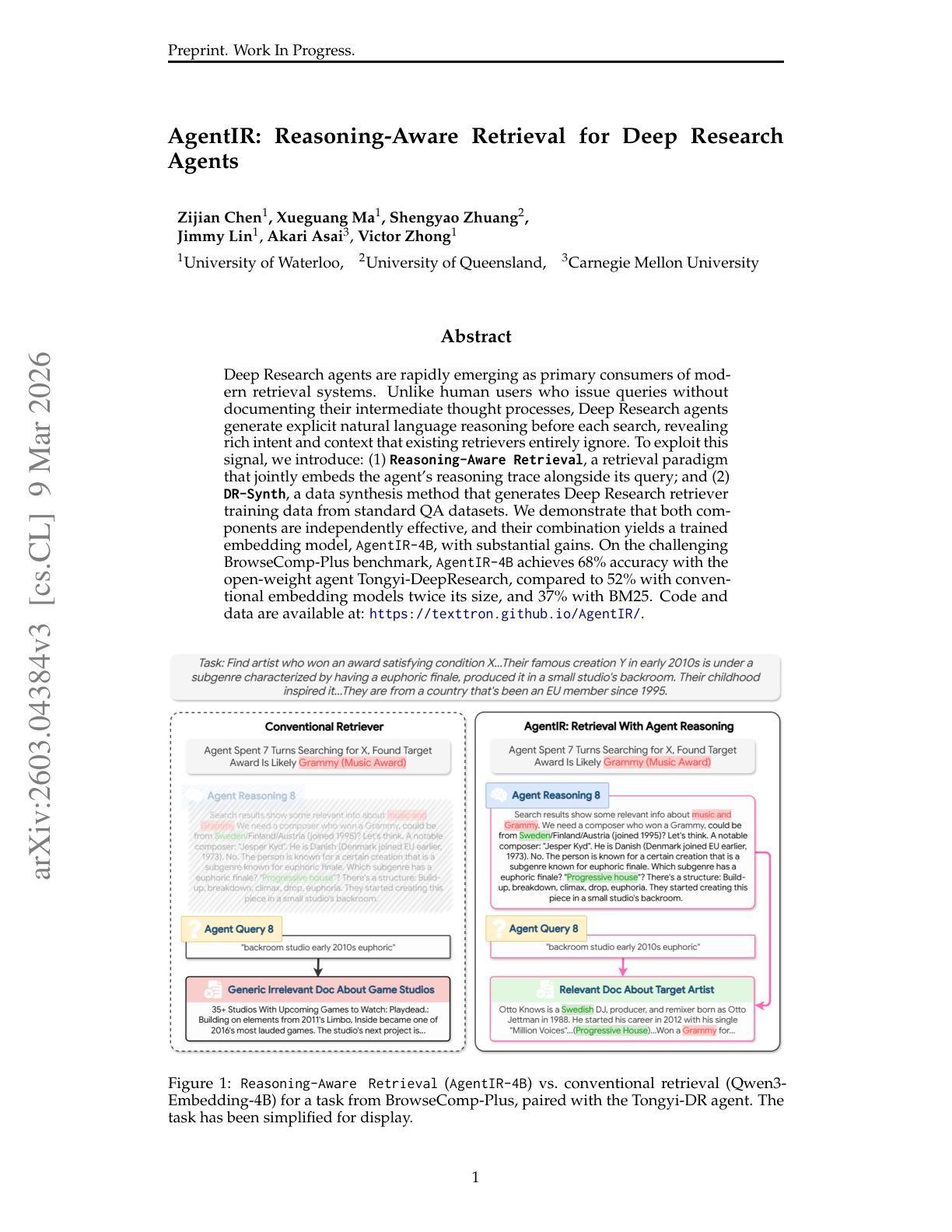
AgentIR
Deep research agents generate explicit reasoning before every search call, but existing retrievers completely ignore these rich signals about search intent and problem context. AgentIR introduces reasoning-aware retrieval that jointly embeds the agent’s reasoning trace alongside its query, along with DR-Synth, a data synthesis method for generating training data from standard QA datasets. On BrowseComp-Plus, AgentIR-4B achieves 68% accuracy with Tongyi-DeepResearch compared to 50% with conventional embedding models twice its size and 37% with BM25.
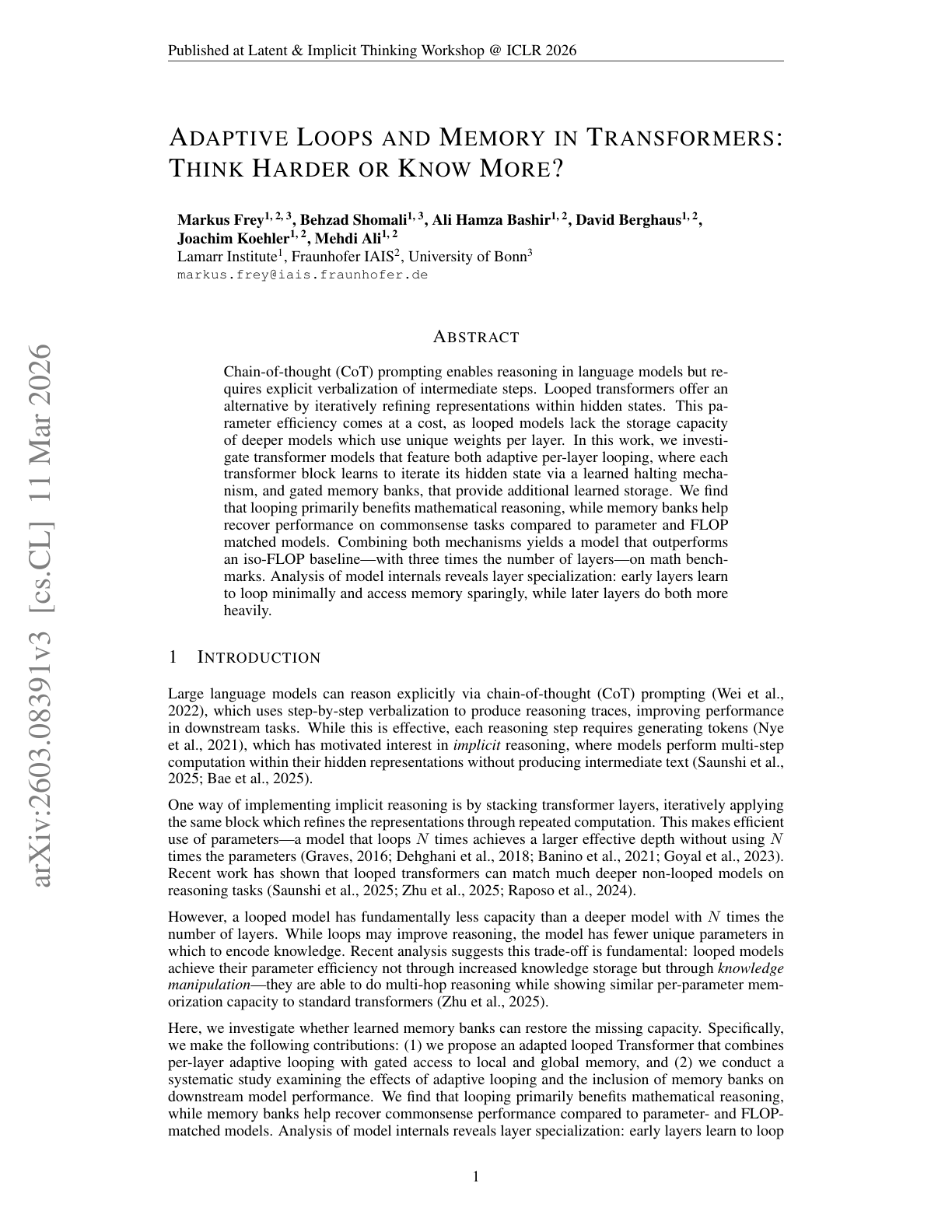
Think Harder or Know More
This paper investigates transformer models featuring both adaptive per-layer looping, where each block learns to iterate its hidden state via a learned halting mechanism, and gated memory banks that provide additional learned storage. The key finding is that looping primarily benefits mathematical reasoning while memory banks help recover performance on commonsense tasks. Combining both mechanisms yields a model that outperforms an iso-FLOP baseline with three times the number of layers on math benchmarks. Analysis of model internals reveals layer specialization: early layers loop minimally and access memory sparingly, while later layers do both more heavily.