Learning to Filter Context for RAG (FILCO)
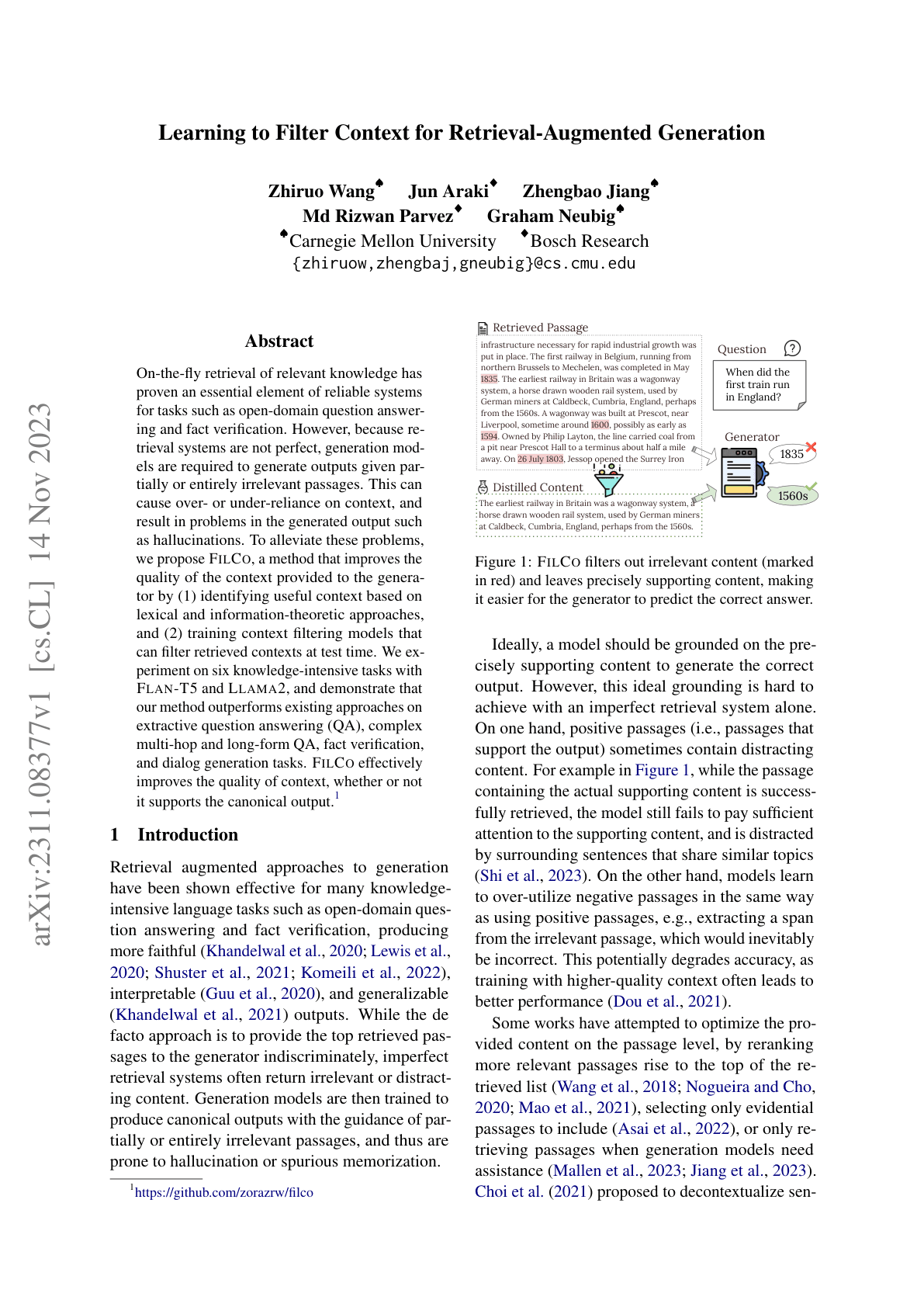
CMU's FILCO improves RAG by training a dedicated model to filter retrieved contexts before they reach the generator.
Ask this paper
Useful-context identification: Uses lexical and information-theoretic signals to identify genuinely useful portions of retrieved documents, rather than passing everything through.
Context-filter training: Trains a separate filtering model whose only job is to retain useful context at inference time.
Extractive QA wins: Outperforms prior RAG approaches on extractive QA benchmarks, a clean demonstration that context filtering is a high-leverage component.
Modular addition: Slots in between retrieval and generation, making it compatible with any retriever/generator pairing.
Abstract
On-the-fly retrieval of relevant knowledge has proven an essential element of reliable systems for tasks such as open-domain question answering and fact verification. However, because retrieval systems are not perfect, generation models are required to generate outputs given partially or entirely irrelevant passages. This can cause over- or under-reliance on context, and result in problems in the generated output such as hallucinations. To alleviate these problems, we propose FILCO, a method that improves the quality of the context provided to the generator by (1) identifying useful context based on lexical and information-theoretic approaches, and (2) training context filtering models that can filter retrieved contexts at test time. We experiment on six knowledge-intensive tasks with FLAN-T5 and LLaMa2, and demonstrate that our method outperforms existing approaches on extractive question answering (QA), complex multi-hop and long-form QA, fact verification, and dialog generation tasks. FILCO effectively improves the quality of context, whether or not it supports the canonical output.