LightThinker
This new paper proposes a novel approach to dynamically compress reasoning steps in LLMs, significantly improving efficiency without sacrificing accuracy. Key insights include:
Ask this paper
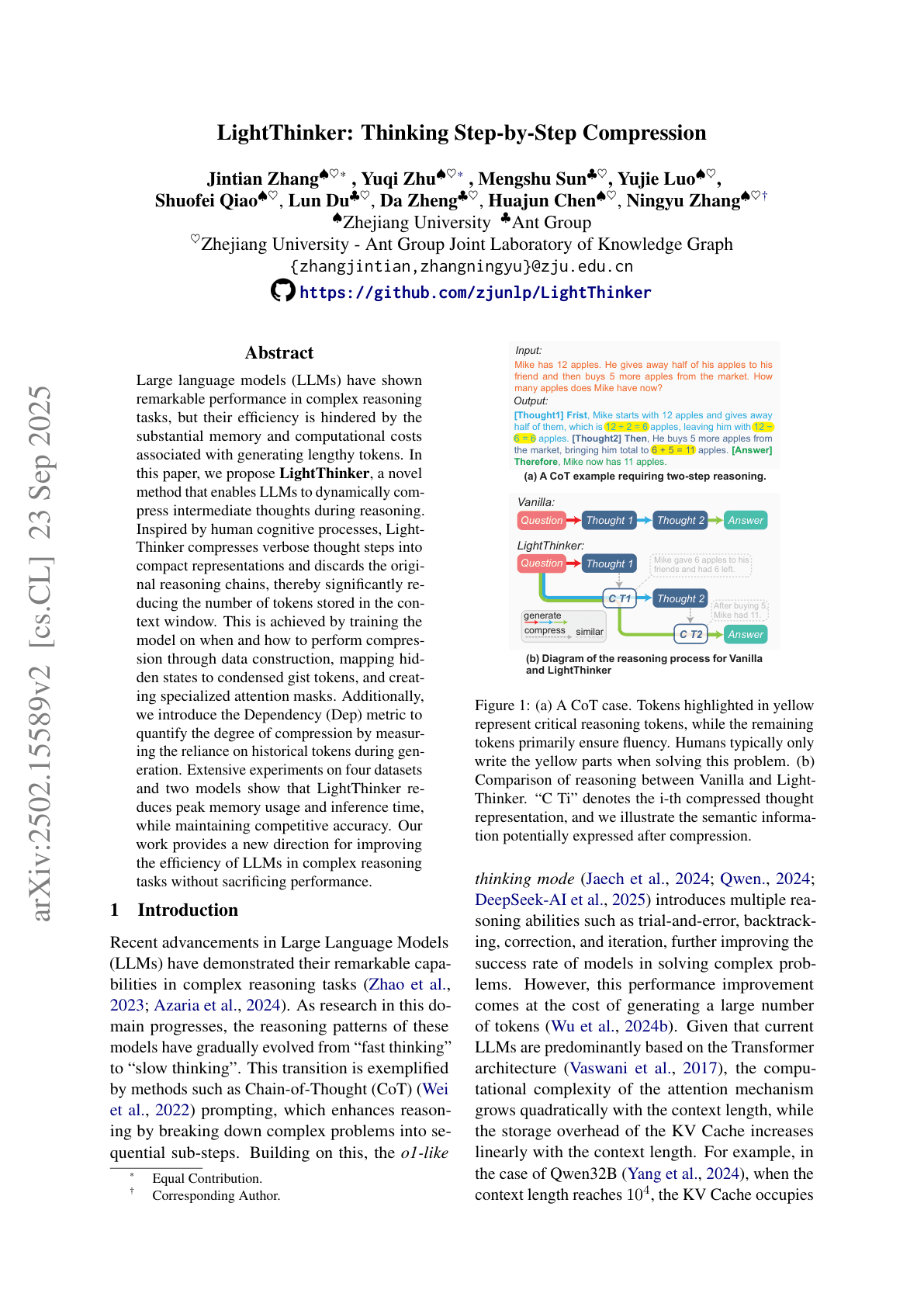
Compression of intermediate thoughts – Inspired by human cognition, LightThinker teaches LLMs to summarize and discard verbose reasoning steps, reducing memory footprint and computational cost during inference.
Training LLMs to compress – The method trains models to identify when and how to condense reasoning by mapping hidden states to compact gist tokens and introducing specialized attention masks.
Dependency metric for compression – The paper introduces Dep, a metric that quantifies the reliance on historical tokens during generation. Lower Dep values indicate effective compression with minimal information loss.
Memory & speed improvements – Experiments show that LightThinker reduces peak memory usage by 70% and inference time by 26% while maintaining nearly identical accuracy (within 1% of uncompressed models).
Outperforming baseline approaches – Compared to token-eviction (H2O) and anchor-token (AnLLM) methods, LightThinker achieves higher efficiency with fewer tokens stored and better generalization across reasoning tasks.
Abstract
Large language models (LLMs) have shown remarkable performance in complex reasoning tasks, but their efficiency is hindered by the substantial memory and computational costs associated with generating lengthy tokens. In this paper, we propose LightThinker, a novel method that enables LLMs to dynamically compress intermediate thoughts during reasoning. Inspired by human cognitive processes, LightThinker compresses verbose thought steps into compact representations and discards the original reasoning chains, thereby significantly reducing the number of tokens stored in the context window. This is achieved by training the model on when and how to perform compression through data construction, mapping hidden states to condensed gist tokens, and creating specialized attention masks. Additionally, we introduce the Dependency (Dep) metric to quantify the degree of compression by measuring the reliance on historical tokens during generation. Extensive experiments on four datasets and two models show that LightThinker reduces peak memory usage and inference time, while maintaining competitive accuracy. Our work provides a new direction for improving the efficiency of LLMs in complex reasoning tasks without sacrificing performance. Code is released at https://github.com/zjunlp/LightThinker.