LingBot-World 2.0
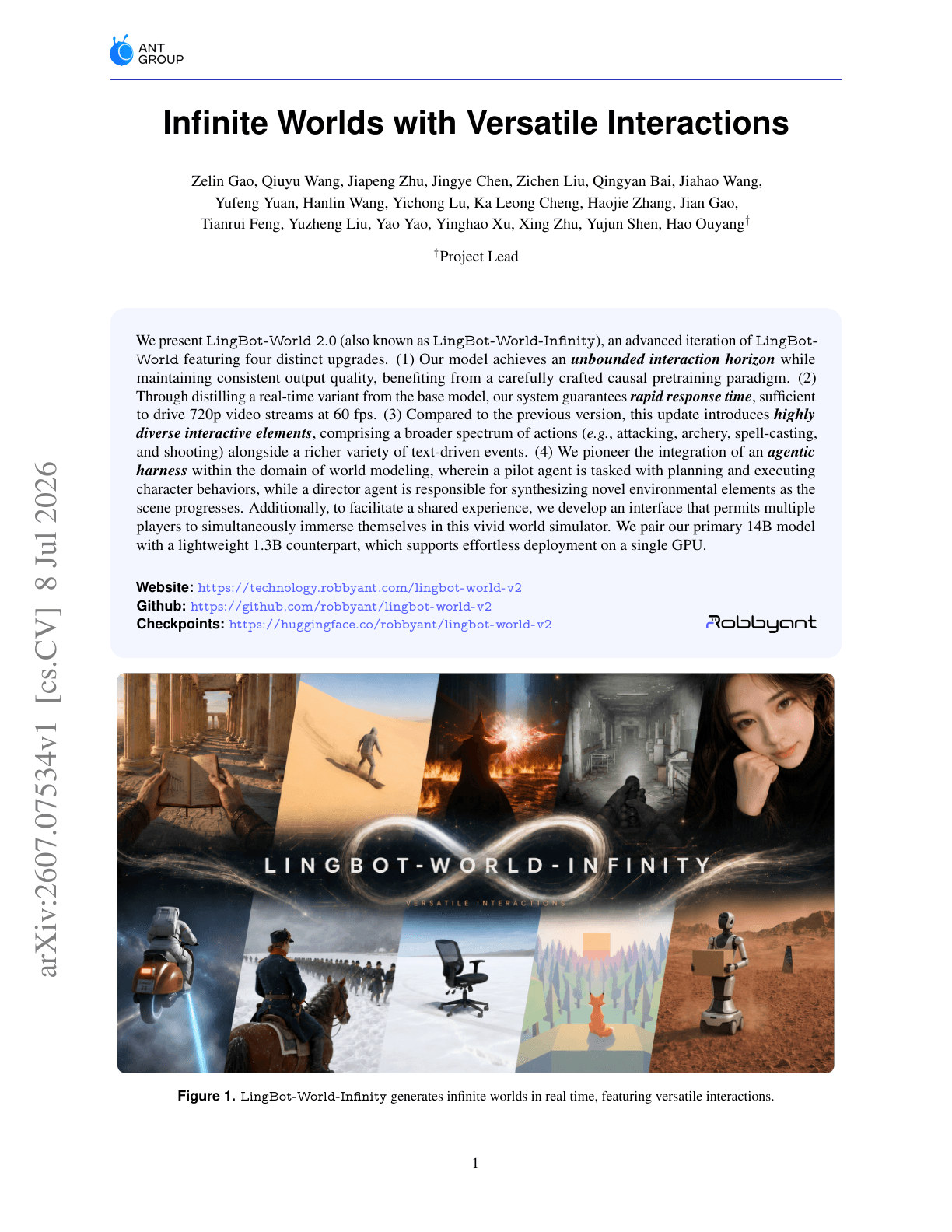
Most world models fall apart after a few seconds, smearing textures and warping geometry as errors compound frame to frame. LingBot-World 2.0 from Robbyant holds 720p at 60 fps for a full hour of interaction and ships fully open.
Ask this paper
Causal backbone beats drift: A causal generation stack trained from the start to limit error accumulation replaces the usual bidirectional design, keeping scenes coherent well past the point where prior causal models collapse.
Durable teacher, real-time student: The high-capacity base model is distilled into a few-step student that renders in real time, so you get both long-horizon stability and responsive interaction from one system.
Act inside the world: Rather than only moving a camera, you can fight, draw a bow, cast spells, and type in events like weather changes, while an agentic harness of a scene-reading brain, a pilot, and a director keeps generating context-aware content.
Why it matters: Pairing hour-scale, real-time, high-fidelity generation with an open release, including a 14B model and a lighter single-GPU variant, gives researchers a serious interactive world model to build on rather than a closed demo.
Abstract
We present LingBot-World 2.0 (also known as LingBot-World-Infinity), an advanced iteration of LingBot-World featuring four distinct upgrades. (1) Our model achieves an unbounded interaction horizon while maintaining consistent output quality, benefiting from a carefully crafted causal pretraining paradigm. (2) Through distilling a real-time variant from the base model, our system guarantees rapid response time, sufficient to drive 720p video streams at 60 fps. (3) Compared to the previous version, this update introduces highly diverse interactive elements, comprising a broader spectrum of actions (e.g., attacking, archery, spell-casting, and shooting) alongside a richer variety of text-driven events. (4) We pioneer the integration of an agentic harness within the domain of world modeling, wherein a pilot agent is tasked with planning and executing character behaviors, while a director agent is responsible for synthesizing novel environmental elements as the scene progresses. Additionally, to facilitate a shared experience, we develop an interface that permits multiple players to simultaneously immerse themselves in this vivid world simulator. We pair our primary 14B model with a lightweight 1.3B counterpart, which supports effortless deployment on a single GPU.