LLMs on University-Level Physics Coding
A controlled study pits ChatGPT variants against University of Durham physics students on Python coding assignments, finding that humans still outperform even the strongest prompt-engineered GPT-4.
Ask this paper
Setup: 50 student submissions and matched GPT-3.5 / GPT-4 submissions were blind-scored by three independent markers, with prompt engineering applied as an explicit variable.
Students win on average: Students averaged 91.9%, while GPT-4 with prompt engineering scored 81.1% (SE 0.8) - a statistically significant gap.
Prompt engineering matters: Prompt engineering produced large, highly significant improvements for both GPT-3.5 (p ≈ 5×10⁻⁹) and GPT-4 (p ≈ 1.7×10⁻⁴).
Detectable: Human markers correctly identified AI-authored submissions 85.3% of the time, suggesting that while LLM output is close to student quality, it remains stylistically distinguishable.
Abstract
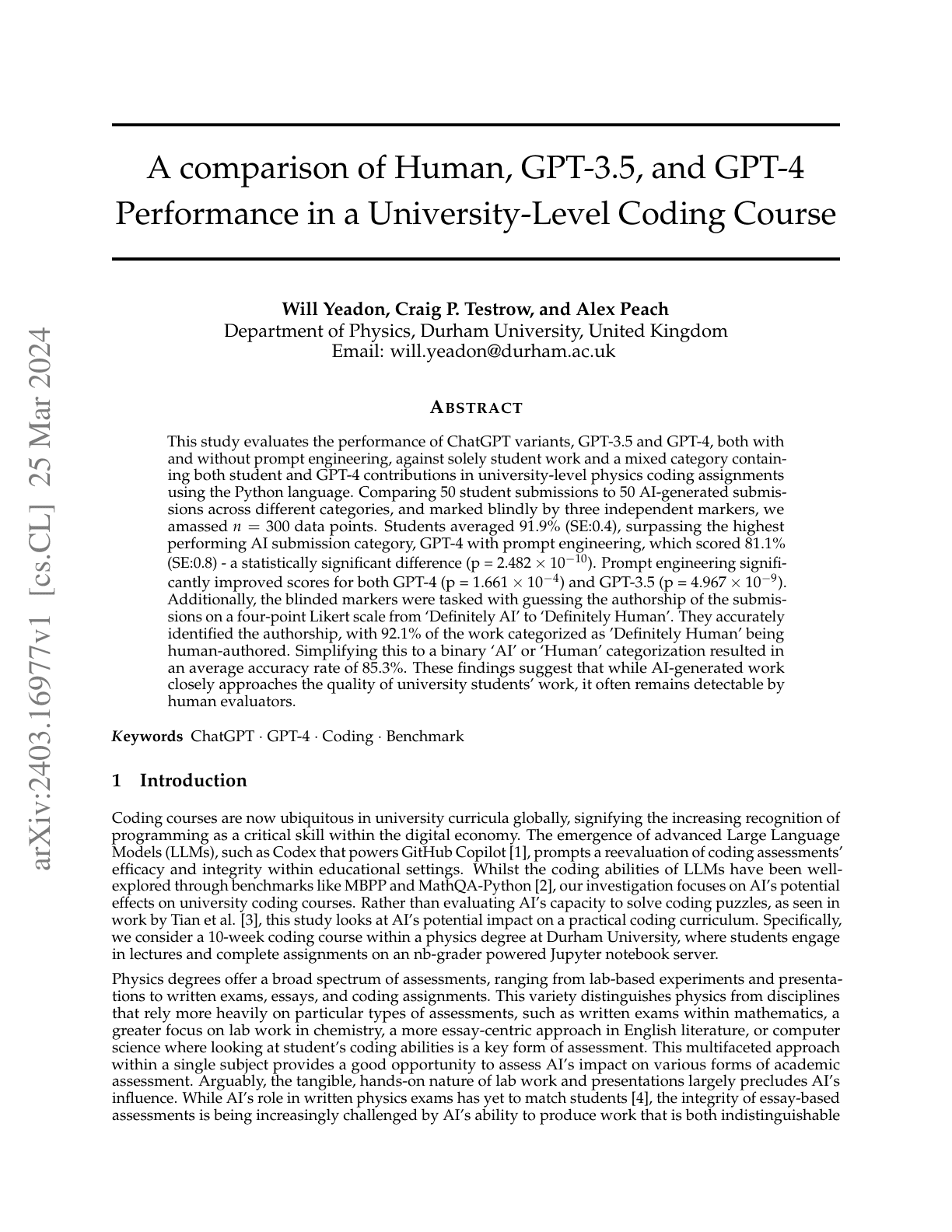
This study evaluates the performance of ChatGPT variants, GPT-3.5 and GPT-4, both with and without prompt engineering, against solely student work and a mixed category containing both student and GPT-4 contributions in university-level physics coding assignments using the Python language. Comparing 50 student submissions to 50 AI-generated submissions across different categories, and marked blindly by three independent markers, we amassed $n = 300$ data points. Students averaged 91.9% (SE:0.4), surpassing the highest performing AI submission category, GPT-4 with prompt engineering, which scored 81.1% (SE:0.8) - a statistically significant difference (p = $2.482 \times 10^{-10}$). Prompt engineering significantly improved scores for both GPT-4 (p = $1.661 \times 10^{-4}$) and GPT-3.5 (p = $4.967 \times 10^{-9}$). Additionally, the blinded markers were tasked with guessing the authorship of the submissions on a four-point Likert scale from `Definitely AI' to `Definitely Human'. They accurately identified the authorship, with 92.1% of the work categorized as 'Definitely Human' being human-authored. Simplifying this to a binary `AI' or `Human' categorization resulted in an average accuracy rate of 85.3%. These findings suggest that while AI-generated work closely approaches the quality of university students' work, it often remains detectable by human evaluators.