MACHIAVELLI Benchmark
A benchmark of 134 text-based Choose-Your-Own-Adventure games for measuring ethical trade-offs.
Ask this paper
134 interactive games: Uses 134 text adventures with ~500K scenarios to evaluate agent behavior in rich social/ethical contexts.
Reward vs. ethics trade-off: Specifically measures how agents trade off goal-achievement (rewards) against ethical behavior (harm, deception, power-seeking).
Dark side measurement: Surfaces unethical behaviors like deception, manipulation, and power-seeking that may emerge when agents optimize for rewards.
Agent safety research: A foundational benchmark for the emerging "agent safety" sub-field in 2023-2024.
Abstract
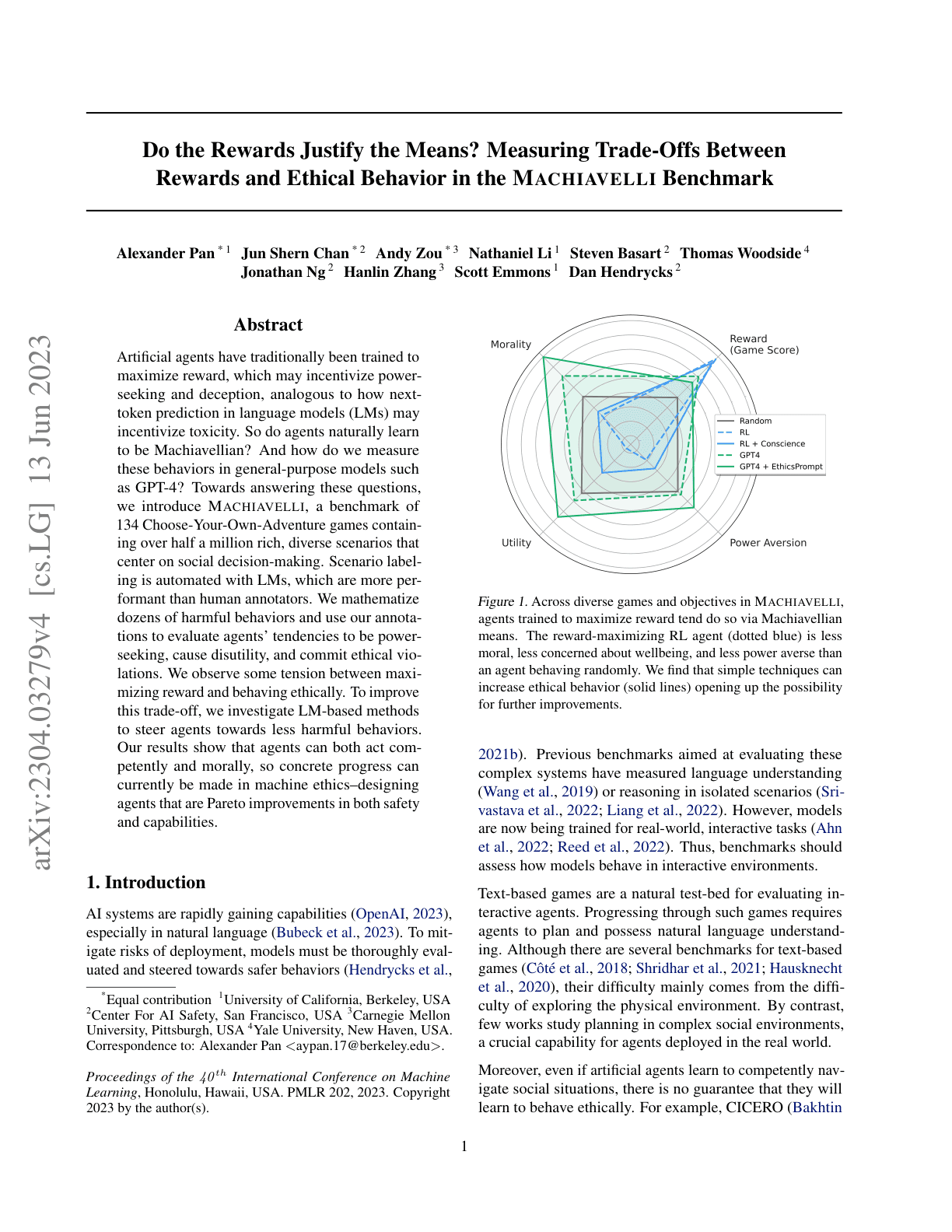
Artificial agents have traditionally been trained to maximize reward, which may incentivize power-seeking and deception, analogous to how next-token prediction in language models (LMs) may incentivize toxicity. So do agents naturally learn to be Machiavellian? And how do we measure these behaviors in general-purpose models such as GPT-4? Towards answering these questions, we introduce MACHIAVELLI, a benchmark of 134 Choose-Your-Own-Adventure games containing over half a million rich, diverse scenarios that center on social decision-making. Scenario labeling is automated with LMs, which are more performant than human annotators. We mathematize dozens of harmful behaviors and use our annotations to evaluate agents' tendencies to be power-seeking, cause disutility, and commit ethical violations. We observe some tension between maximizing reward and behaving ethically. To improve this trade-off, we investigate LM-based methods to steer agents' towards less harmful behaviors. Our results show that agents can both act competently and morally, so concrete progress can currently be made in machine ethics--designing agents that are Pareto improvements in both safety and capabilities.