Make Your LLM Fully Utilize the Context (FILM-7B)
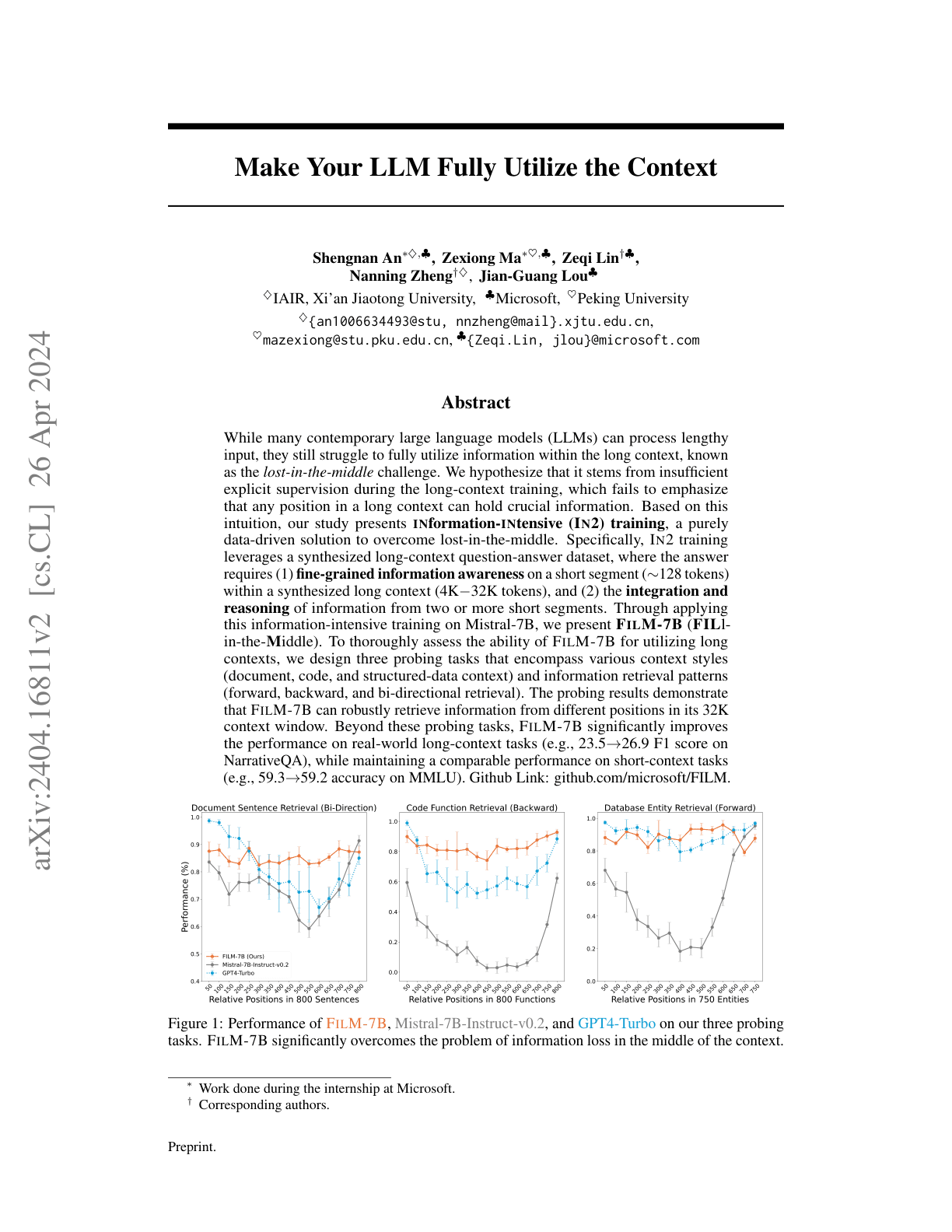
FILM-7B targets the lost-in-the-middle problem where long-context LLMs fail to retrieve information buried between the start and end of their input. The authors apply an information-intensive (IN2) training recipe to Mistral-7B that forces uniform attention across the full 32K window.
Ask this paper
IN2 synthetic data: Training examples are constructed so the answer requires either fine-grained awareness of a ~128-token segment placed anywhere in a 4K-32K context, or integration of information from two or more such segments.
Position robustness: After IN2 training, FILM-7B retrieves reliably from arbitrary positions across document, code, and structured-data contexts, with forward, backward, and bidirectional retrieval patterns all supported.
Real-world gains with minimal regression: NarrativeQA F1 jumps from 23.5 to 26.9 and short-context capability is effectively preserved (MMLU drops only 59.3 to 59.2), showing the fix is targeted rather than disruptive.
Generalizable recipe: IN2 training is positioned as a cheap, bolt-on remedy that can be applied to existing long-context models to correct position-dependent attention failures systematically.
Abstract
While many contemporary large language models (LLMs) can process lengthy input, they still struggle to fully utilize information within the long context, known as the lost-in-the-middle challenge. We hypothesize that it stems from insufficient explicit supervision during the long-context training, which fails to emphasize that any position in a long context can hold crucial information. Based on this intuition, our study presents information-intensive (IN2) training, a purely data-driven solution to overcome lost-in-the-middle. Specifically, IN2 training leverages a synthesized long-context question-answer dataset, where the answer requires (1) fine-grained information awareness on a short segment (~128 tokens) within a synthesized long context (4K-32K tokens), and (2) the integration and reasoning of information from two or more short segments. Through applying this information-intensive training on Mistral-7B, we present FILM-7B (FILl-in-the-Middle). To thoroughly assess the ability of FILM-7B for utilizing long contexts, we design three probing tasks that encompass various context styles (document, code, and structured-data context) and information retrieval patterns (forward, backward, and bi-directional retrieval). The probing results demonstrate that FILM-7B can robustly retrieve information from different positions in its 32K context window. Beyond these probing tasks, FILM-7B significantly improves the performance on real-world long-context tasks (e.g., 23.5->26.9 F1 score on NarrativeQA), while maintaining a comparable performance on short-context tasks (e.g., 59.3->59.2 accuracy on MMLU). Github Link: https://github.com/microsoft/FILM.