MASS-RAG
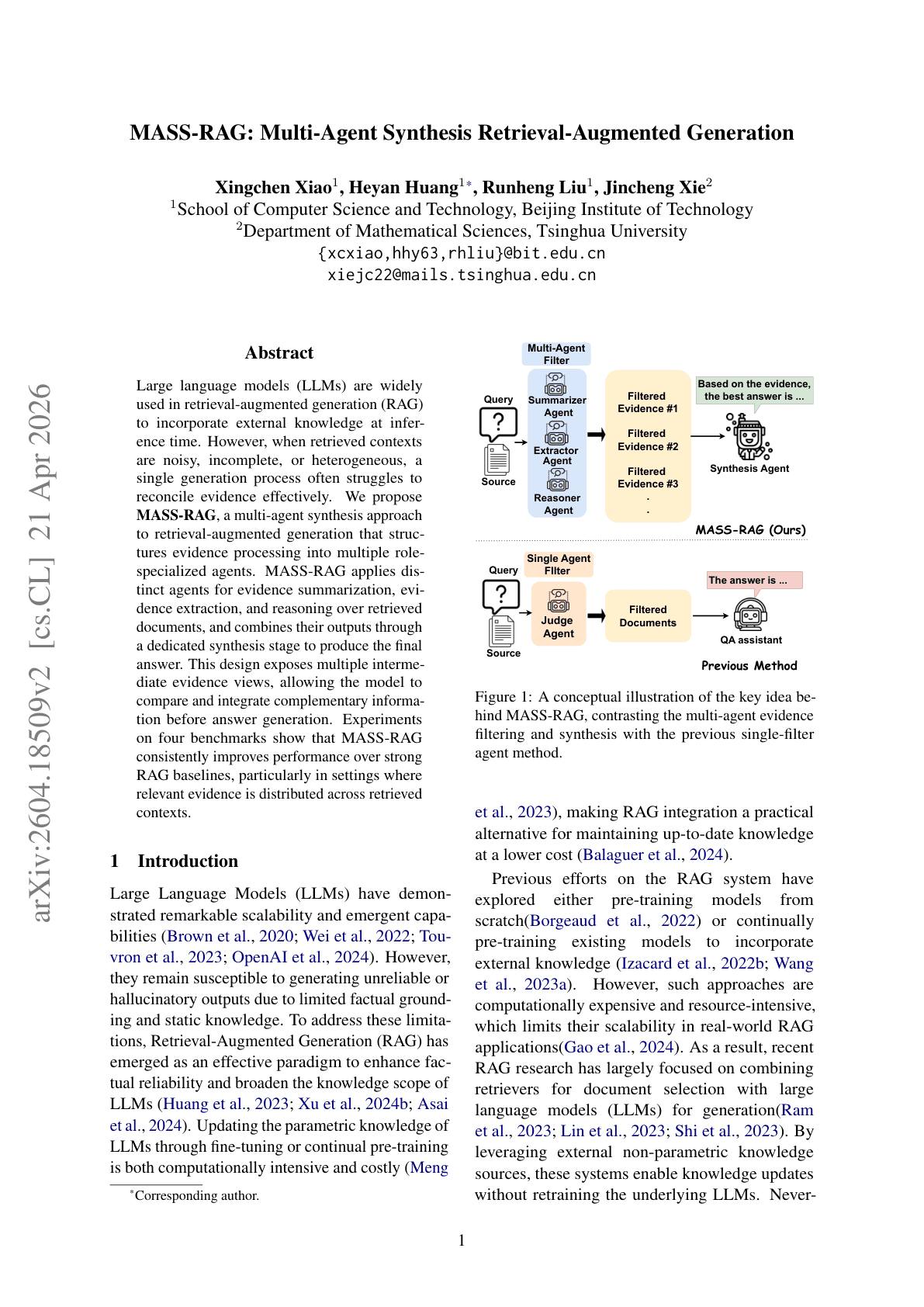
Most real-world RAG failures come from retrieving technically-relevant but contextually useless documents, then forcing a single model to reconcile them. MASS-RAG is a multi-agent synthesis framework for retrieval-augmented generation where specialized agents handle distinct roles: retrieving candidate documents, assessing their actual relevance to the query, and synthesizing the final answer from evidence that actually contributes. Instead of one model doing everything, responsibility is decomposed across coordinated evaluators, which fits the direction the field is heading for deep research agents.
Ask this paper
Abstract
Large language models (LLMs) are widely used in retrieval-augmented generation (RAG) to incorporate external knowledge at inference time. However, when retrieved contexts are noisy, incomplete, or heterogeneous, a single generation process often struggles to reconcile evidence effectively. We propose \textbf{MASS-RAG}, a multi-agent synthesis approach to retrieval-augmented generation that structures evidence processing into multiple role-specialized agents. MASS-RAG applies distinct agents for evidence summarization, evidence extraction, and reasoning over retrieved documents, and combines their outputs through a dedicated synthesis stage to produce the final answer. This design exposes multiple intermediate evidence views, allowing the model to compare and integrate complementary information before answer generation. Experiments on four benchmarks show that MASS-RAG consistently improves performance over strong RAG baselines, particularly in settings where relevant evidence is distributed across retrieved contexts.