Mirasol3B
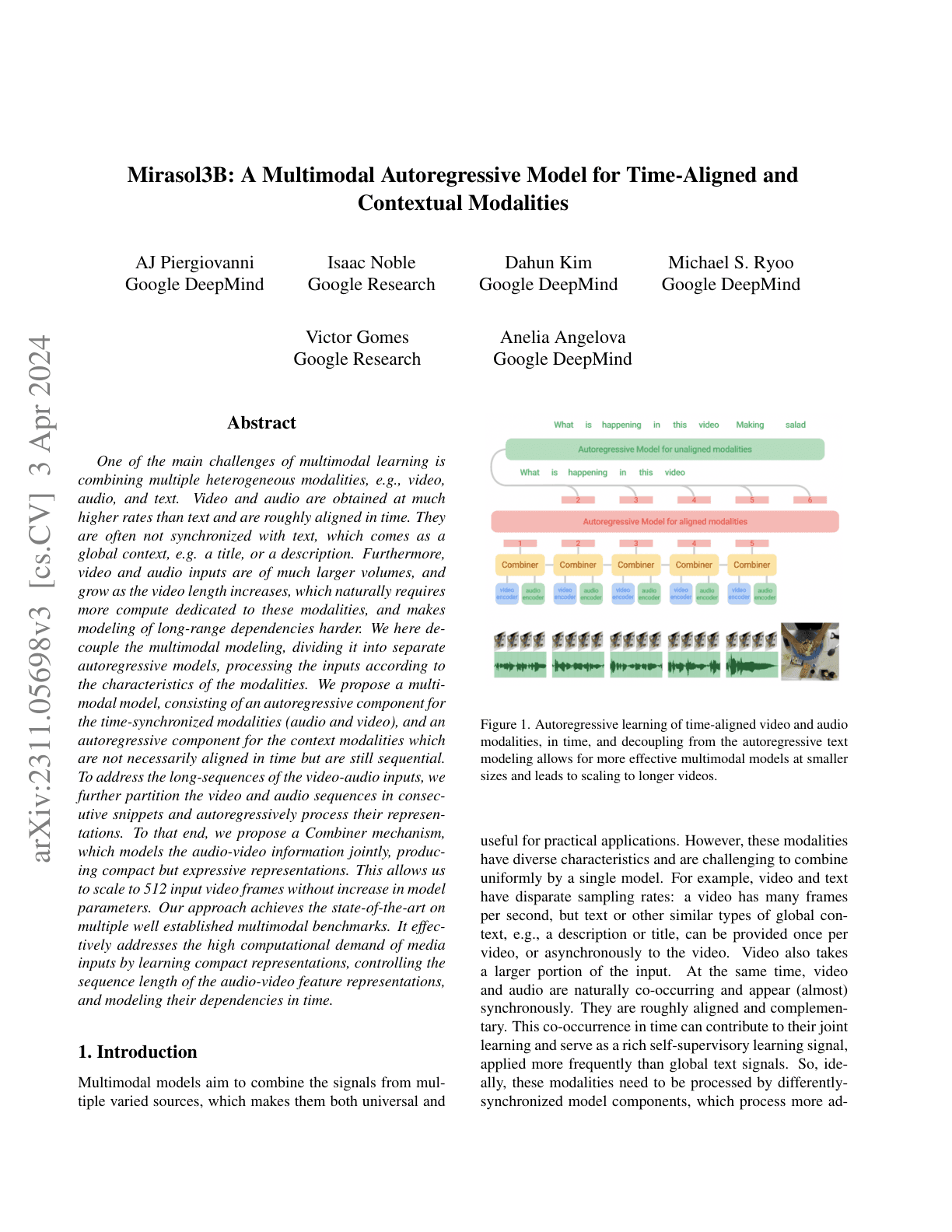
Google's Mirasol3B is a multimodal model that decouples modalities into focused autoregressive components rather than forcing a single fused stream.
Ask this paper
Decoupled autoregressive modeling: Separates audio/video processing from text processing into focused autoregressive components that communicate through learned cross-modal interfaces.
Handles longer videos: The decoupled design lets the model handle longer video inputs than typical end-to-end multimodal models constrained by sequence length.
Modality-specific processing: Inputs are processed according to their modalities with appropriate tokenization rather than forcing a one-size-fits-all tokenizer.
SoTA on video benchmarks: Outperforms prior methods on video QA, long-video QA, and audio-video-text benchmarks, validating the decoupled approach.
Abstract
One of the main challenges of multimodal learning is the need to combine heterogeneous modalities (e.g., video, audio, text). For example, video and audio are obtained at much higher rates than text and are roughly aligned in time. They are often not synchronized with text, which comes as a global context, e.g., a title, or a description. Furthermore, video and audio inputs are of much larger volumes, and grow as the video length increases, which naturally requires more compute dedicated to these modalities and makes modeling of long-range dependencies harder. We here decouple the multimodal modeling, dividing it into separate, focused autoregressive models, processing the inputs according to the characteristics of the modalities. We propose a multimodal model, called Mirasol3B, consisting of an autoregressive component for the time-synchronized modalities (audio and video), and an autoregressive component for the context modalities which are not necessarily aligned in time but are still sequential. To address the long-sequences of the video-audio inputs, we propose to further partition the video and audio sequences in consecutive snippets and autoregressively process their representations. To that end, we propose a Combiner mechanism, which models the audio-video information jointly within a timeframe. The Combiner learns to extract audio and video features from raw spatio-temporal signals, and then learns to fuse these features producing compact but expressive representations per snippet. Our approach achieves the state-of-the-art on well established multimodal benchmarks, outperforming much larger models. It effectively addresses the high computational demand of media inputs by both learning compact representations, controlling the sequence length of the audio-video feature representations, and modeling their dependencies in time.