MIRIX-2.0: Multi-Agent Memory System
Wei-Chieh Huang, Weizhi Zhang and colleagues at MIRIX AI present MIRIX-2.0, a multi-agent memory system that keeps complete records, indexes them with a provenance hypergraph and retrieves under explicit budgets.
Ask this paper
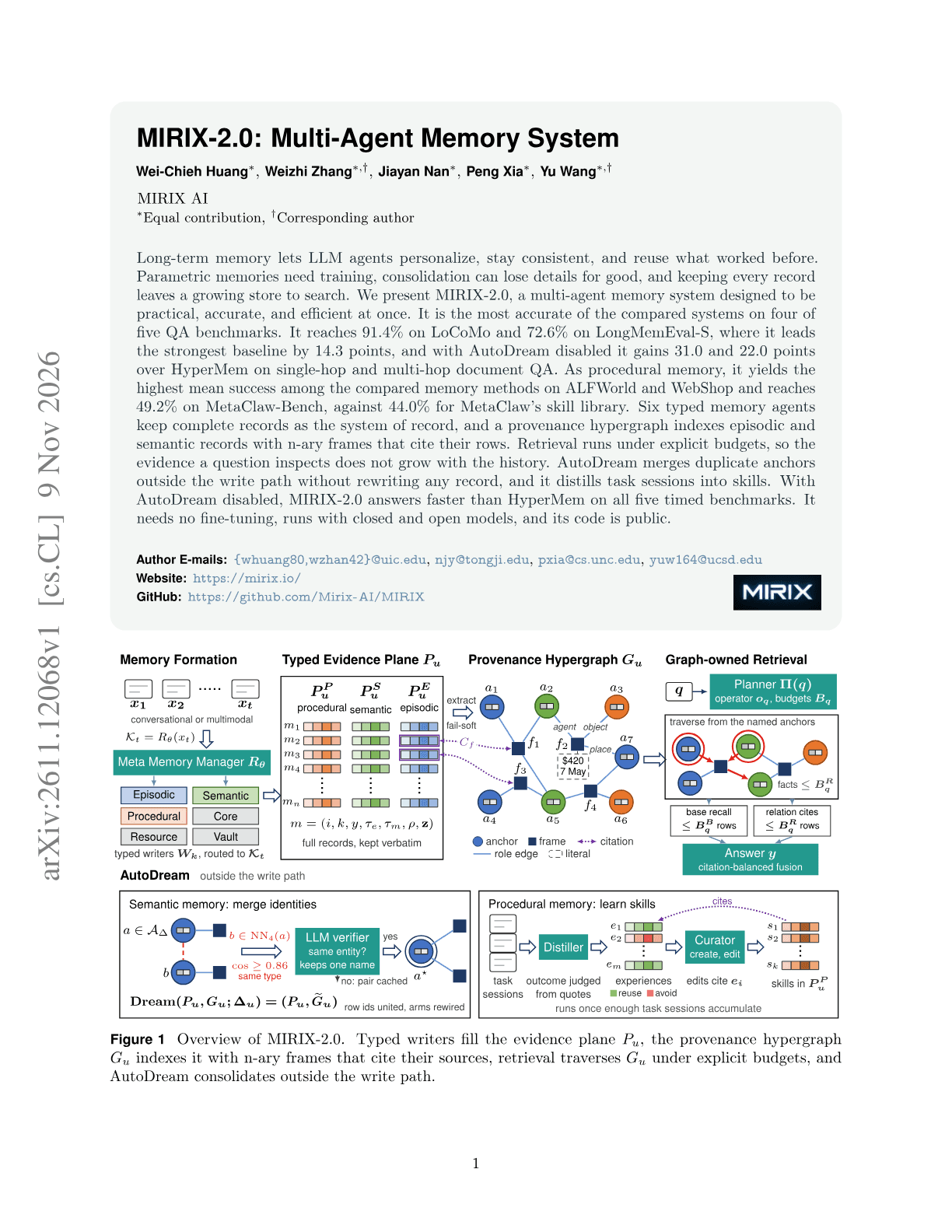
Architecture. Six typed memory agents keep complete records as the system of record. A provenance hypergraph indexes episodic and semantic records with frames that cite their source rows, and retrieval cost does not grow with history length.
AutoDream. An offline process merges duplicate anchors without rewriting any record and distills task sessions into skills.
QA results. Most accurate of the compared systems on four of five QA benchmarks: 91.4% on LoCoMo and 72.6% on LongMemEval-S, 14.3 points above the strongest baseline. Without AutoDream it gains 31.0 and 22.0 points over HyperMem on single- and multi-hop document QA.
Procedural memory. Highest mean success among compared memory methods on ALFWorld and WebShop, and 49.2% on MetaClaw-Bench against 44.0% for MetaClaw's skill library. No fine-tuning; code is public.
Abstract
Long-term memory lets LLM agents personalize, stay consistent, and reuse what worked before. Parametric memories need training, consolidation can lose details for good, and keeping every record leaves a growing store to search. We present MIRIX-2.0, a multi-agent memory system designed to be practical, accurate, and efficient at once. It is the most accurate of the compared systems on four of five QA benchmarks. It reaches 91.4% on LoCoMo and 72.6% on LongMemEval-S, where it leads the strongest baseline by 14.3 points, and with AutoDream disabled it gains 31.0 and 22.0 points over HyperMem on single-hop and multi-hop document QA. As procedural memory, it yields the highest mean success among the compared memory methods on ALFWorld and WebShop and reaches 49.2% on MetaClaw-Bench, against 44.0% for MetaClaw's skill library. Six typed memory agents keep complete records as the system of record, and a provenance hypergraph indexes episodic and semantic records with n-ary frames that cite their rows. Retrieval runs under explicit budgets, so the evidence a question inspects does not grow with the history. AutoDream merges duplicate anchors outside the write path without rewriting any record, and it distills task sessions into skills. With AutoDream disabled, MIRIX-2.0 answers faster than HyperMem on all five timed benchmarks. It needs no fine-tuning, runs with closed and open models, and its code is public.