Model Kinship for Merging LLMs
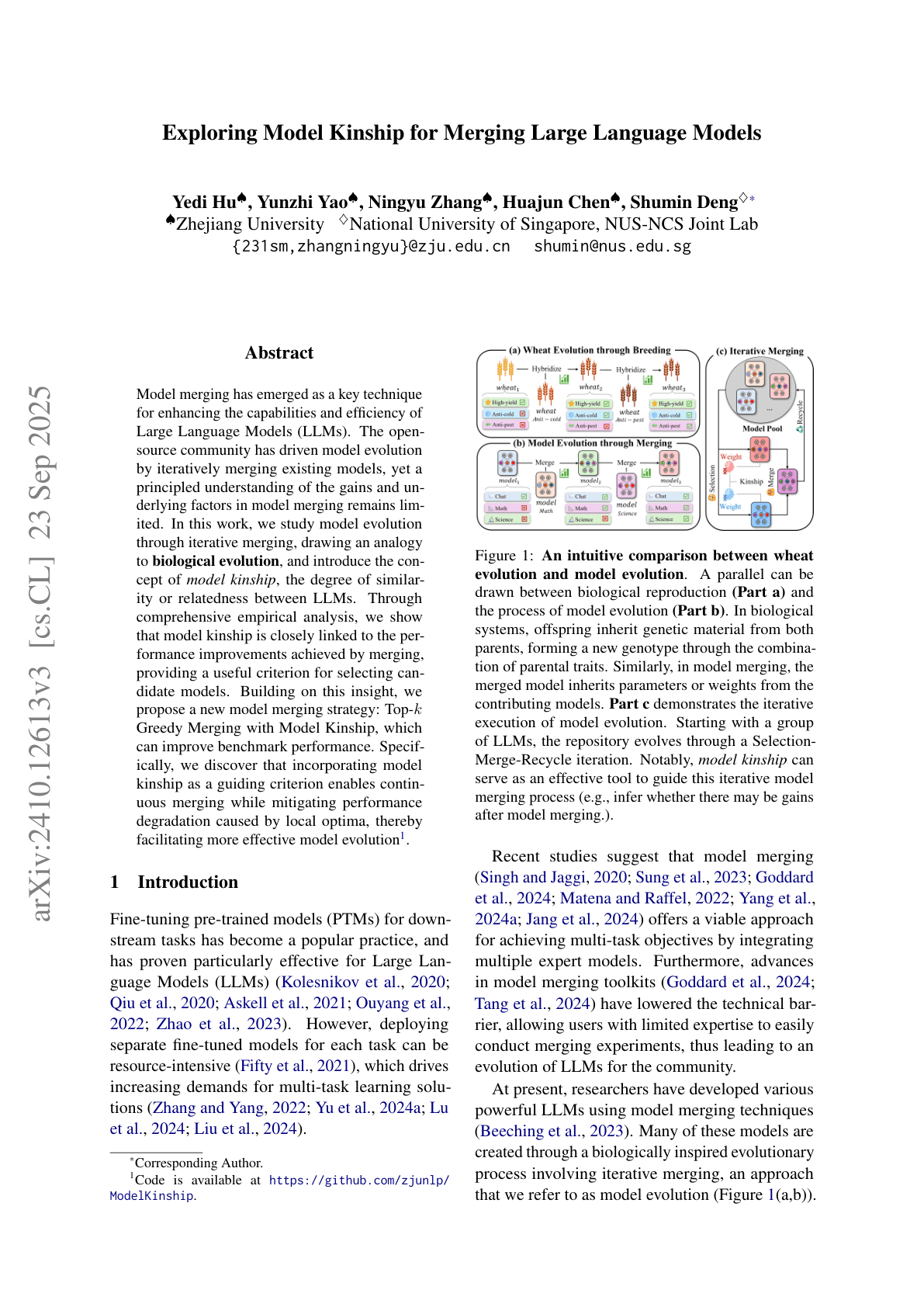
proposes model kinship to measure the degree of similarity between LLMs; model kinship is used to build a model merging strategy (Top-k Greedy Merging with Model Kinship) which yields better performance; the authors find that this new criterion can be used to effectively and continuously perform model merging.
Ask this paper
Abstract
Model merging has emerged as a key technique for enhancing the capabilities and efficiency of Large Language Models (LLMs). The open-source community has driven model evolution by iteratively merging existing models, yet a principled understanding of the gains and underlying factors in model merging remains limited. In this work, we study model evolution through iterative merging, drawing an analogy to biological evolution, and introduce the concept of model kinship, the degree of similarity or relatedness between LLMs. Through comprehensive empirical analysis, we show that model kinship is closely linked to the performance improvements achieved by merging, providing a useful criterion for selecting candidate models. Building on this insight, we propose a new model merging strategy: Top-k Greedy Merging with Model Kinship, which can improve benchmark performance. Specifically, we discover that incorporating model kinship as a guiding criterion enables continuous merging while mitigating performance degradation caused by local optima, thereby facilitating more effective model evolution. Code is available at https://github.com/zjunlp/ModelKinship.