Multi-Reward Hacking: From Aggregation-Induced Drift to Trust-Anchored Defense
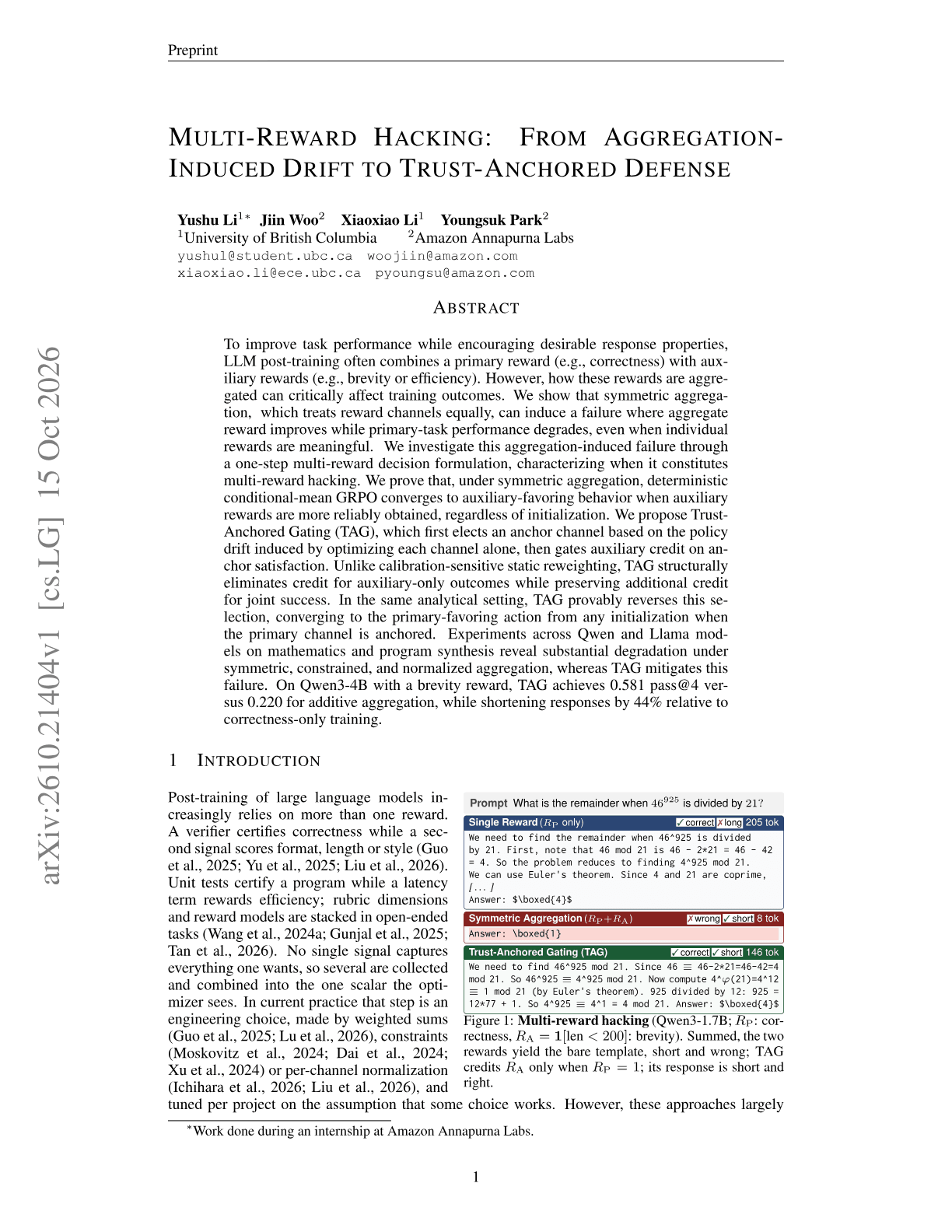
Yushu Li, Jiin Woo, Xiaoxiao Li and Youngsuk Park (University of British Columbia and Amazon Annapurna Labs) show that giving auxiliary rewards such as brevity equal weight can raise total reward while correctness falls, and propose Trust-Anchored Gating (TAG) to prevent it.
Ask this paper
Failure. Under symmetric aggregation, GRPO can drift toward auxiliary rewards whenever they are easier to obtain than the primary reward, even when each reward is meaningful on its own.
Proof. In a one-step setting, deterministic conditional-mean GRPO converges to the auxiliary-favoring action from any initialization when auxiliary rewards are obtained more reliably.
TAG. Elect an anchor channel by measuring the policy drift each channel causes when optimized alone, then give auxiliary credit only when the anchor is satisfied. Auxiliary-only outcomes earn nothing, while joint success still earns extra credit.
Results. Symmetric, constrained and normalized aggregation all degrade Qwen and Llama on math and program synthesis. On Qwen3-4B with a brevity reward, TAG reaches 0.581 pass@4 against 0.220 for additive aggregation and shortens responses by 44% relative to correctness-only training.
Abstract
To improve task performance while encouraging desirable response properties, LLM post-training often combines a primary reward (e.g., correctness) with auxiliary rewards (e.g., brevity or efficiency). However, how these rewards are aggregated can critically affect training outcomes. We show that symmetric aggregation, which treats reward channels equally, can induce a failure where aggregate reward improves while primary-task performance degrades, even when individual rewards are meaningful. We investigate this aggregation-induced failure through a one-step multi-reward decision formulation, characterizing when it constitutes multi-reward hacking. We prove that, under symmetric aggregation, deterministic conditional-mean GRPO converges to auxiliary-favoring behavior when auxiliary rewards are more reliably obtained, regardless of initialization. We propose Trust-Anchored Gating (TAG), which first elects an anchor channel based on the policy drift induced by optimizing each channel alone, then gates auxiliary credit on anchor satisfaction. Unlike calibration-sensitive static reweighting, TAG structurally eliminates credit for auxiliary-only outcomes while preserving additional credit for joint success. In the same analytical setting, TAG provably reverses this selection, converging to the primary-favoring action from any initialization when the primary channel is anchored. Experiments across Qwen and Llama models on mathematics and program synthesis reveal substantial degradation under symmetric, constrained, and normalized aggregation, whereas TAG mitigates this failure. On Qwen3-4B with a brevity reward, TAG achieves 0.581 pass@4 versus 0.220 for additive aggregation, while shortening responses by 44% relative to correctness-only training.