Negative Self-Distillation: Learning to Reason by Avoiding Flaws
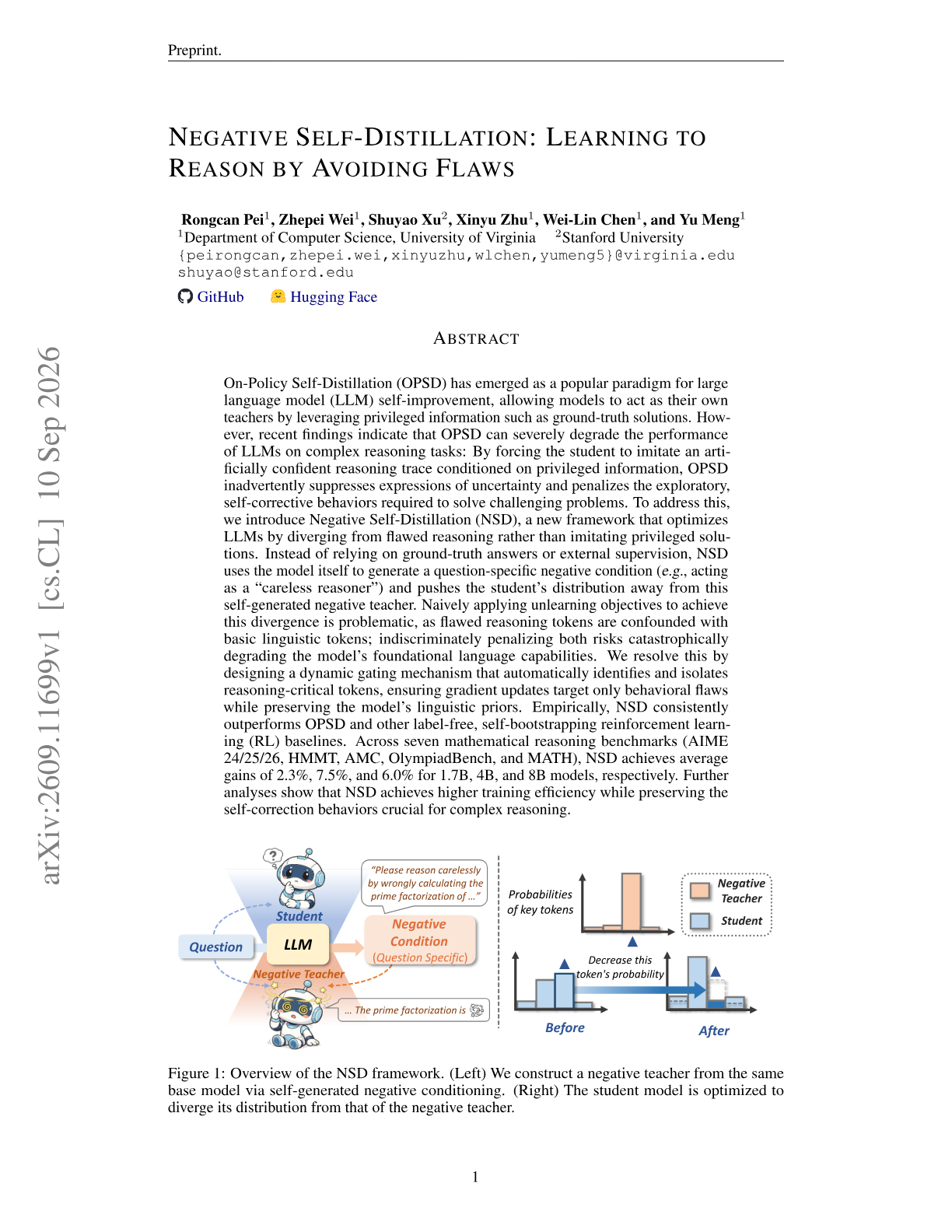
Rongcan Pei, Yu Meng and colleagues (University of Virginia) replace on-policy self-distillation's imitation of privileged solutions with Negative Self-Distillation, which pushes the model away from a self-generated flawed reasoner and needs no ground-truth answers.
Ask this paper
Problem with OPSD: Imitating a confident trace conditioned on the ground-truth solution suppresses expressions of uncertainty and penalizes the exploratory, self-correcting behavior hard problems need.
Negative teacher: The model generates a question-specific negative condition, such as acting as a careless reasoner, and the student distribution is pushed away from that teacher.
Dynamic gating: Flawed reasoning tokens are mixed with ordinary language tokens, so penalizing all of them damages basic language ability. A gate identifies reasoning-critical tokens and applies the update only to them.
Results: NSD consistently beats OPSD and other label-free self-bootstrapping RL baselines on reasoning benchmarks.
Abstract
On-Policy Self-Distillation (OPSD) has emerged as a popular paradigm for large language model (LLM) self-improvement, allowing models to act as their own teachers by leveraging privileged information such as ground-truth solutions. However, recent findings indicate that OPSD can severely degrade the performance of LLMs on complex reasoning tasks: By forcing the student to imitate an artificially confident reasoning trace conditioned on privileged information, OPSD inadvertently suppresses expressions of uncertainty and penalizes the exploratory, self-corrective behaviors required to solve challenging problems. To address this, we introduce Negative Self-Distillation (NSD), a new framework that optimizes LLMs by diverging from flawed reasoning rather than imitating privileged solutions. Instead of relying on ground-truth answers or external supervision, NSD uses the model itself to generate a question-specific negative condition (eg, acting as a ``careless reasoner'') and pushes the student's distribution away from this self-generated negative teacher. Naively applying unlearning objectives to achieve this divergence is problematic, as flawed reasoning tokens are confounded with basic linguistic tokens; indiscriminately penalizing both risks catastrophically degrading the model's foundational language capabilities. We resolve this by designing a dynamic gating mechanism that automatically identifies and isolates reasoning-critical tokens, ensuring gradient updates target only behavioral flaws while preserving the model's linguistic priors. Empirically, NSD consistently outperforms OPSD and other label-free, self-bootstrapping reinforcement learning (RL) baselines.