Nested Learning Framework
Figure 1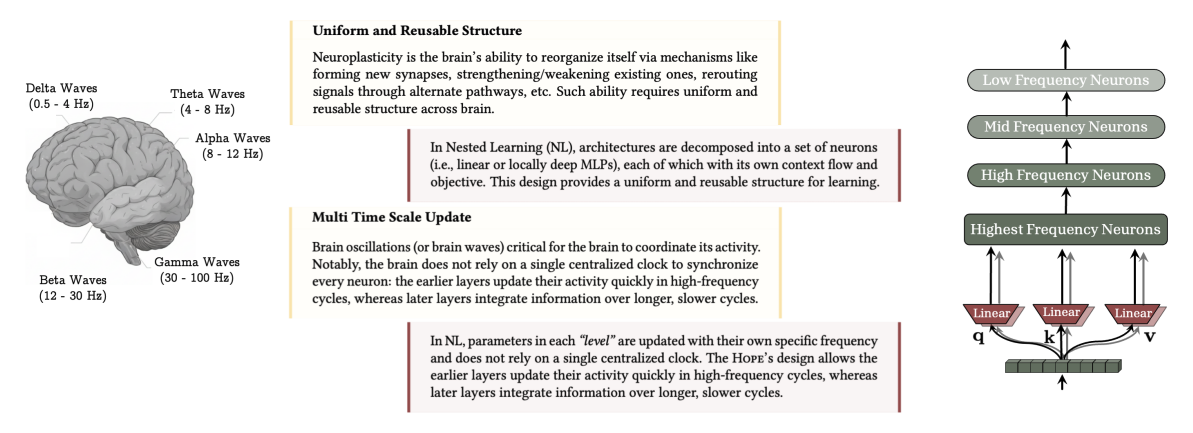
The curator’s take
Google Research introduces Nested Learning (NL), a paradigm representing models as nested optimization problems where each component has its own context flow, revealing that deep learning methods compress context and explaining how in-context learning emerges. The framework shows gradient-based optimizers (Adam, SGD with Momentum) are associative memory modules that compress gradients, enabling design of more expressive optimizers with deep memory. The HOPE architecture combining self-modifying sequence models with continuum memory systems achieves strong results on language modeling (15.11 WikiText perplexity at 1.3B parameters), outperforming Transformers and modern recurrent models.