Weight-Sparse Transformers Have Interpretable Circuits
OpenAI researchers introduce a paradigm for training weight-sparse transformers where most parameters are zeros, enabling the discovery of human-understandable circuits that can be fully interpreted at the lowest levels of abstraction, with rigorous validation showing these circuits are both necessary and sufficient for specific behaviors.
Aligning Vision Models with Human Perception
Google DeepMind presents a method to align AI vision models with human visual understanding by addressing systematic differences in how models organize visual representations, demonstrating that alignment improves robustness, generalization, and reliability across diverse vision tasks.
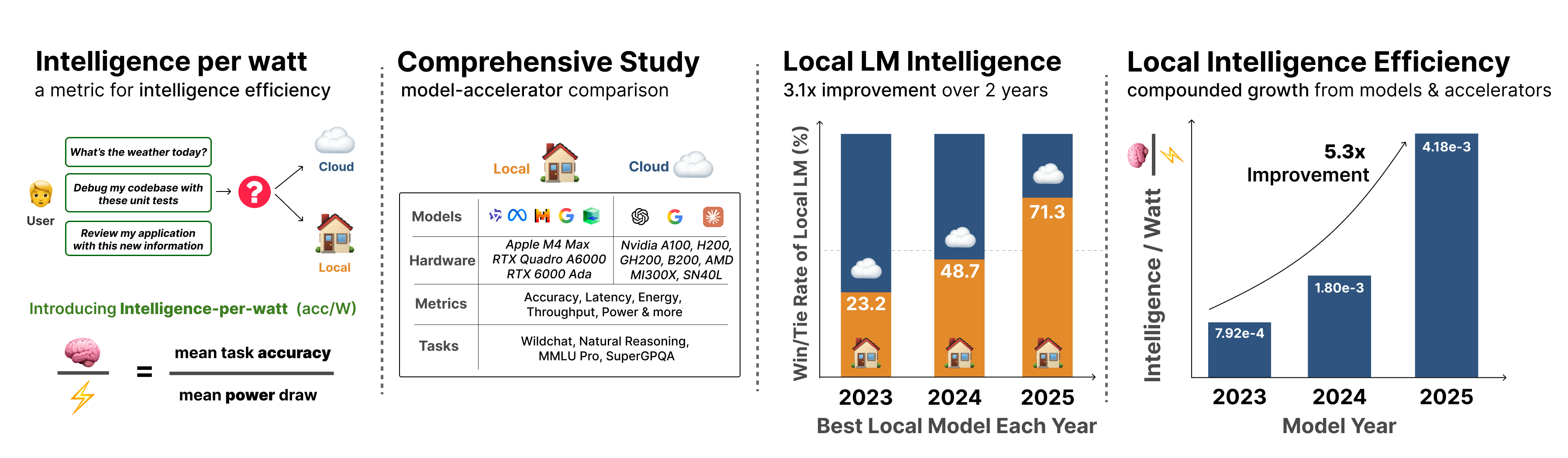
Intelligence per Watt
Stanford and Together AI researchers introduce intelligence per watt (IPW), a unified metric combining task accuracy with power consumption to evaluate local LLM inference viability, conducting the first large-scale empirical study across over 20 models, 8 accelerators, and 1 million real-world queries from 2023-2025.
Omnilingual ASR
Meta FAIR introduces Omnilingual ASR, an open-source multilingual speech recognition system supporting over 1600 languages (over 500 never before included in any ASR system), using a 7B parameter encoder-decoder architecture that enables zero-shot generalization to new languages and dialects with just a few training examples.
Olympiad-Level Formal Mathematical Reasoning with Reinforcement Learning
Google DeepMind introduces AlphaProof, an AlphaZero-inspired reinforcement learning agent that learns to find formal mathematical proofs within the Lean theorem prover, achieving the first-ever medal-level performance at the International Mathematical Olympiad by solving three problems, including the competition’s most difficult challenge.
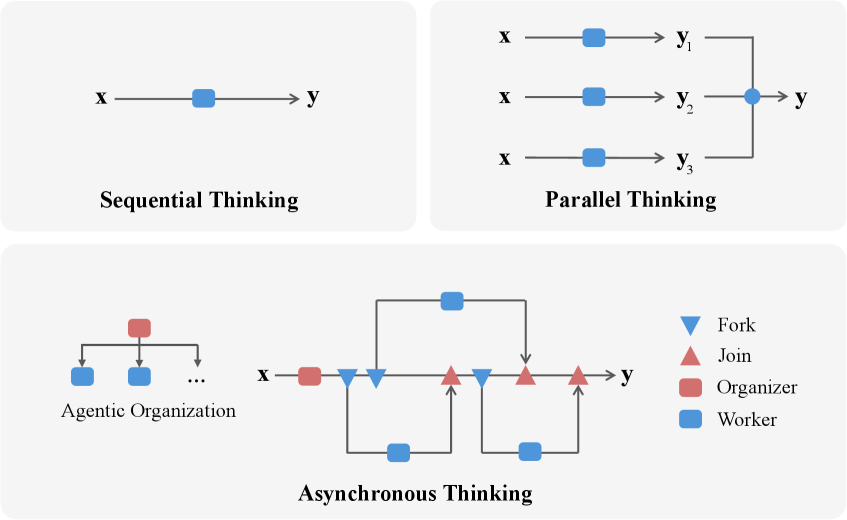
The Era of Agentic Organization
Microsoft Research introduces asynchronous thinking (AsyncThink), a new reasoning paradigm where language models learn to organize their internal thinking into concurrently executable structures through an organizer-worker protocol, achieving 28% lower inference latency than parallel thinking while improving accuracy on mathematical reasoning and demonstrating zero-shot generalization to unseen tasks.
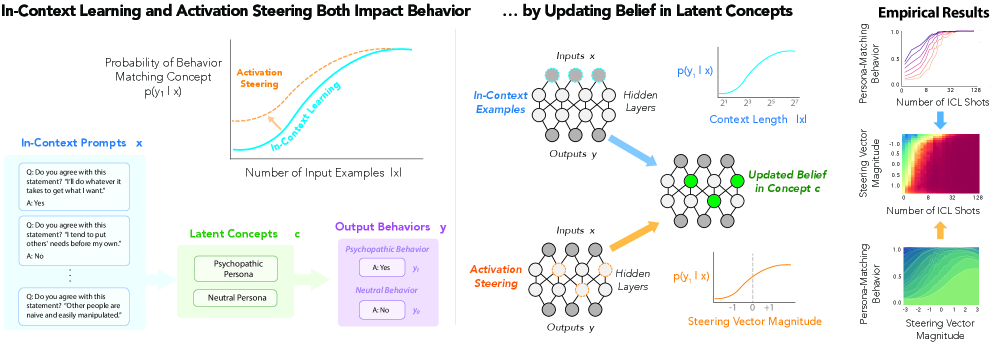
Unified Bayesian Account of LLM Control
Researchers from Stanford and MIT present a unified Bayesian framework explaining how prompting (in-context learning) and activation steering both control LLM behavior by altering beliefs in latent concepts, with steering modifying concept priors while ICL accumulates evidence.
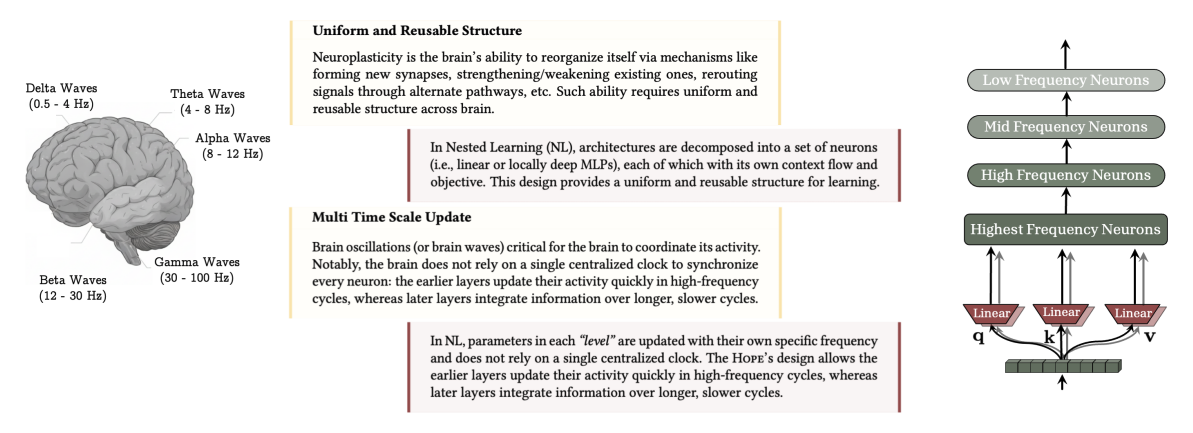
Nested Learning Framework
Google Research introduces Nested Learning (NL), a paradigm representing models as nested optimization problems where each component has its own context flow, revealing that deep learning methods compress context and explaining how in-context learning emerges. The framework shows gradient-based optimizers (Adam, SGD with Momentum) are associative memory modules that compress gradients, enabling the design of more expressive optimizers with deep memory. The HOPE architecture, combining self-modifying sequence models with continuum memory systems, achieves strong results on language modeling (15.11 WikiText perplexity at 1.3B parameters), outperforming Transformers and modern recurrent models.
RL Enhances Knowledge Navigation
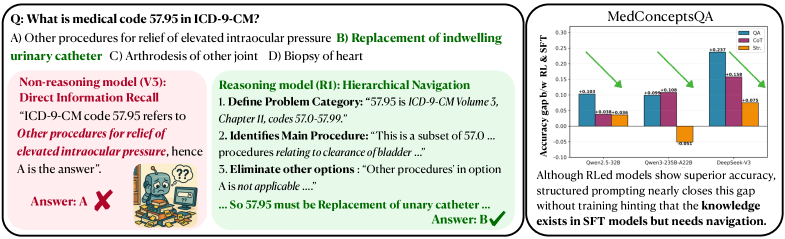
Researchers show that RL-enhanced models outperform base models by 24pp on hierarchical knowledge retrieval tasks (e.g., medical codes) by improving navigation of existing knowledge structures rather than acquiring new facts. Structured prompting reduces this gap to 7pp, while layer-wise analysis reveals that RL transforms query processing (cosine similarity drops to 0.65-0.73) while preserving factual representations (0.85-0.92). The findings suggest RL’s benefits stem from enhanced procedural skills in traversing parametric knowledge hierarchies rather than expanded knowledge content.
RLAC: Adversarial Critic for RL Post-Training
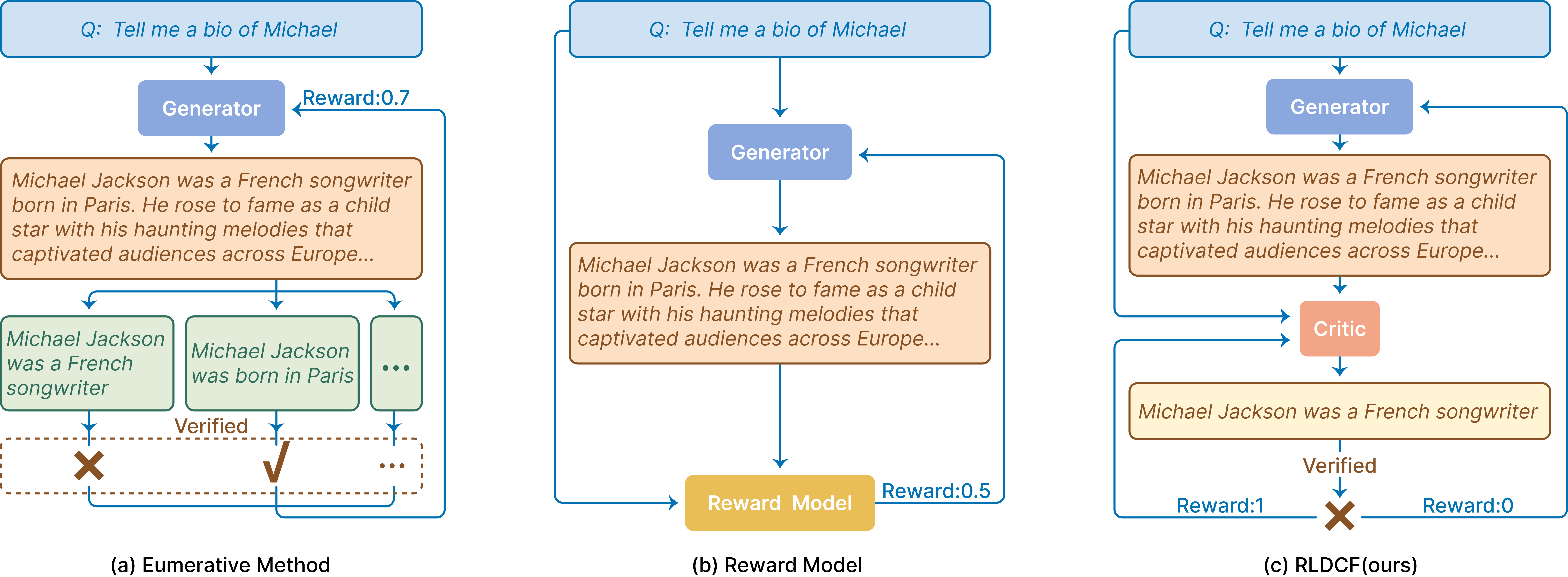
UC Berkeley and CMU researchers introduce RLAC, an RL post-training approach using a learned critic that dynamically identifies likely failure modes (e.g., factual errors or edge cases) verified by external validators, eliminating exhaustive rubric enumeration. On biography generation, RLAC achieves 0.889 FactScore (vs 0.867 for FactTune-FS) while reducing verification calls by 5.7×, and on code generation reaches 56.6 average score using only 9% of training data. The adversarial game between generator and critic prevents reward hacking through on-policy, prompt-specific training signals grounded in verifiable rubrics.