Occamy-1.0: Open Pareto-frontier 35B Intelligence for Co-work
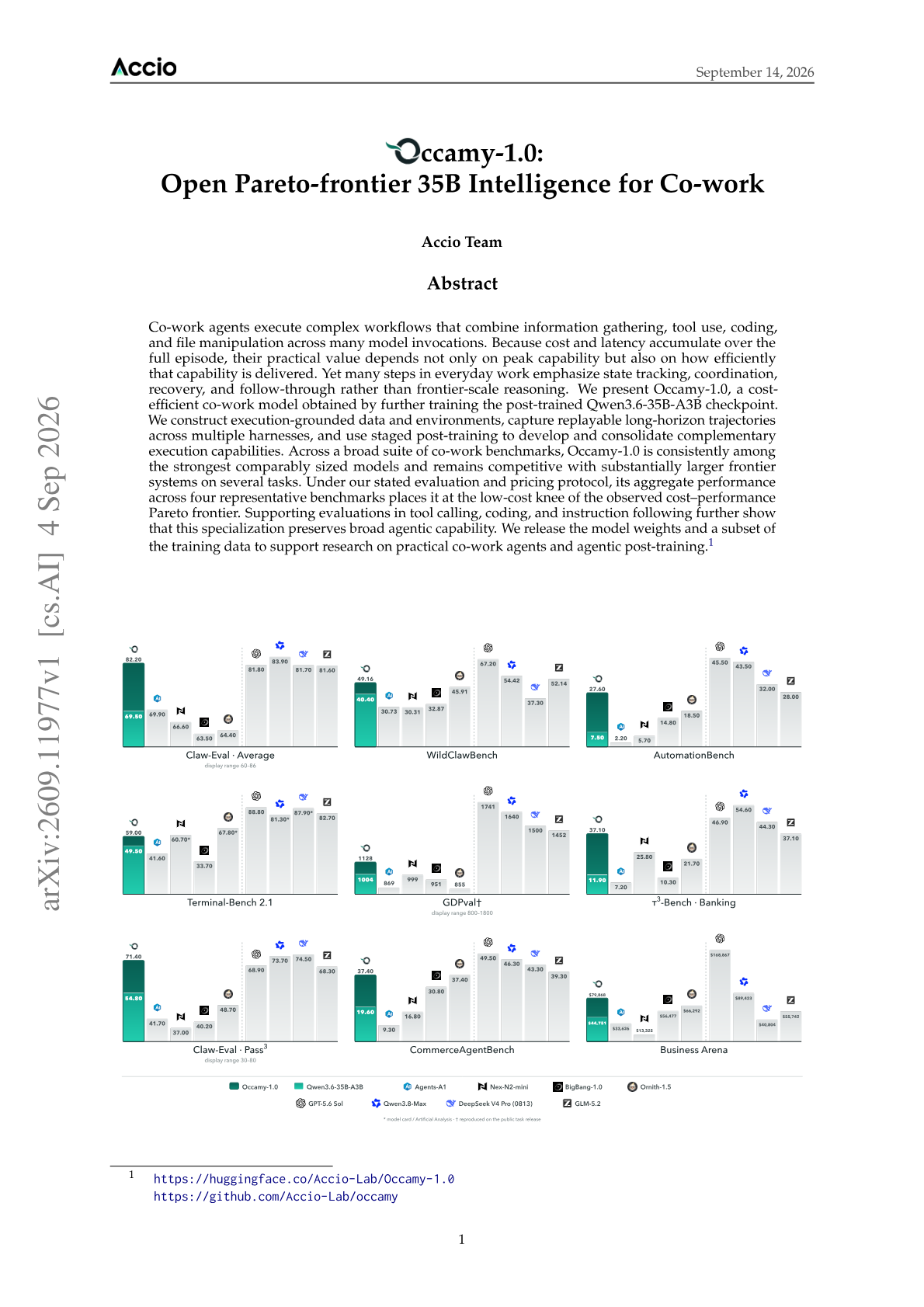
The Accio Team presents Occamy-1.0, an open-weight co-work agent model trained from the post-trained Qwen3.6-35B-A3B checkpoint for long workflows that mix research, tool use, coding and file work, with the goal of low cost per episode.
Ask this paper
Premise: Many steps in everyday co-work are state tracking, coordination, recovery and follow-through, which do not require frontier-scale reasoning.
Execution-grounded data: Task construction, runnable environments, trajectory collection and grading share one traceable pipeline, and trajectories are captured token-exactly across several harnesses for replay.
Two experts merged: A Marathon Expert for sustained execution (SFT then HDPO) and a Sprint Expert for shorter agentic tasks are merged, then trained further on a broad co-work mixture.
Result: Across four representative benchmarks Occamy-1.0 sits at the low-cost end of the observed cost-performance Pareto frontier, and it remains competitive with much larger models on several tasks.
Release: Weights and a subset of the training data are public on Hugging Face and GitHub.
Abstract
Co-work agents execute complex workflows that combine information gathering, tool use, coding, and file manipulation across many model invocations. Because cost and latency accumulate over the full episode, their practical value depends not only on peak capability but also on how efficiently that capability is delivered. Yet many steps in everyday work emphasize state tracking, coordination, recovery, and follow-through rather than frontier-scale reasoning. We present Occamy-1.0, a cost-efficient co-work model obtained by further training the post-trained Qwen3.6-35B-A3B checkpoint. We construct execution-grounded data and environments, capture replayable long-horizon trajectories across multiple harnesses, and use staged post-training to develop and consolidate complementary execution capabilities. Across a broad suite of co-work benchmarks, Occamy-1.0 is consistently among the strongest comparably sized models and remains competitive with substantially larger frontier systems on several tasks. Under our stated evaluation and pricing protocol, its aggregate performance across four representative benchmarks places it at the low-cost knee of the observed cost--performance Pareto frontier. Supporting evaluations in tool calling, coding, and instruction following further show that this specialization preserves broad agentic capability. We release the model weights and a subset of the training data to support research on practical co-work agents and agentic post-training.